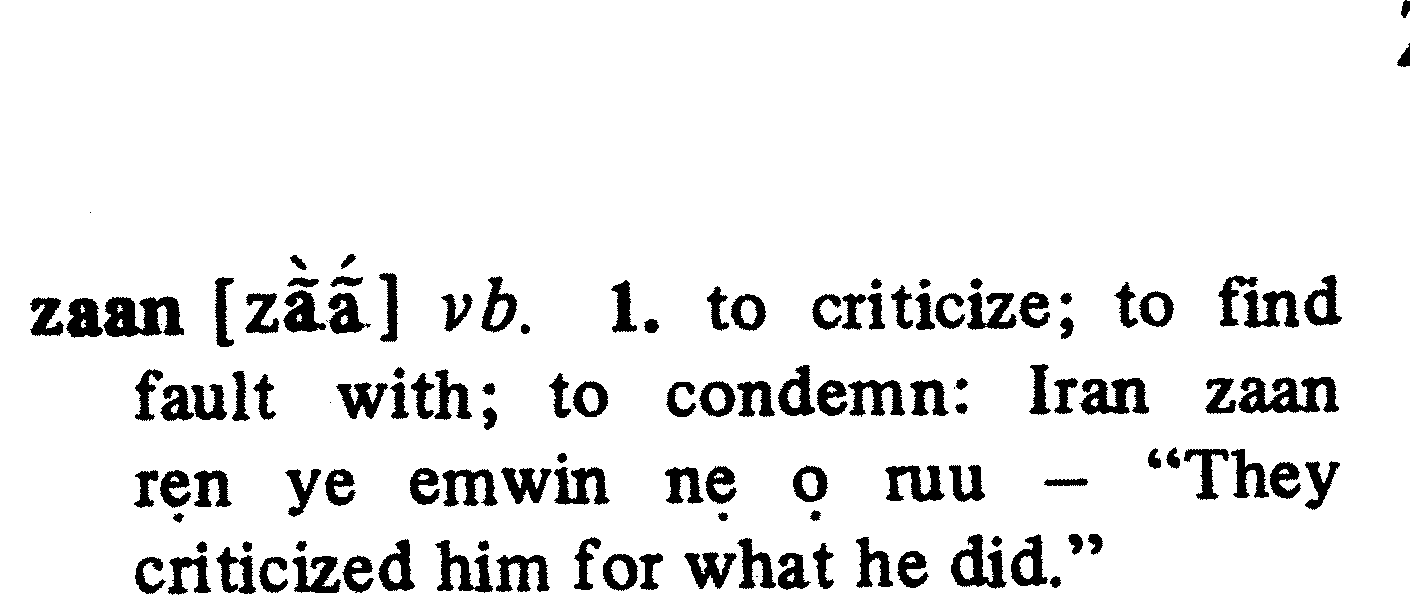
zaan [zã̀ã́] vb. 1. to criticize; to find
fault with; to condemn: Iran zaan
rẹn ye emwin nẹ ọ ruu ― “They
criticized him for what he did.”
zabọ [zàbɔ́] vb. expresses the adv.
%%

meaning of “quickly”: Ọ zabọ kpaọ ―
“He quickly left.”

zaro [záɽò] vb. to reprimand; to scold:
Ọ zaro mu ẹnrẹn vbe ọ viẹ ― “He
reprimanded her when she was
$Page 167$

crying.”

zagadabu [zàgàdàbú] vb.; idiom. to
have fun; to play around.

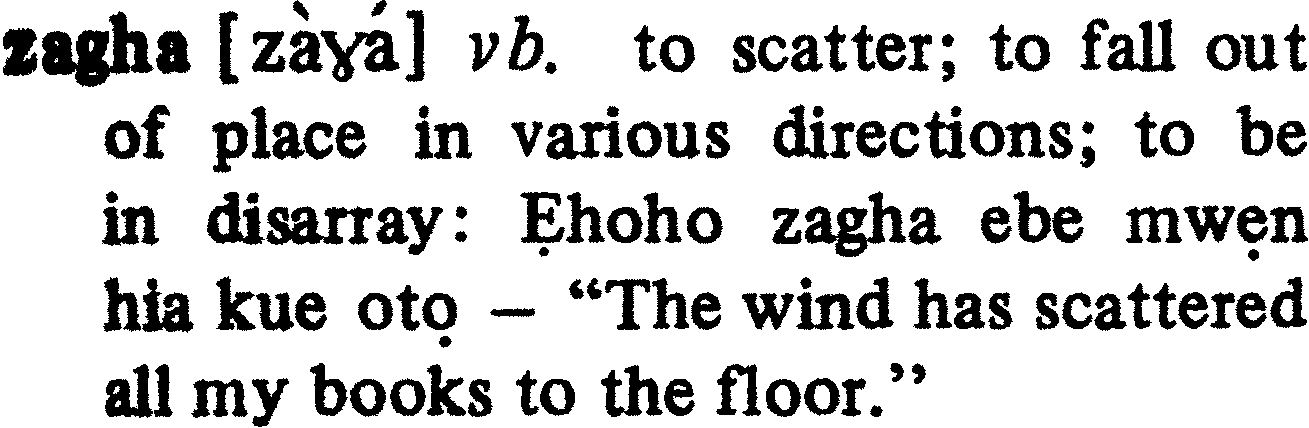
zagha [zàɣá] vb. to scatter; to fall out
of place in various directions; to be
in disarray: Ẹhoho zagha ebe mwẹn
hia kue otọ ― “The wind has scattered
all my books to the floor.”
zaghazagha [zàɣàzàɣà] adv.; adj. de-
scribes things that are disorderly
and unkempt.

zaizai [zàizài] adv. 1. quickly; briskly:
Ọ ruẹe zaizai ― “He did it quickly.”

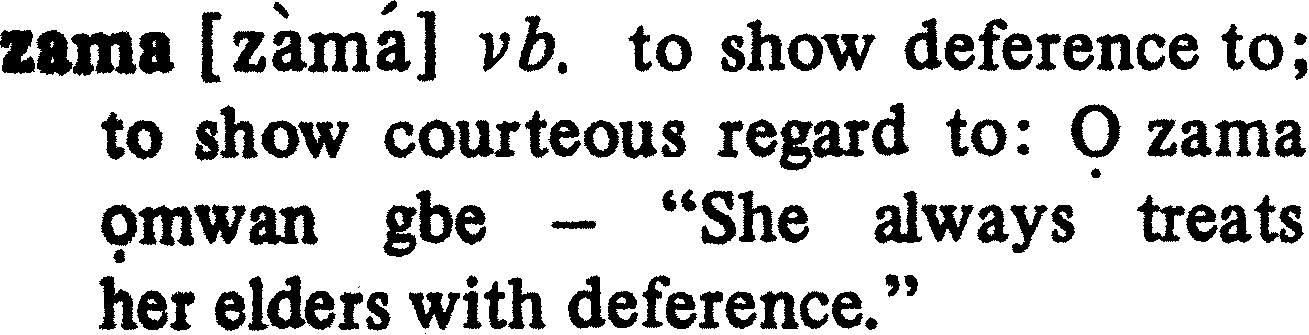
zama [zàmá] vb. to show deference to;
to show courteous regard to: Ọ zama
ọmwan gbe ― “She always treats
her elders with deference.”
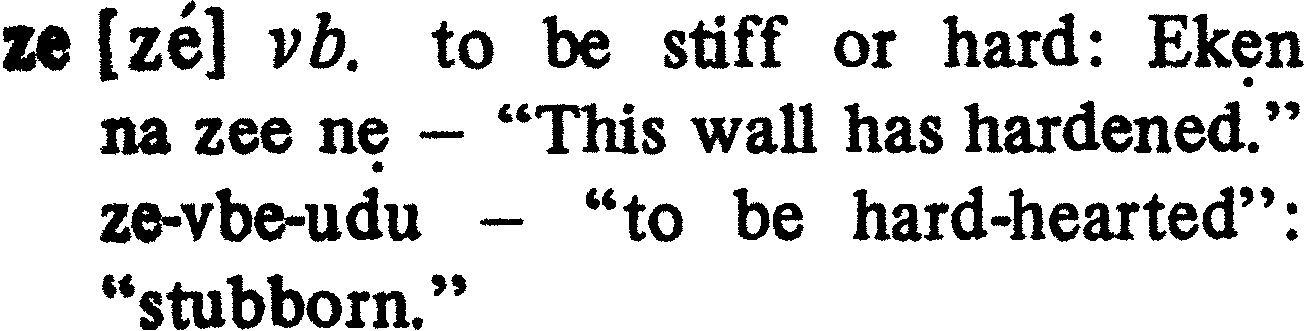
ze [zé] vb. to be stiff or hard: Ekẹn
na zee nẹ ― “This wall has hardened.”
ze-vbe-udu ― “to be hard-hearted”:
“stubborn.”
zedu [zèdú] vb. (< zẹ4 ― edu) to
interpret; to translate: Ọ ma miẹ
ene ọ gha zedu nẹẹn ― “He did not
find anyone to interpret for him.”
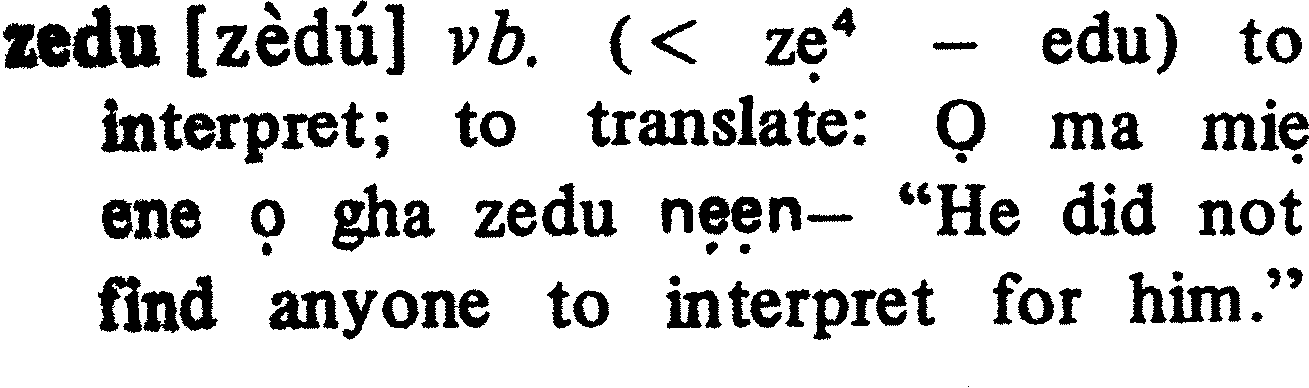
zenunu [zènúnù] idiom. (< zẹ4 ― ene
― unu) “speak that of the mouth”^:
to state one’s case (in a dispute):
Iran we ne ọ zenunu ẹnrẹn ― “They
asked her to state her case.”
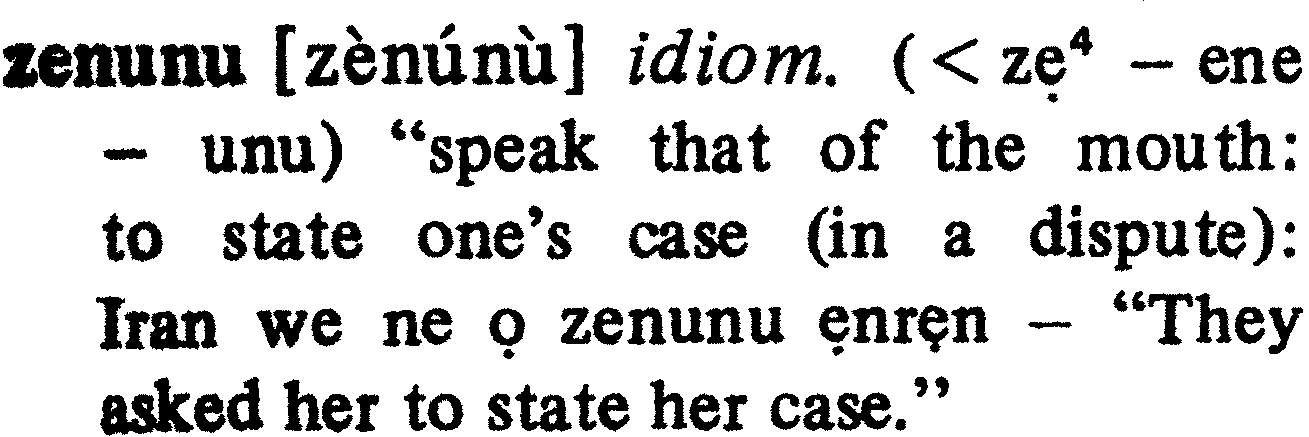
zẹ1 [zɛ́] vb. 1. to select; to choose:
Ọ zẹ ẹwu ne ọ yẹ ọre ― “She chose
the dress that she liked.”; 2. to
delegate (a person): Ozo ẹre iran zẹe
gha khian ― “Ozo was the person
they delegated to go.”; 3. (of solid
mass nouns) to take a portion of:
Ọ zẹ izẹ mu gie iran ― “She took
some rice to carry to them.” zẹ
hin ― “to remove some portion of”;
%%
zẹ baa ― “to add a portion to”; zẹ
kua ― “to pour a portion away etc.”

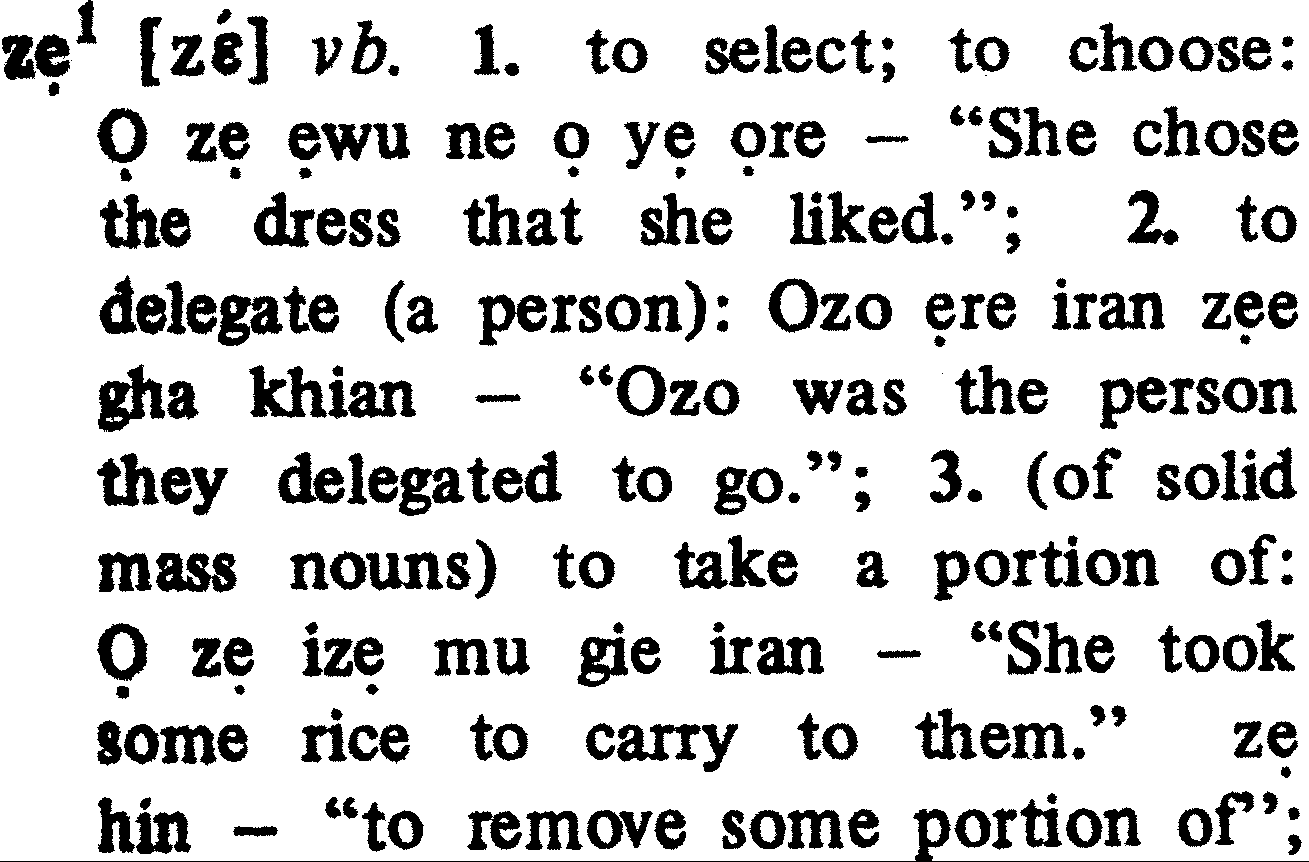
zẹ2 [zɛ́] vb. to be responsible for (an
action); to cause a situation: Iran
ẹre ọ zẹe ighẹ ma miẹ odẹ la ― “They
were responsible for our being able
to find a way to pass.”
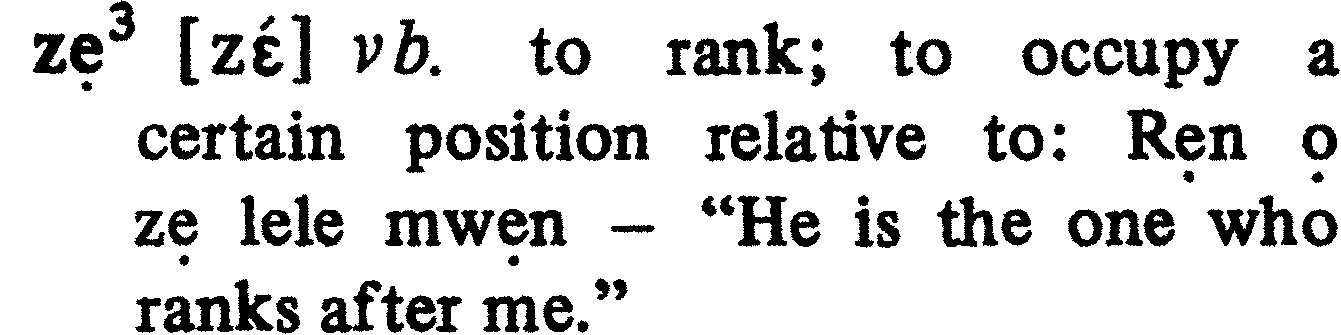
zẹ3 [zɛ́] vb. to rank; to occupy a
certain position relative to: Rẹn ọ
zẹ lele mwẹn ― “He is the one who
ranks after me.”
ze4 [zɛ́] vb. to speak a language: Ọ gua
zẹ Ebo ― “He can speak English.”

zẹ5 [zɛ́] vb. to spend (money); to pay
a levy or fine: Ọ zẹ ígho-emitin ― “He
contributed his society levy.”

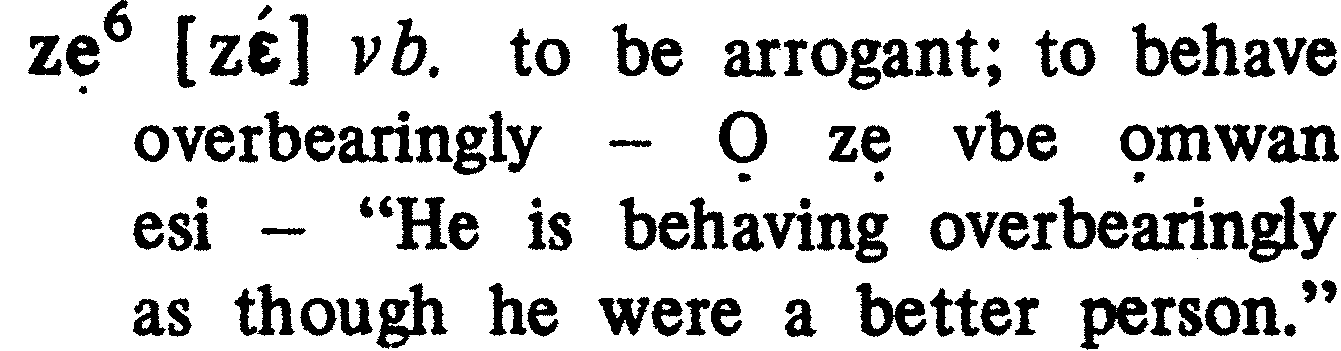
zẹ6 [zɛ́] vb. to be arrogant; to behave
overbearingly ― Ọ zẹ vbe ọmwan
esi ― “He is behaving overbearingly
as though he were a better person.”
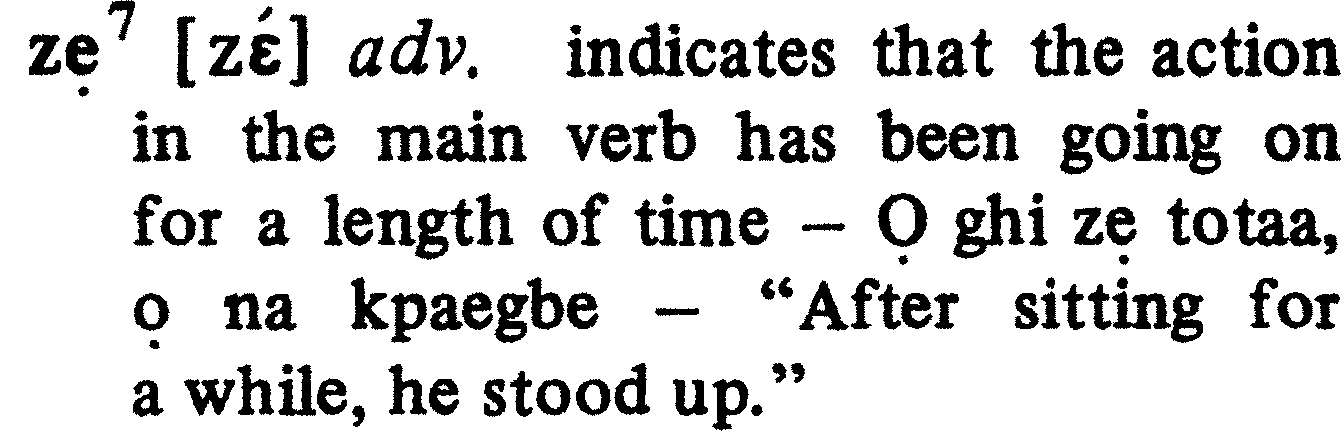
zẹ7 [zɛ́] adv. indicates that the action
in the main verb has been going on
for a length of time ― Ọ ghi zẹ totaa,
ọ na kpaegbe ― “After sitting for
a while, he stood up.”
zẹ-baa [zɛ̀bàá] idiom. to tell lies
against: Ọ zẹbaa re ― “It was a lie
that he told against her.”

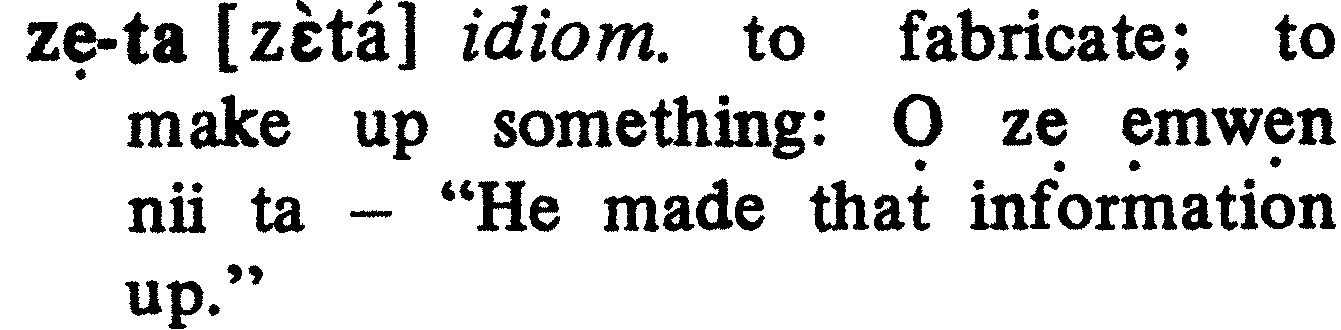
zẹ-ta [zɛ̀tá] idiom. to fabricate; to
make up something: Ọ zẹ ẹmwẹn
nii ta ― “He made that information
up.”
zẹ-yi [zɛ̀yí] idiom. to mind; to pay
attention to: Ọ ma zẹ-yọ mwẹn ẹmwẹn
― “He did not mind my words.”

zẹbi [zɛ̀bí] vb. to be guilty: Ozo ọ zẹbi
vbe ẹzo na ― “Ozo is the guilty party
in this case.”
$Page 168$

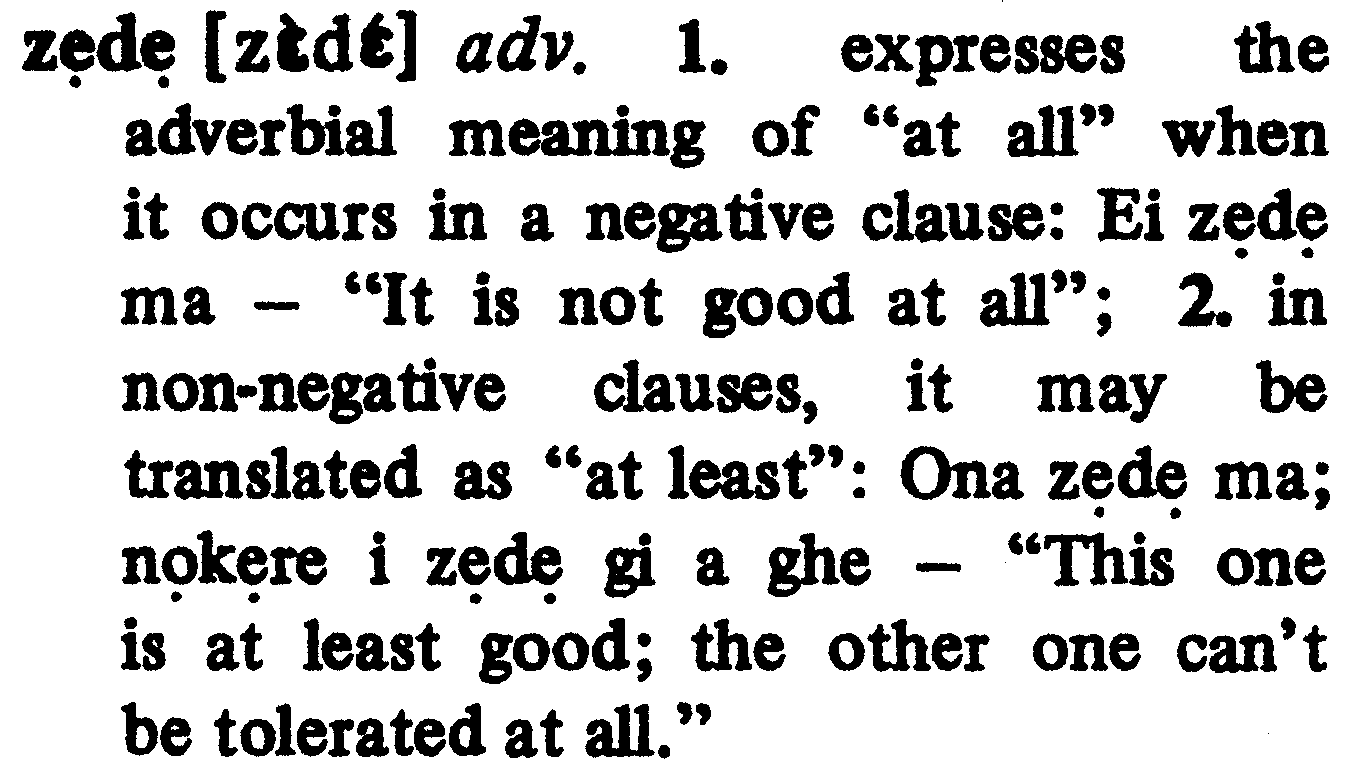
zẹdẹ [zɛ̀dɛ́] adv. 1. expresses the
adverbial meaning of “at all” when
it occurs in a negative clause: Ei zẹdẹ
ma ― “It is not good at all”; 2. in
non-negative clauses, it may be
translated as “at least”: Ona zẹdẹ ma;
nọkẹre i zẹdẹ gi a ghe ― “This one
is at least good; the other one can’t
be tolerated at all.”
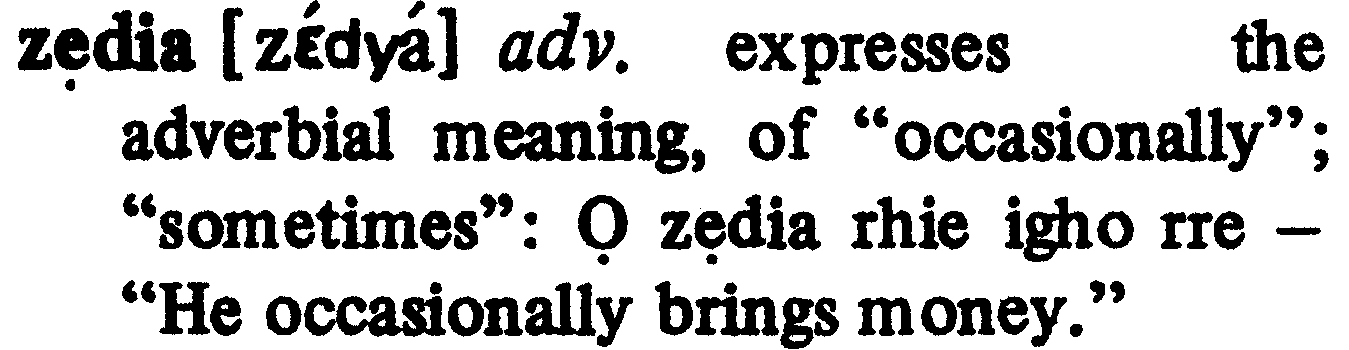
zẹdia [zɛ́dyá] adv. expresses the
adverbial meaning, of “occasionally”;
“sometimes”: Ọ zẹdia rhie igho rre ―
“He occasionally brings money.”
zẹẹ [zɛ́ɛ́] adv. cf. zẹrẹ.

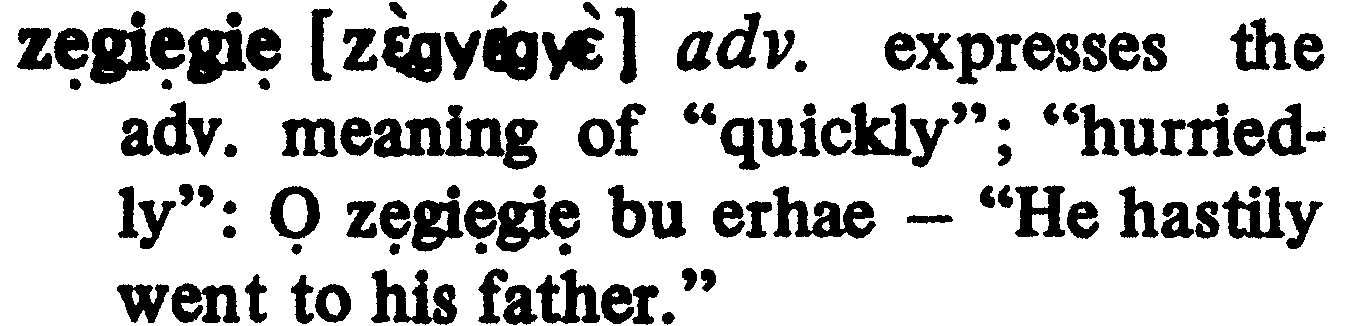
zẹgiẹgiẹ [zɛ̀gyɛ́gyɛ̀] adv. expresses the
adv. meaning of “quickly”; “hurried-
ly”: Ọ zẹgiẹgiẹ bu erhae ― “He hastily
went to his father.”
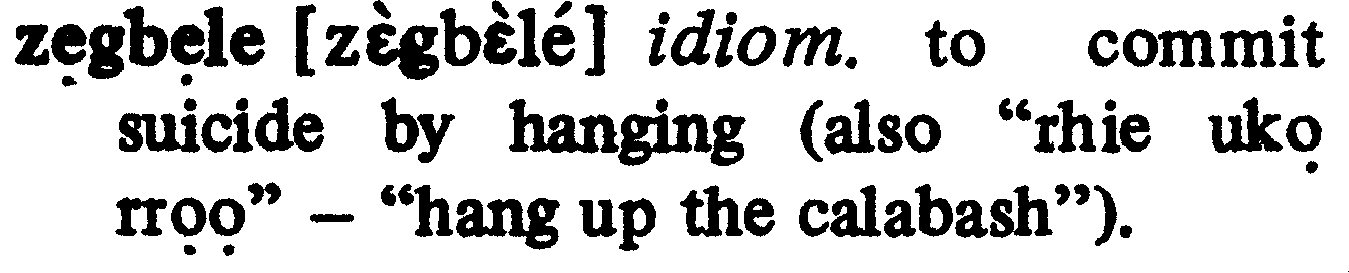
zẹgbẹle [zɛ̀gbɛ̀lé] idiom. to commit
suicide by hanging (also “rhie ukọ
rrọọ” ― “hang up the calabash”).
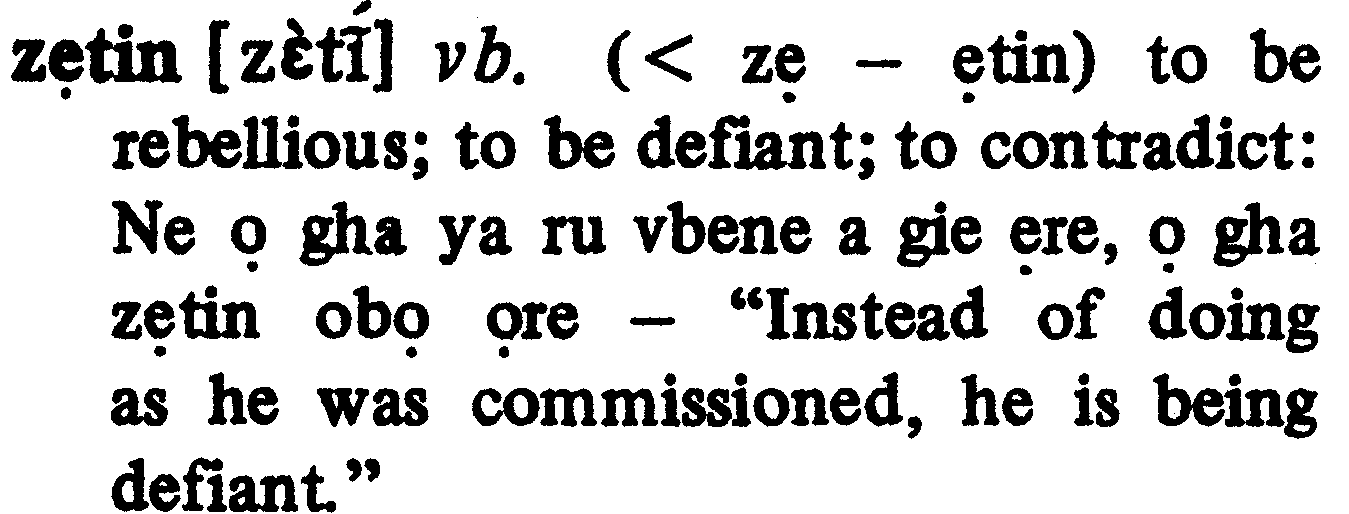
zẹtin [zɛ̀tĩ́] vb. (< zẹ ― ẹtin) to be
rebellious; to be defiant; to contradict:
Ne ọ gha ya ru vbene a gie ẹre, ọ gha
zẹtin obọ ọre ― “Instead of doing
as he was commissioned, he is being
defiant.”
zidase [zìdásé] idiom. to play pranks;
to behave naughtily.

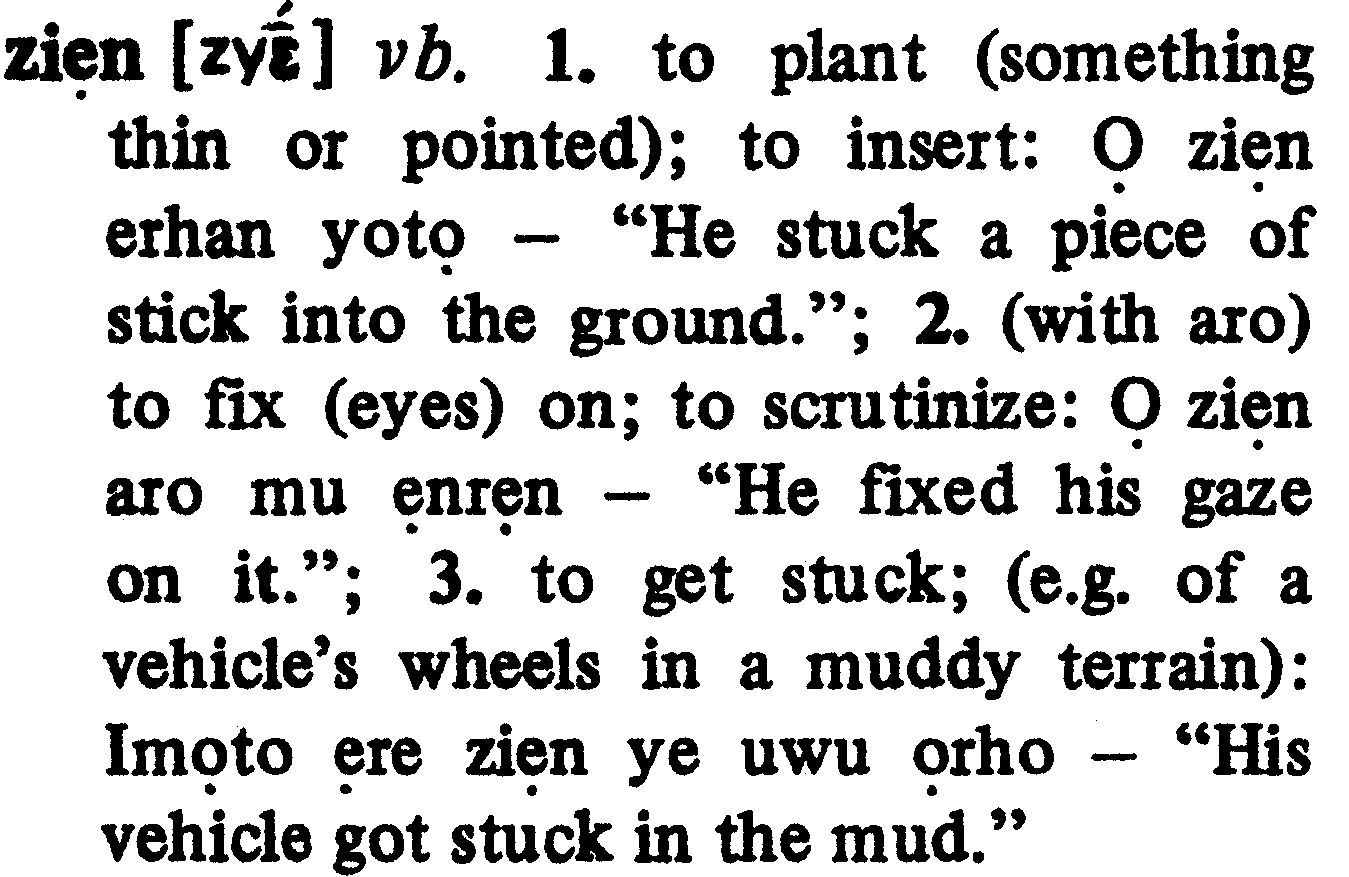
ziẹn [zyɛ̃́] vb. 1. to plant (something
thin or pointed); to insert: Ọ ziẹn
erhan yotọ ― “He stuck a piece of
stick into the ground.”; 2. (with aro)
to fix (eyes) on; to scrutinize: Ọ ziẹn
aro mu ẹnrẹn ― “He fixed his gaze
on it.”; 3. to get stuck; (e.g. of a
vehicle’s wheels in a muddy terrain):
Imọto ẹre ziẹn ye uwu ọrho ― “His
vehicle got stuck in the mud.”
ziẹnziẹn [zyɛ̀zyɛ̃́] vb. to squeeze into;
to force into; to penetrate by force:
%%

Ọ ziẹnziẹn egbe la owa ― “He squeezed
to get into the house.”

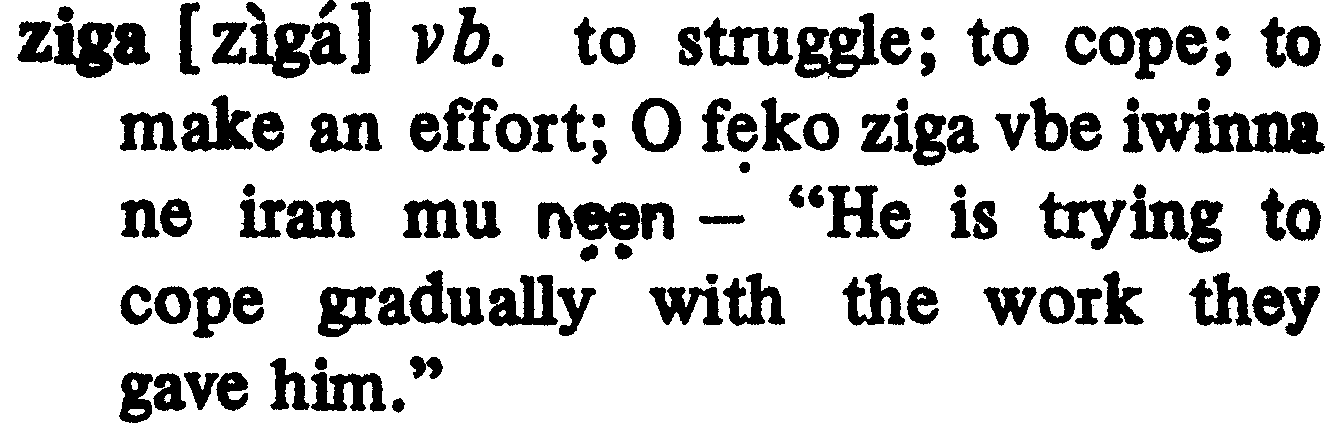
ziga [zìgá] vb. to struggle; to cope; to
make an effort; O fẹko ziga vbe iwinna
ne iran mu nẹẹn ― “He is trying to
cope gradually with the work they
gave him.”
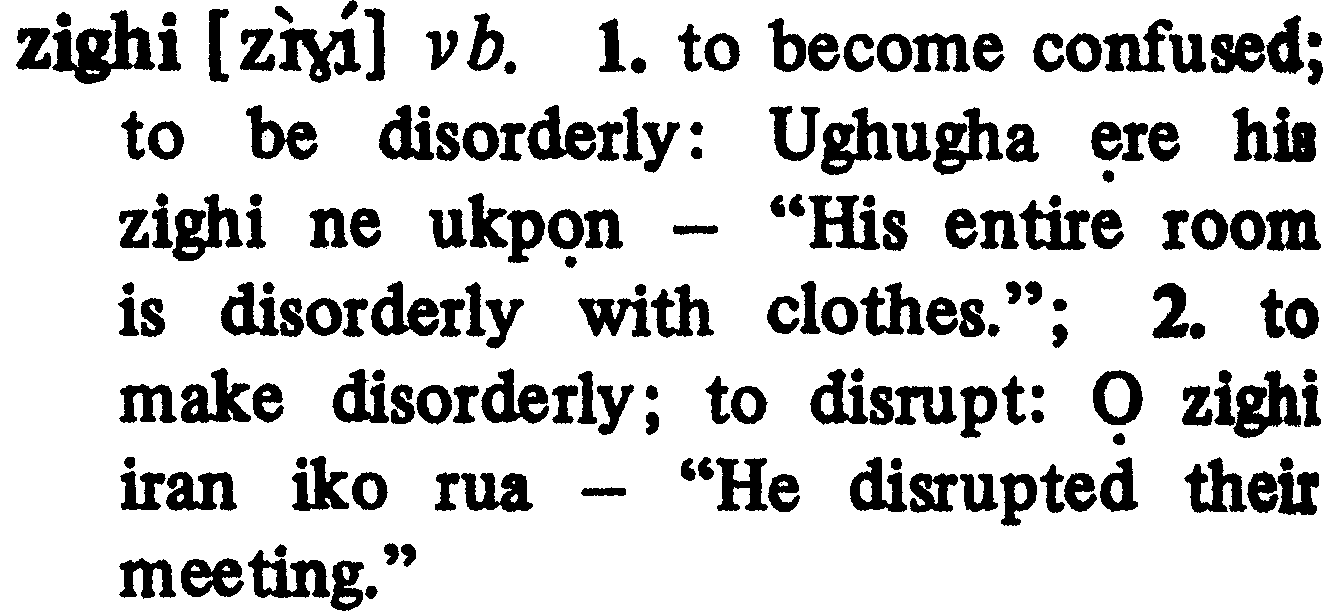
zighi [zìɣí] vb. 1. to become confused;
to be disorderly: Ughugha ẹre hia
zighi ne ukpọn ― “His entire room
is disorderly with clothes.”; 2. to
make disorderly; to disrupt: Ọ zighi
iran iko rua ― “He disrupted their
meeting.”
zighó1 [zíɣó] vb. (< zẹ ― ígho) to
cut milk-teeth.

zighó2 [zíɣó] vb. (< zẹ5 ― ígho) 1.
to spend money; 2. to pay a fine.

zighò [zíɣò] vb. (< zọọ ― ìgho) to
grow horns.

zihin [zìhĩ́] vb. (< zẹ ― ihiin) to
blow the nose.

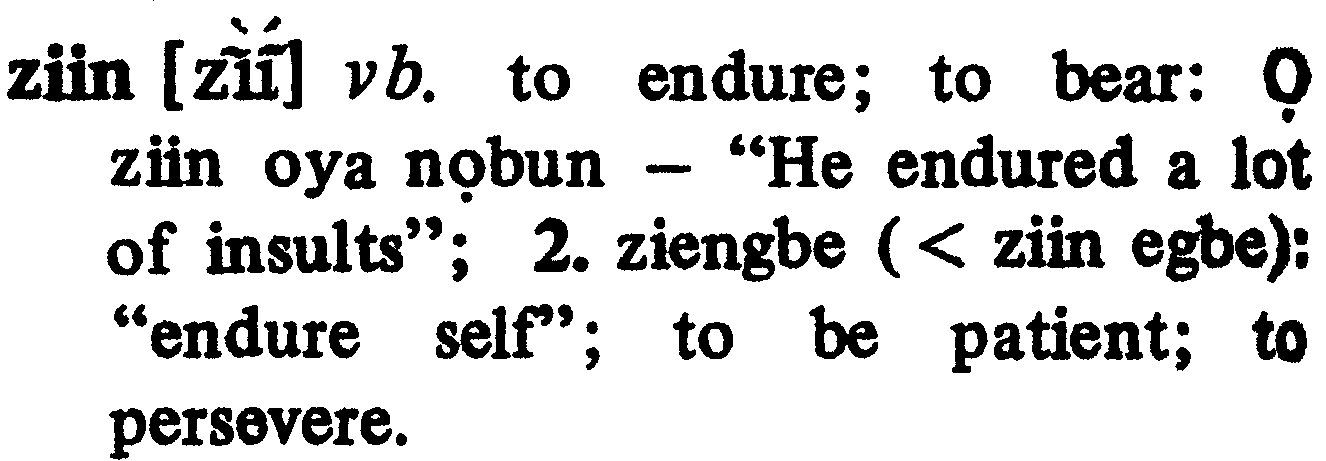
ziin [zĩ̀ĩ́] vb. 1^.^ to endure; to bear: Ọ
ziin oya nọbun ― “He endured a lot
of insults”; 2. ziengbe (< ziin egbe):
“endure self”; to be patient; to
persevere.
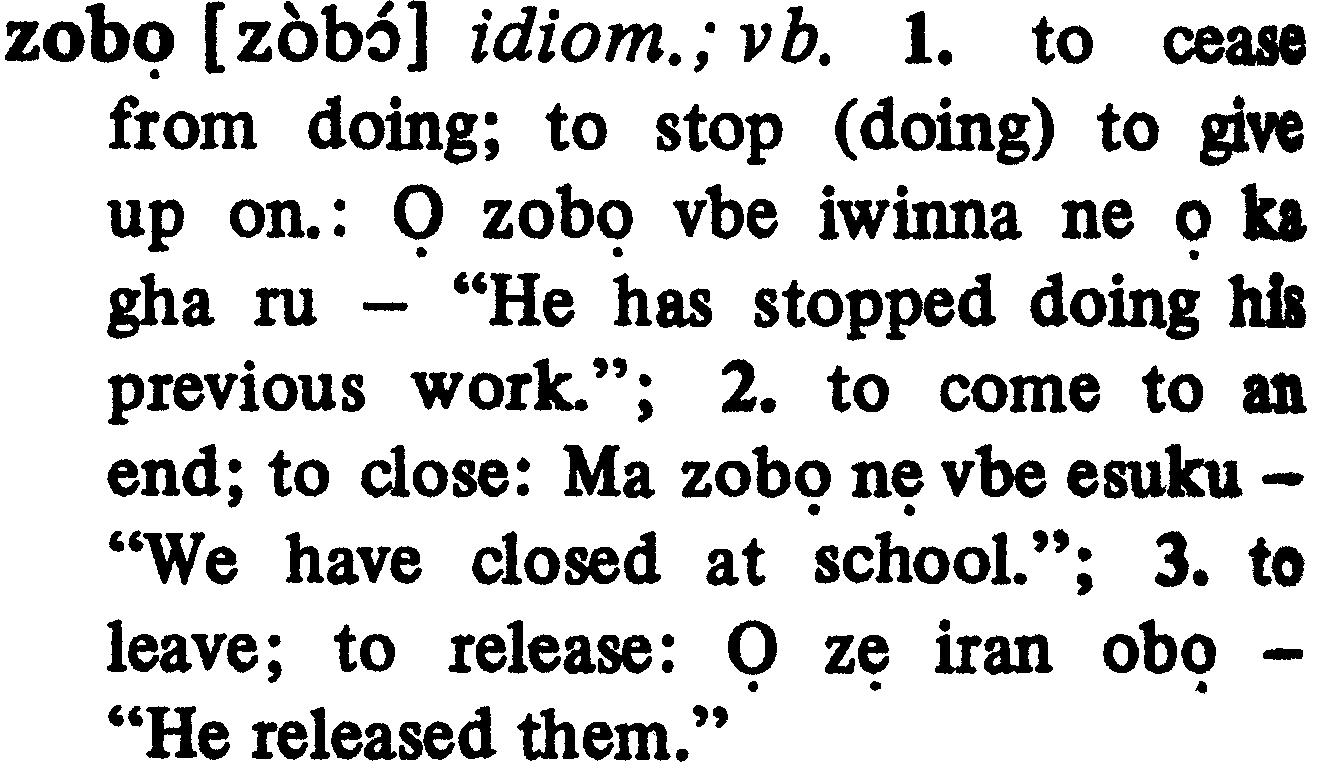
zobọ [zòbɔ́] idiom.; vb. 1. to cease
from doing; to stop (doing) to give
up on.: Ọ zobọ vbe iwinna ne ọ ka
gha ru ― “He has stopped doing his
previous work.”; 2. to come to an
end; to close: Ma zobọ nẹ vbe esuku ―
“We have closed at school.”; 3. to
leave; to release: Ọ zẹ iran obọ ―
“He released them.”
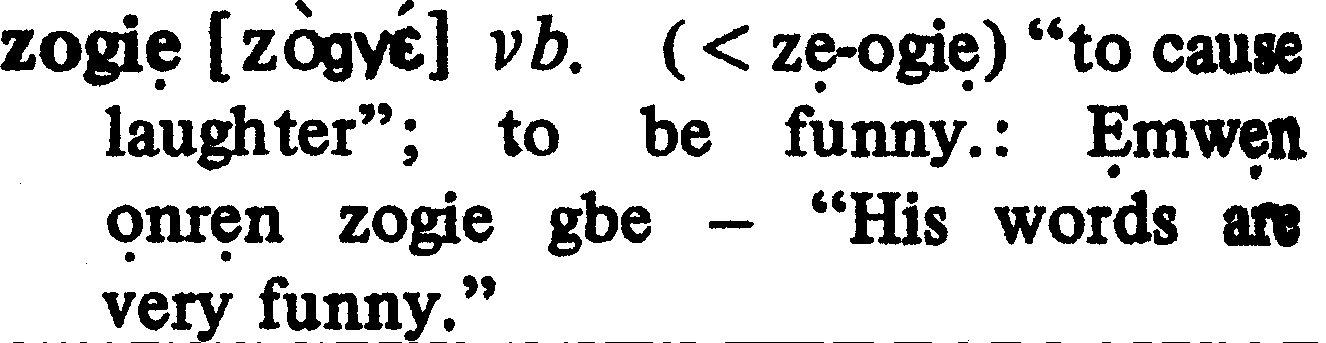
zogiẹ [zògyɛ́] vb. (< zẹ-ogiẹ) “to cause
laughter”; to be funny.: Ẹmwẹn
ọnrẹn zogie gbe ― “His words are
very funny.”
$Page 169$
zokeke [zòkékè] idiom. (< zẹ ―
okeke) to pretend; to make false
pretences.

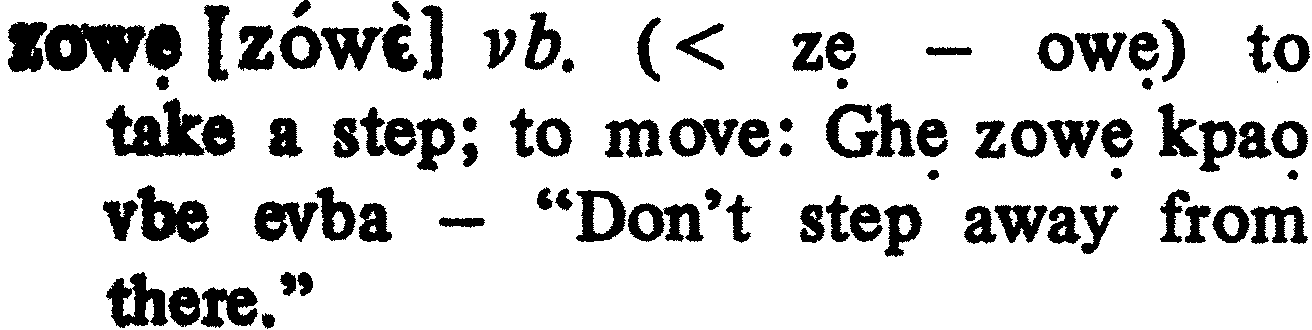
zowẹ [zówɛ̀] vb. (< zẹ ― owẹ) to
take a step; to move: Ghẹ zowẹ kpaọ
vbe evba ― “Don’t step away from
there.”
zozo [zòzó] vb. to wander; to per-
ambulate: Ọ zozo gbe ― “He wanders
too much.”

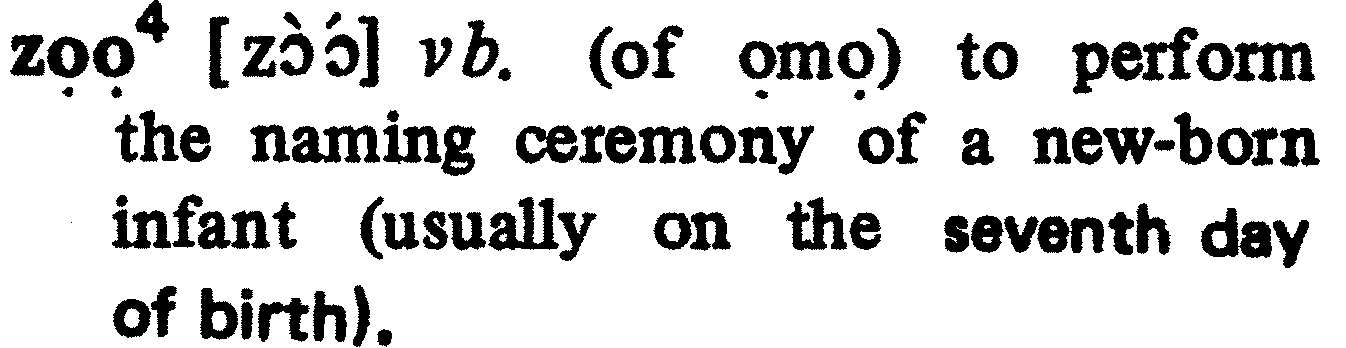
zọkan [zc̀kã́] vb. to shout angrily; to
speak harshly: Ọ zọkan mu ẹnrẹn ―
“He shouted angrily at him.”
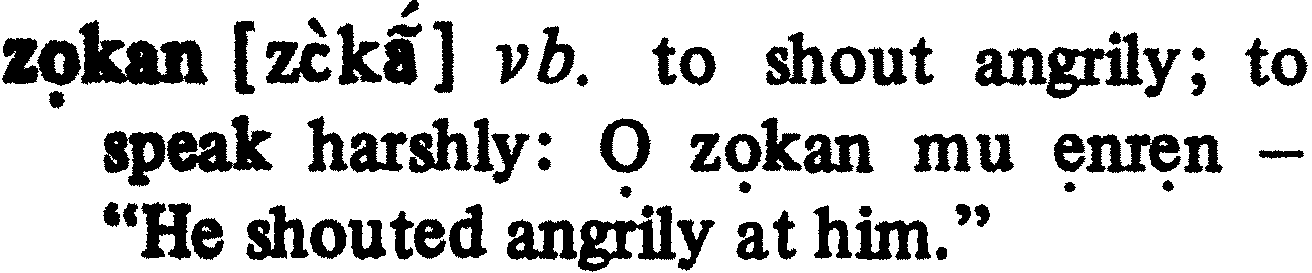
zọlọ [zɔ̀lɔ́] vb. the pl. or reit. sense
of zọọ2: Iran zọlọ iyan foo vbe akhe ―
“They picked out all the yam pieces
from the pot.”
zọọ1 [zɔ̀ɔ́] vb. 1. to germinate; to
sprout: Ọka ne ọ kọe zọọ nẹ ― “The
corn that she planted has sprouted.”

zọọ2 [zɔ̀ɔ́] vb. 1. to extract; to pick
out: Ọ zọọ igban hin ẹre owẹ rre ―
“He extracted a thorn from his foot.”

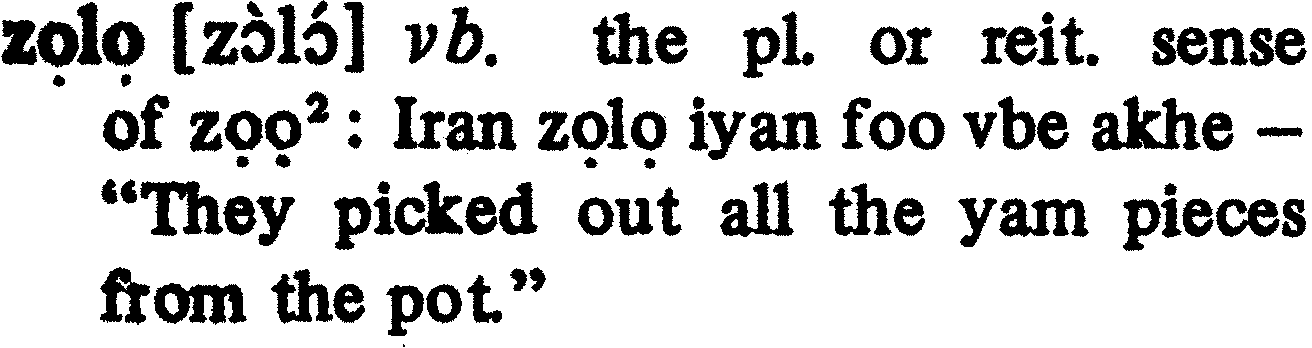
zọọ3 [zɔ̀ɔ́] vb. (with ẹse) 1. to per-
%%

form a sacrifice (usually determined
by the oracle as a means of atoning
for some previous wrongdoing, or of
ensuring the goodwill of some power-
ful forces, etc.).
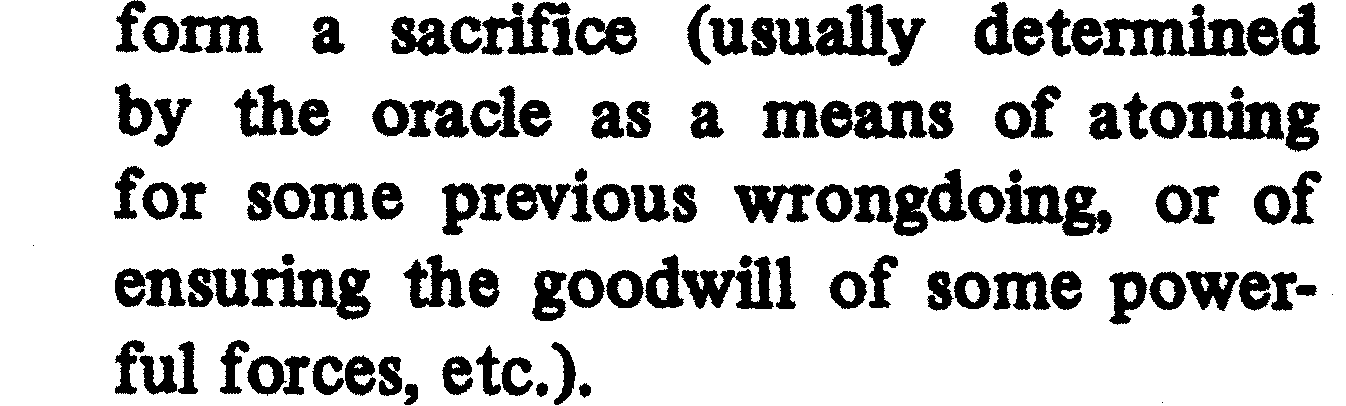
zọọ4 [zɔ̀ɔ́] vb. (of ọmọ) to perform
the naming ceremony of a new-born
infant (usually on the seventh day
of birth).
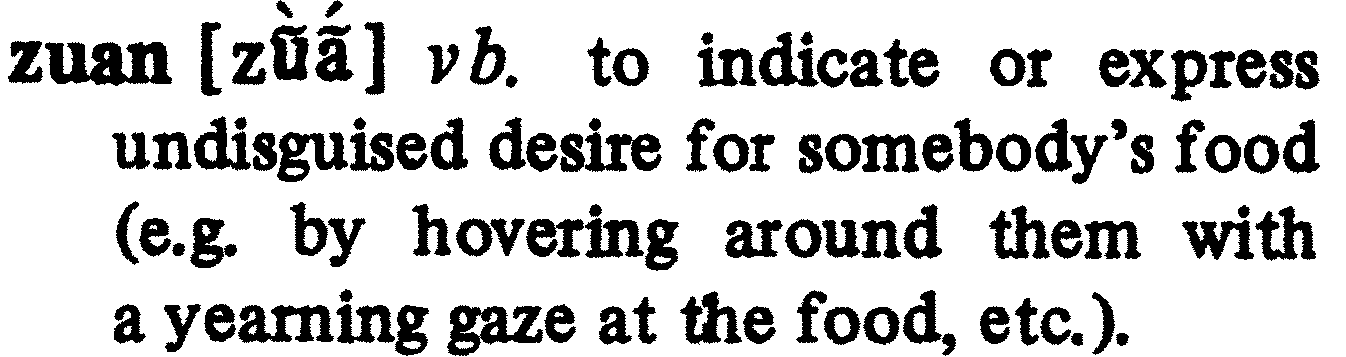
zuan [zũ̀ã́] vb. to indicate or express
undisguised desire for somebody’s food
(e.g. by hovering around them with
a yearning gaze at the food, etc. ).
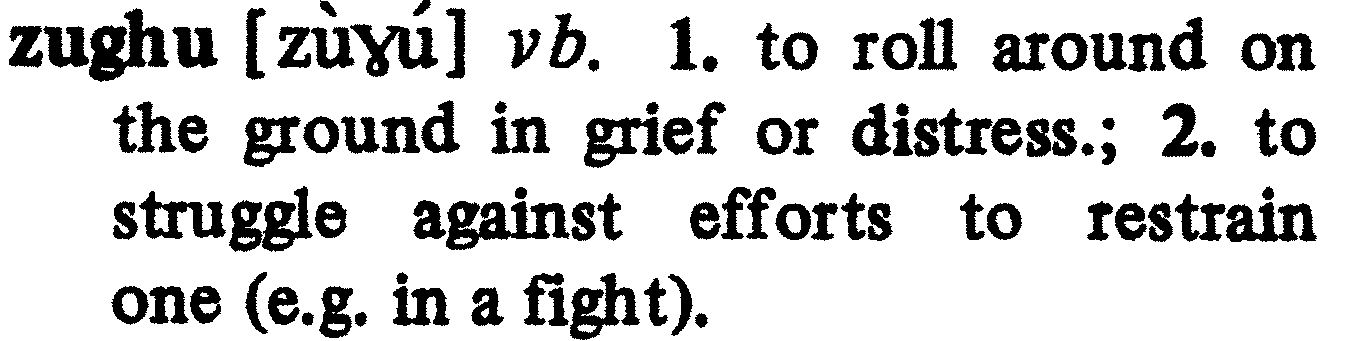
zughu [zùɣú] vb. 1. to roll around on
the ground in grief or distress.; 2. to
struggle against efforts to restrain
one (e.g. in a fight).
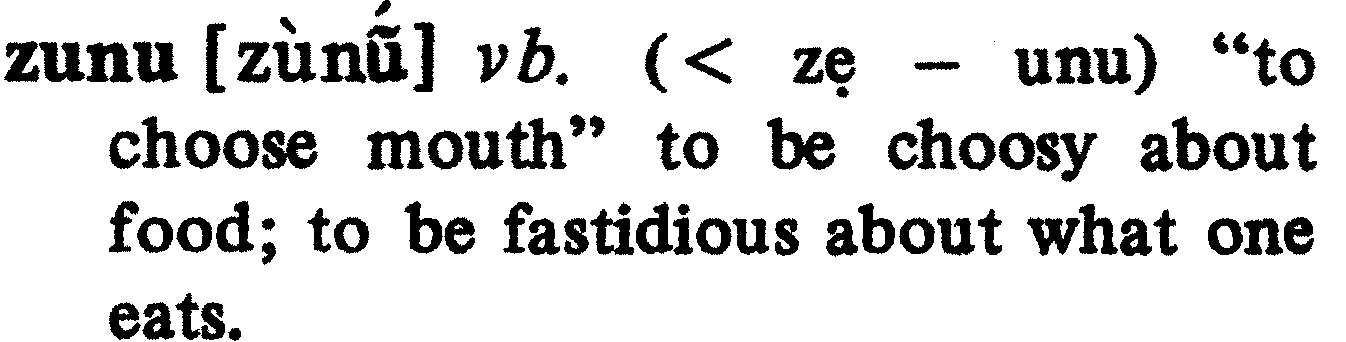
zunu [zùnṹ] vb. (< zẹ ― unu) “to
choose mouth” to be choosy about
food; to be fastidious about what one
eats.
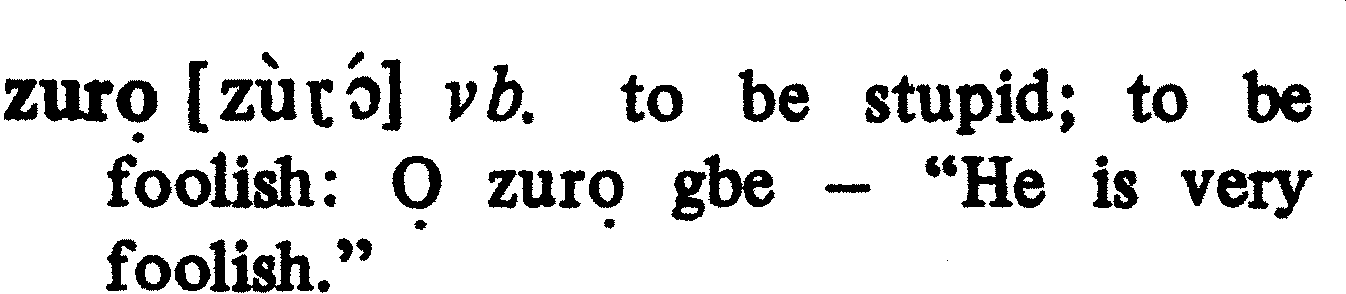
zurọ [zùɽɔ́] vb. to be stupid; to be
foolish: Ọ zurọ gbe ― “He is very
foolish.”
zuwu [zùwú] vb. to commit suicide.
