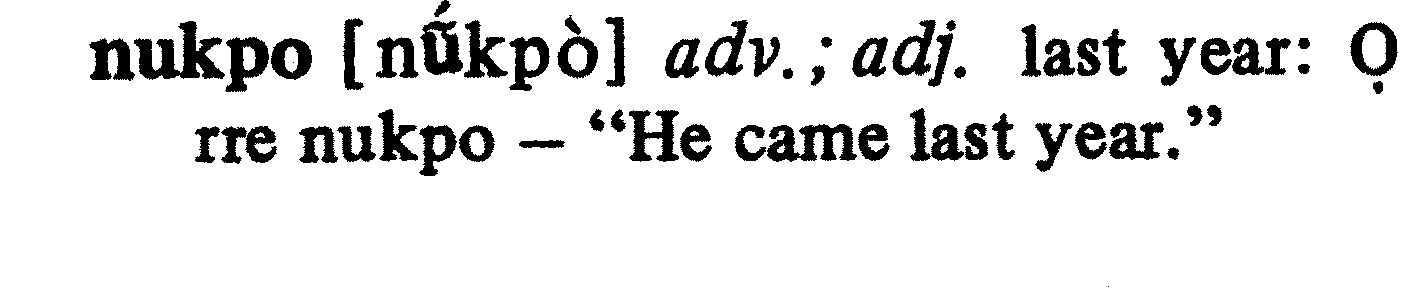
na1 [nã́] vb. 1. to narrate: Ozo na
evbene emwin nii hia ya sunu hẹẹ ―
“Ozo narrated how all those things
came about”; 2. to say, to utter
(e.g. a prayer). (cf. naa).
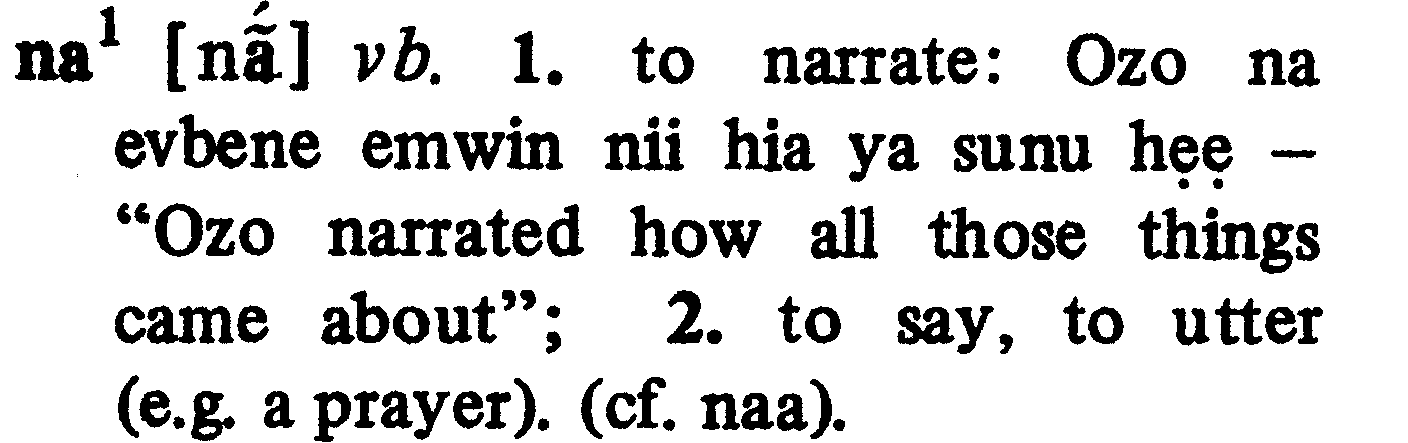
na2 [nã́] adv. sequential marker: then;
and then: Ọ ghi tuẹ iran nẹ, ọ na tota:
― “After he had greeted them, he
then sat down.”
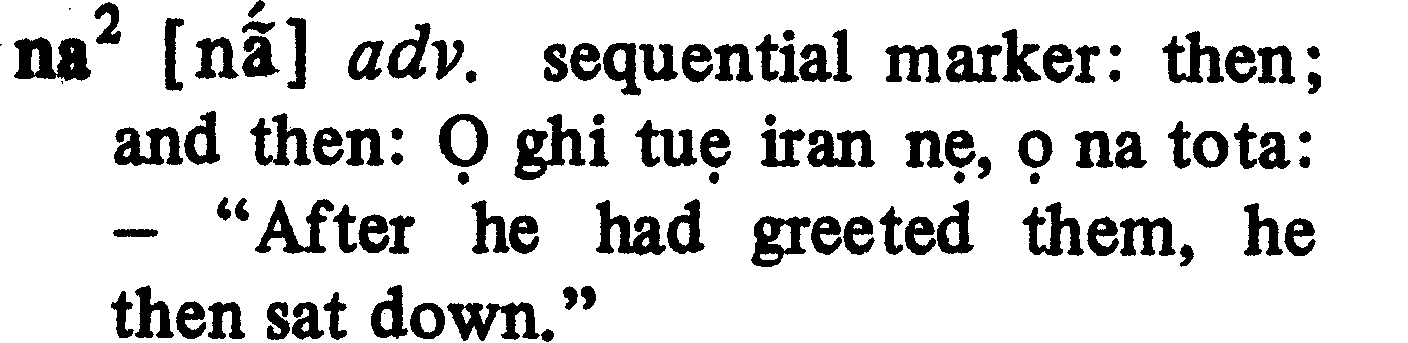
na3 [nã́] prep. A variant of the prep.
ne which introduces the recipient
or beneficiary in a sentence with
verbs such as rhie, mu, viọ, etc. na
is used when the complement NP
does not immediately follow it: Ọ
rhie ígho ne Ozo: “He gave money
to Ozo”; Ozo ẹre ọ rhie ígho na ―
“It is Ozo that he gave the money
to.”
%%
na [nã́] adv. 1. occurs in relative clauses
in which the relation is either temporal
or locational: Ẹghẹ ne ọ na rre, ma
ma miẹ ọnrẹn ― “At the time when
he came, we did not see him.” 2. Ọ
khama ima ehe ne ọ na miẹ ọnrẹn ―
“She told us the place where she
saw him.”
na [nà] dem. pron. 1. this: Owa na
ẹre ọ ye ― “This house is where he
lives.”; 2. general proximate: nearest,
next before or after (in terms of
place, order, time, thought sequence,
causation, etc.): Emwin ne u ru na
i yẹ mwẹn ― “What you are doing
now does not please me.” Ne ọ na
rre na, vbe ọ ghi ra dia? “As he has
now come, where will he stay?”.
naa [nã̀ã́] vb. to spread uncompliment-
ary information about; to broadcast
$Page 100$

maliciously: Ọ gha naa mwẹn khian
ighẹ i ma rhie okhuo: “He is spreading
unpleasant news about me concerning
my not marrying.”
naa-ẹko [nã̀ɛkó] idiom. to make preg-
nant; to put in the family way: Ozo
ọ naa Atiti ẹko: “It was Ozo that
put Atiti in the family way.”
namwunsin [náɱṹsĩ̀] adv. ― cf.
enamwunsin.

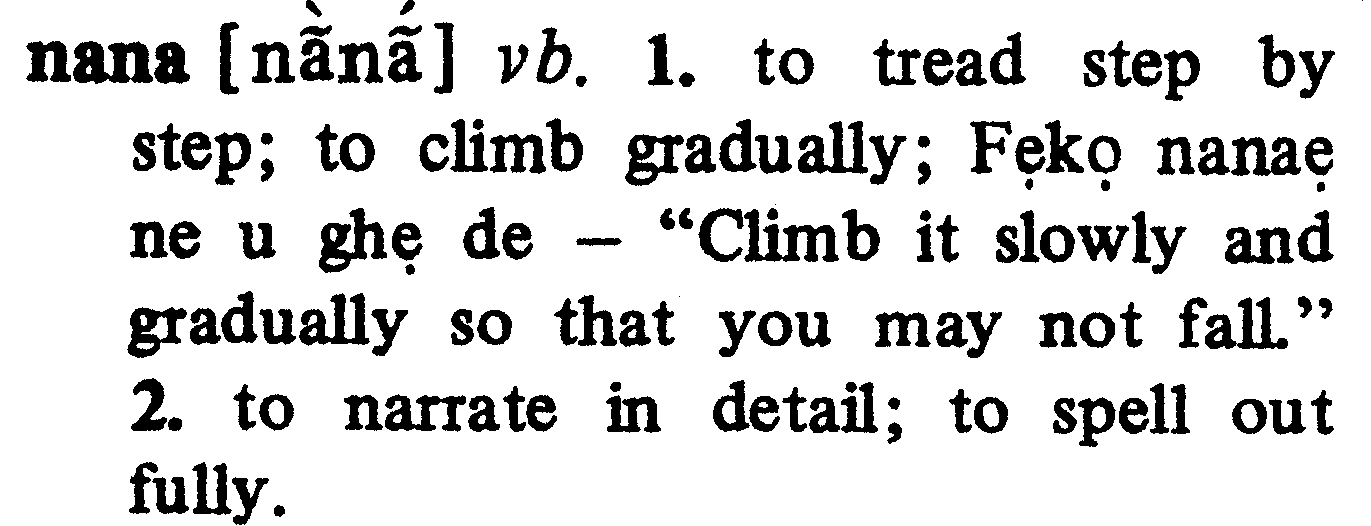
nana [nã̀nã́] vb. 1. to tread step by
step; to climb gradually; Fẹkọ nanaẹ
ne u ghẹ de ― “Climb it slowly and
gradually so that you may not fall.”
2. to narrate in detail; to spell out
fully.
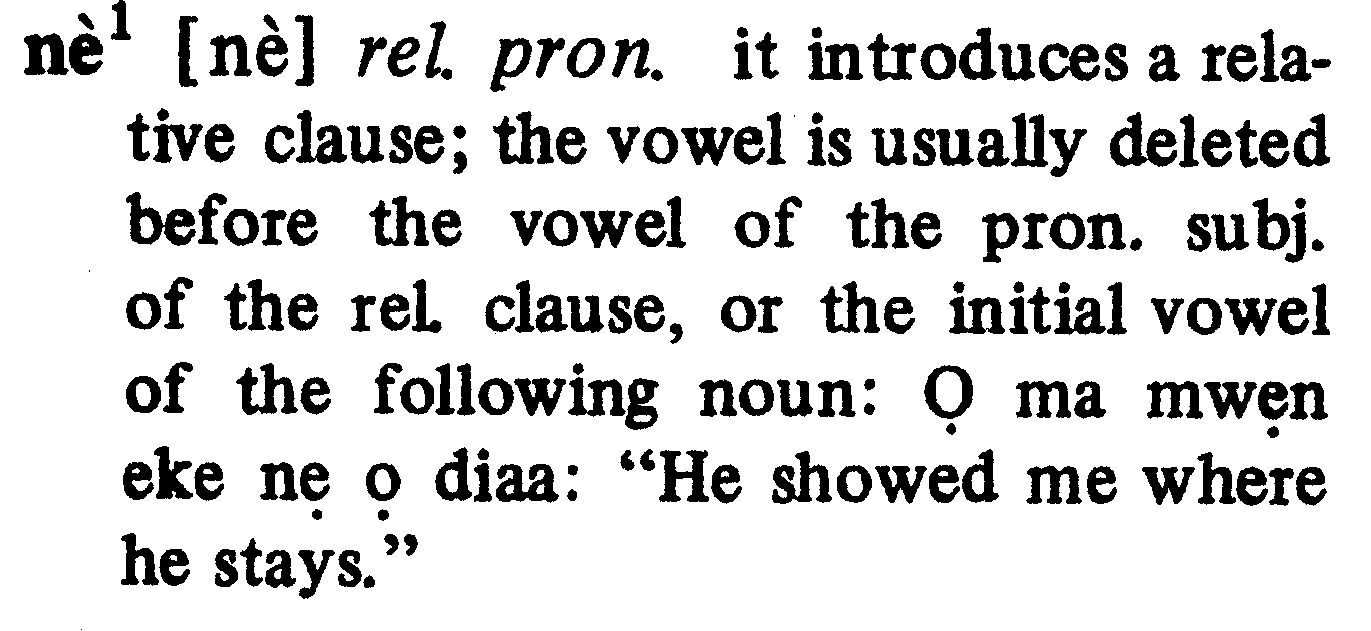
nè1 [nè] rel. pron. it introduces a rela-
tive clause; the vowel is usually deleted
before the vowel of the pron. subj.
of the rel. clause, or the initial vowel
of the following noun: Ọ ma mwẹn
eke nẹ ọ diaa: “He showed me where
he stays.”
nè2 [nè] prep. see na3.

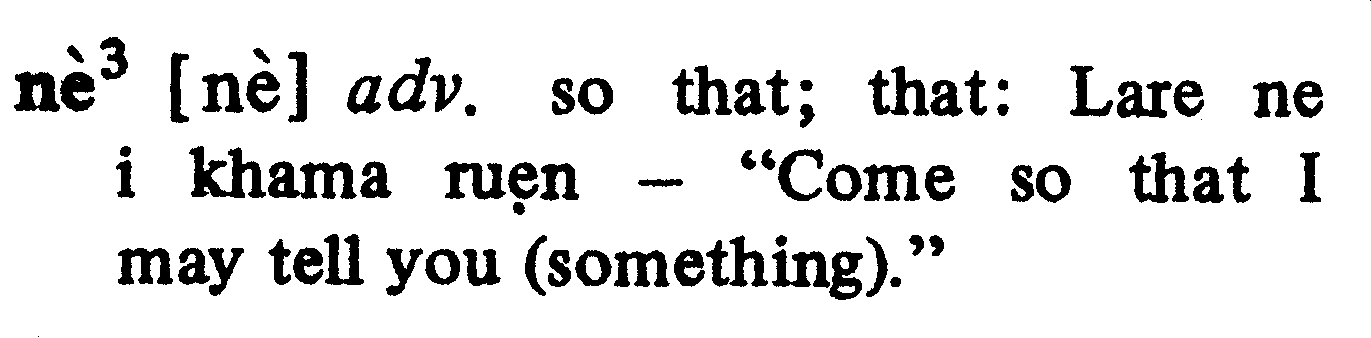
nè3 [nè] adv. so that; that: Lare ne
i khama ruẹn ― “Come so that I
may tell you (something).”
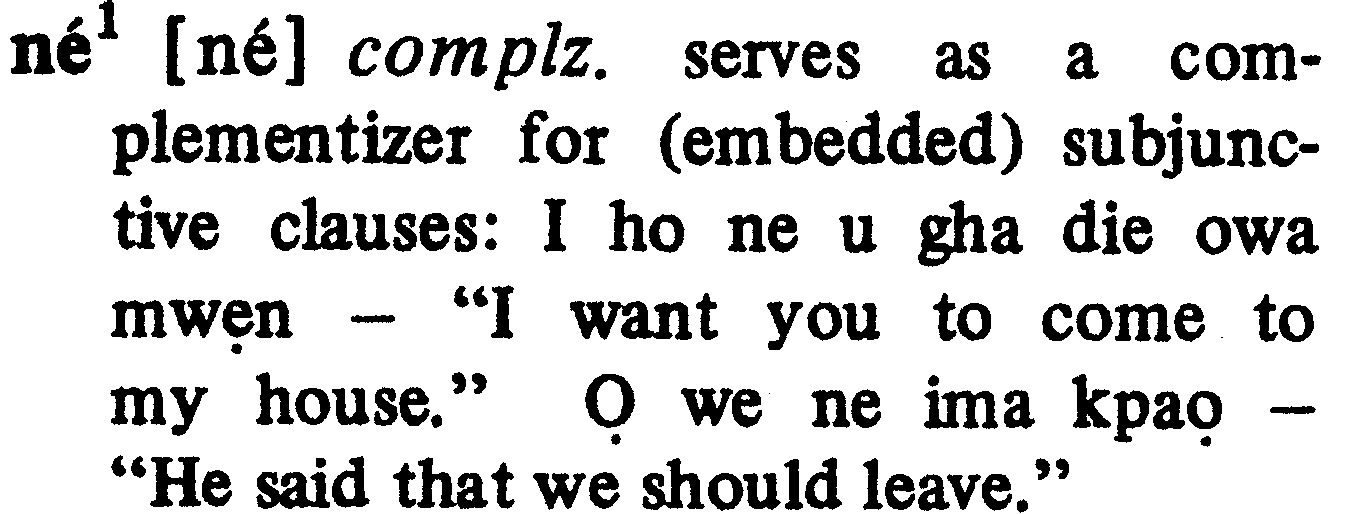
né1 [né] complz. serves as a com-
plementizer for (embedded) subjunc-
tive clauses: I ho ne u gha die owa
mwẹn ― “I want you to come to
my house.” Ọ we ne ima kpaọ ―
“He said that we should leave.”
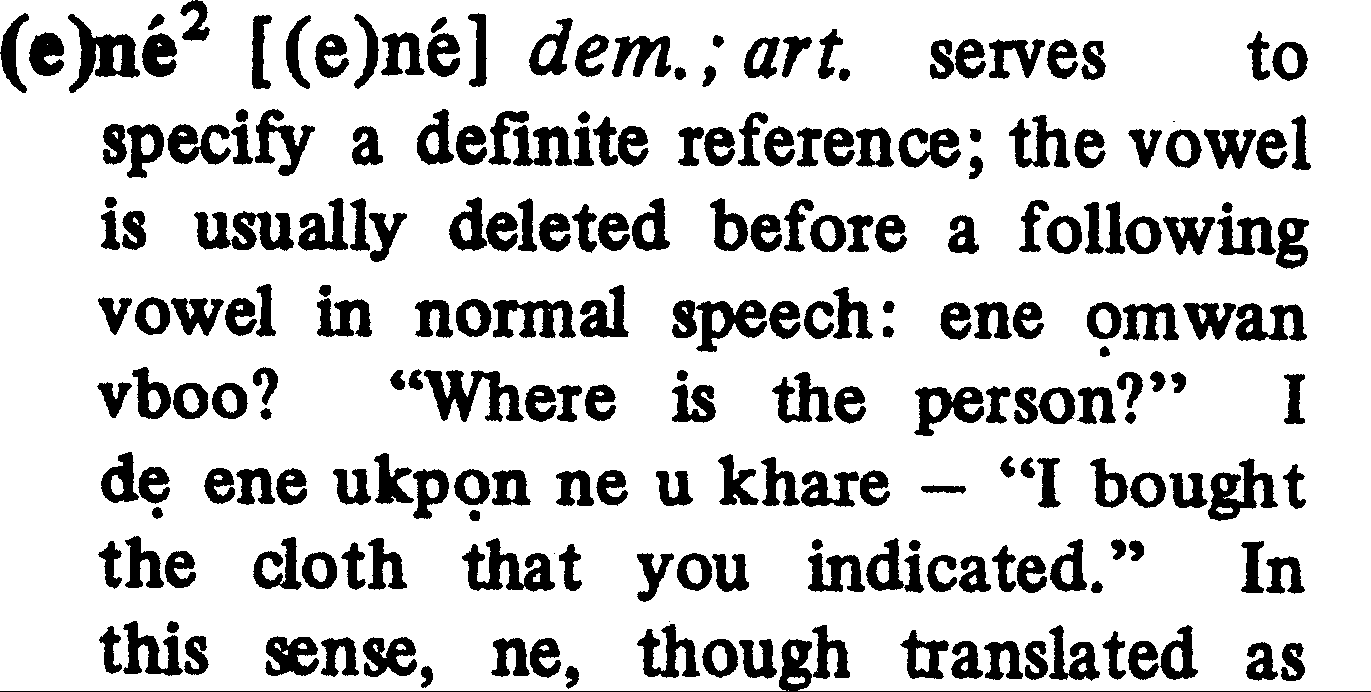
(e)né2 [(e)né] dem.; art. 1^.^ serves to
specify a definite reference; the vowel
is usually deleted before a following
vowel in normal speech: ene ọmwan
vboo? “Where is the person?” I
dẹ ene ukpọn ne u khare ― “I bought
the cloth that you indicated.” In
this sense, ne, though translated as
%%
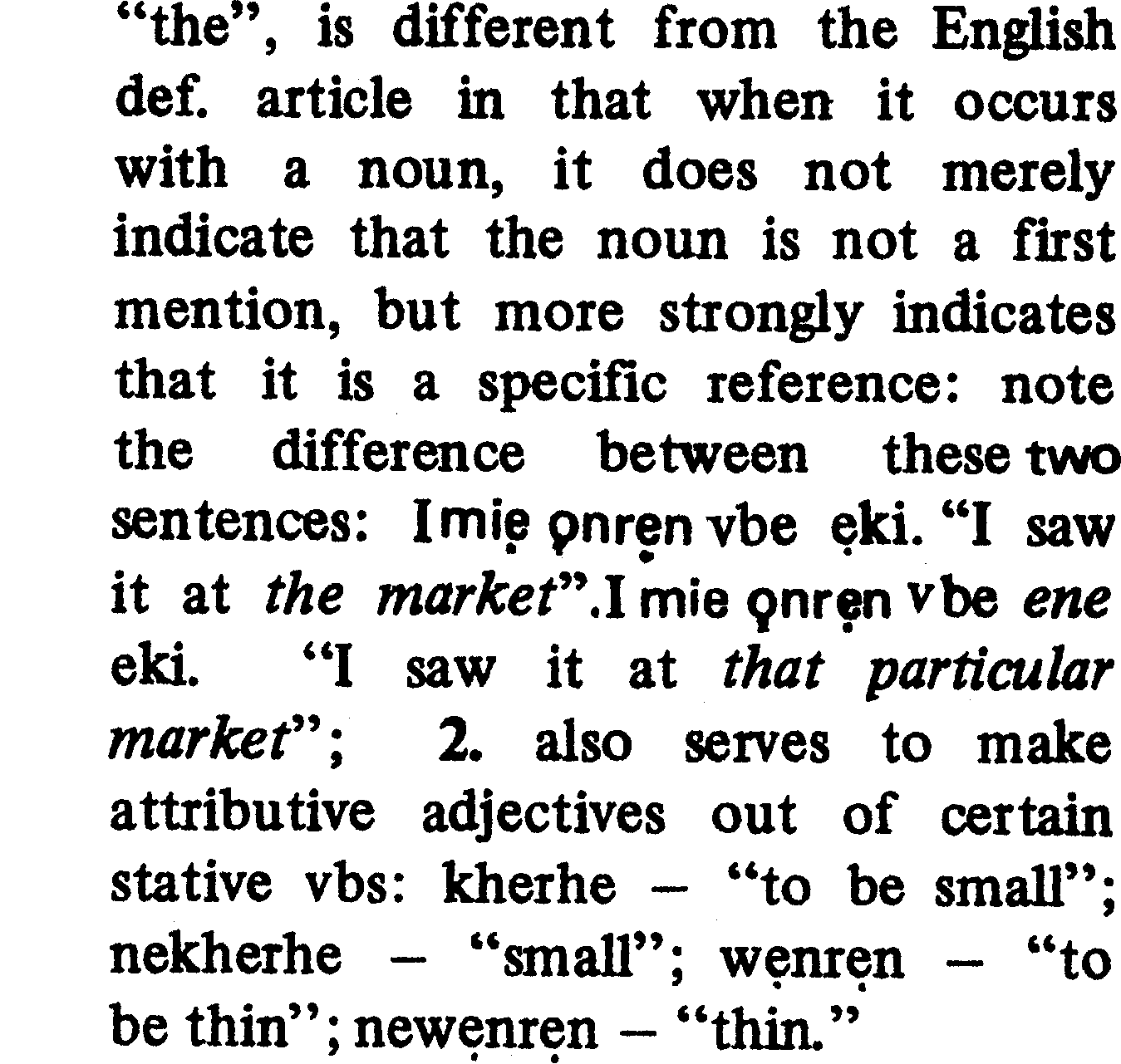
“the”, is different from the English
def. article in that when it occurs
with a noun, it does not merely
indicate that the noun is not a first
mention, but more strongly indicates
that it is a specific reference: note
the difference between these two
sentences: I miẹ ọnrẹn vbe ẹki. “I saw
it at the market”. I miẹ ọnrẹn vbe ene
eki. “I saw it at that particular
market”; 2. also serves to make
attributive adjectives out of certain
stative vbs: kherhe ― “to be small”;
nekherhe ― “small”; wẹnrẹn ― “to
be thin”; newẹnrẹn ― “thin.”
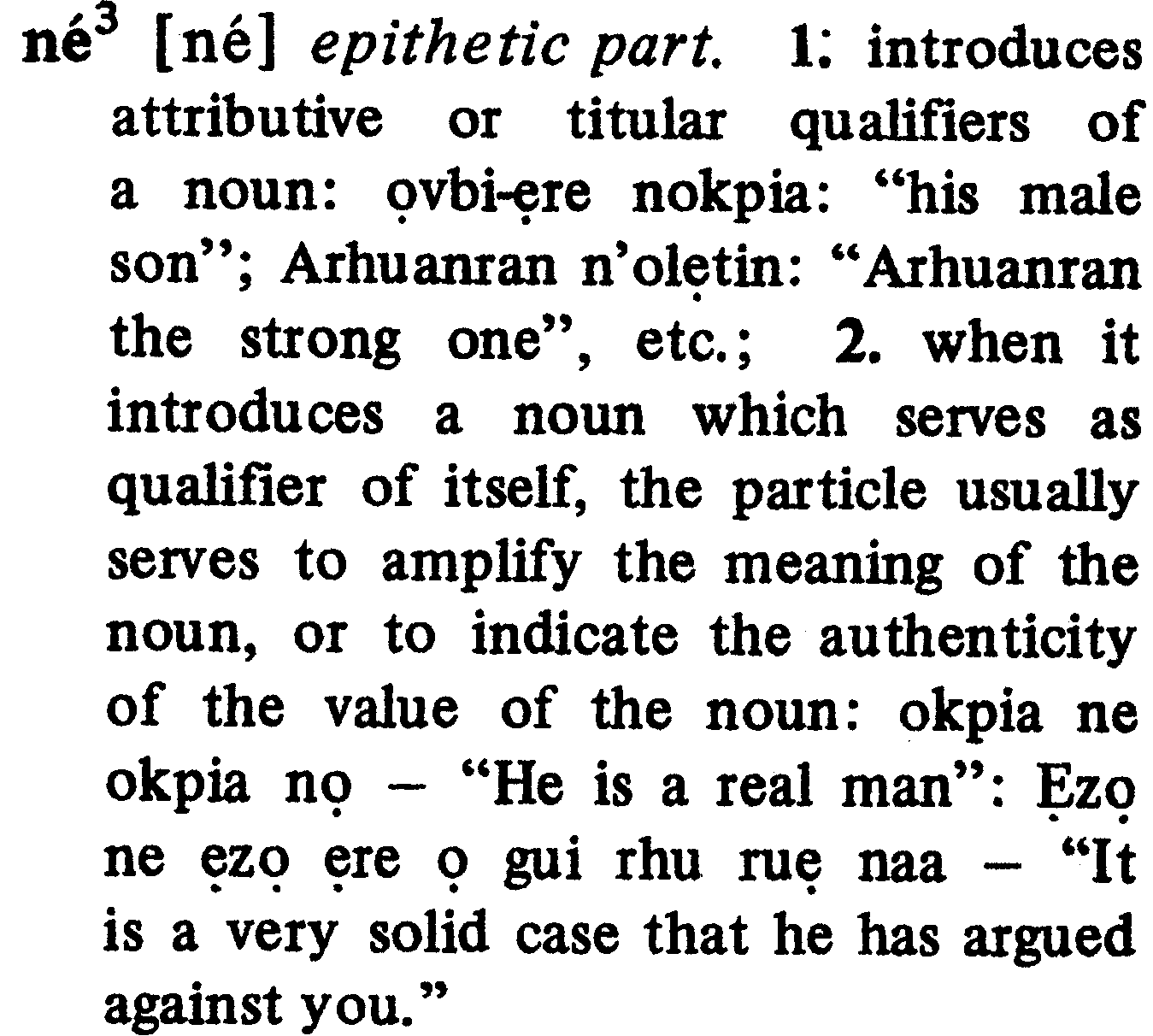
né3 [né] epithetic part. 1. introduces
attributive or titular qualifiers of
a noun: ọvbi-ẹre nokpia: “his male
son”; Arhuanran n’olẹtin: “Arhuanran
the strong one”, etc.; 2. when it
introduces a noun which serves as
qualifier of itself, the particle usually
serves to amplify the meaning of the
noun, or to indicate the authenticity
of the value of the noun: okpia ne
okpia nọ ― “He is a real man”: Ẹzọ
ne ẹzọ ẹre ọ gui rhu ruẹ naa ― “It
is a very solid case that he has argued
against you.”
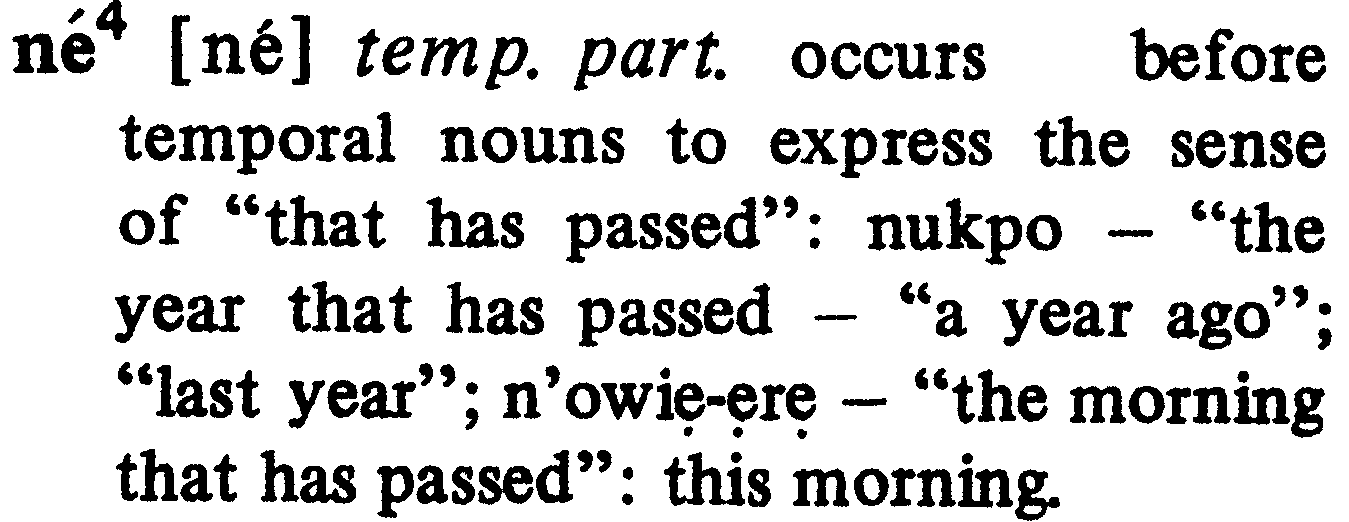
né4 [né] temp. part. occurs before
temporal nouns to express the sense
of “that has passed”: nukpo ― “the
year that has passed”^ ― “a year ago”;
“last year”; n’owiẹ-ẹrẹ ― “the morning
that has passed”: this morning.
negẹdẹẹgbẹ [négɛ̀dɛ̀g͡bɛ̀] adj. very big,
huge.

nekherhe [néxeře] adj. small; little:
Owa nekherhe ― “a little house.”

nekhui [néxwì] adj. black: Ọmwan
nekhui ― “a black person.”

nene [néne] dem. art. emphatic form
of né2: n’okpia ọna khin ― “This
$Page 101$

is the man (we were talking about).”
nene okpia ọna khin ― “This is the
very man (we were talking about).”

nerhunmwun [néřũ̀ɱũ̀] vb. to pray
(also lerhunmwun).

nẹ1 [nɛ́] vb. to defecate; to pass out
faeces.

nẹ2 [nɛ́] adv. already: Ọ wu nẹ ra?
“Has he died already?”

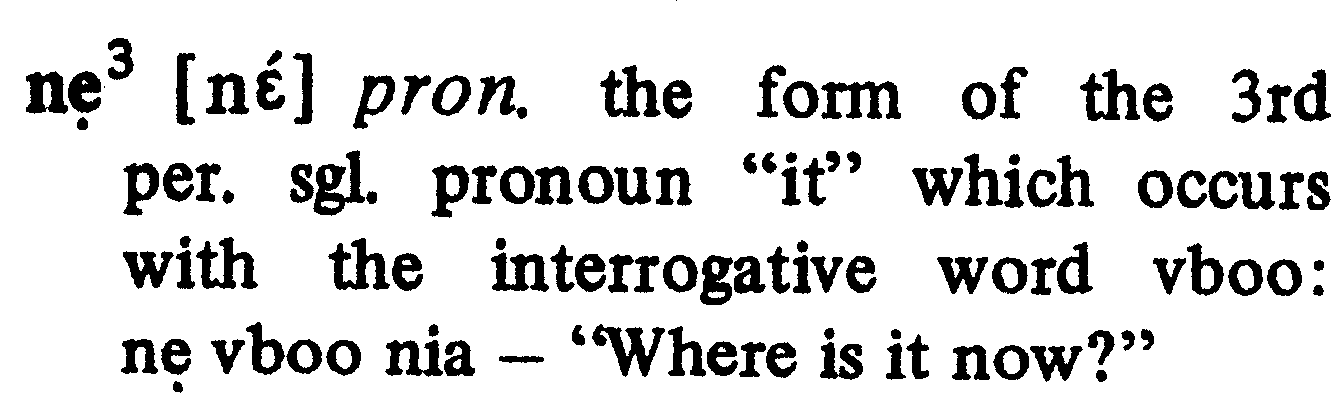
nẹ3 [nɛ́] n. the form of the 3rd
per. sgl. pronoun “it” which occurs
with the interrogative word vboo:
nẹ vboo nia ― “Where is it now?”
nẹdẹ [nɛ́dɛ̀] adj.; adv. in the days past;
in the old days.

nẹdẹso [nɛ́dɛsò] adj.; adv. some time
ago.

nẹghẹdia [nɛ́ɣɛ́dya] adj.; adv. two
days ago (third day back from today).

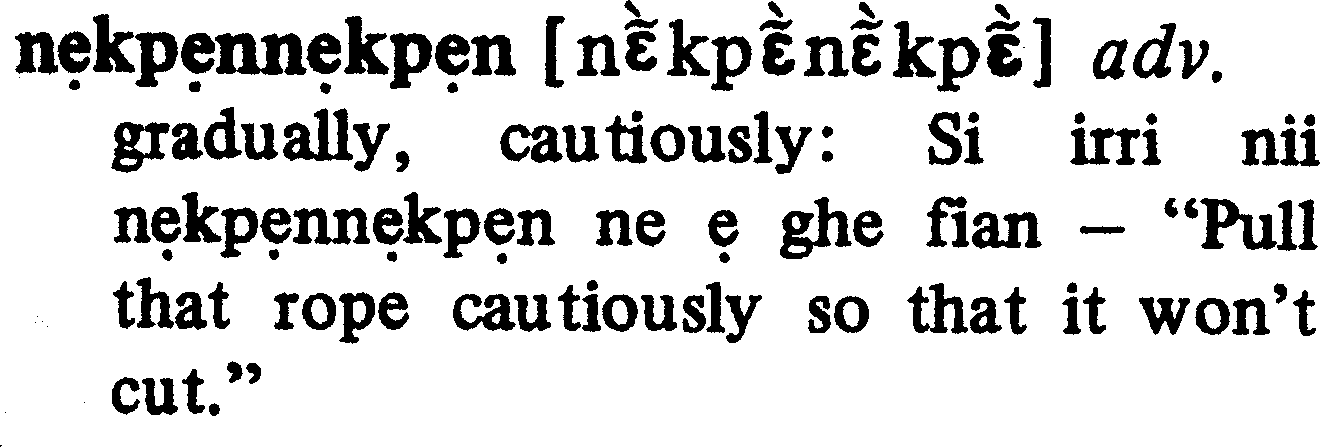
nẹkpẹnnẹkpẹn [nɛ̃̀kpɛ̃̀nɛ̃̀kpɛ̃̀] adv.
gradually, cautiously: Si irri nii
nẹkpẹnnẹkpẹn ne ẹ ghe fian ― “Pull
that rope cautiously so that it won’t
cut.”
nẹvusẹn [nɛ́vúsɛ̃̀] adj.; adv. four days
ago (fifth day back from today).

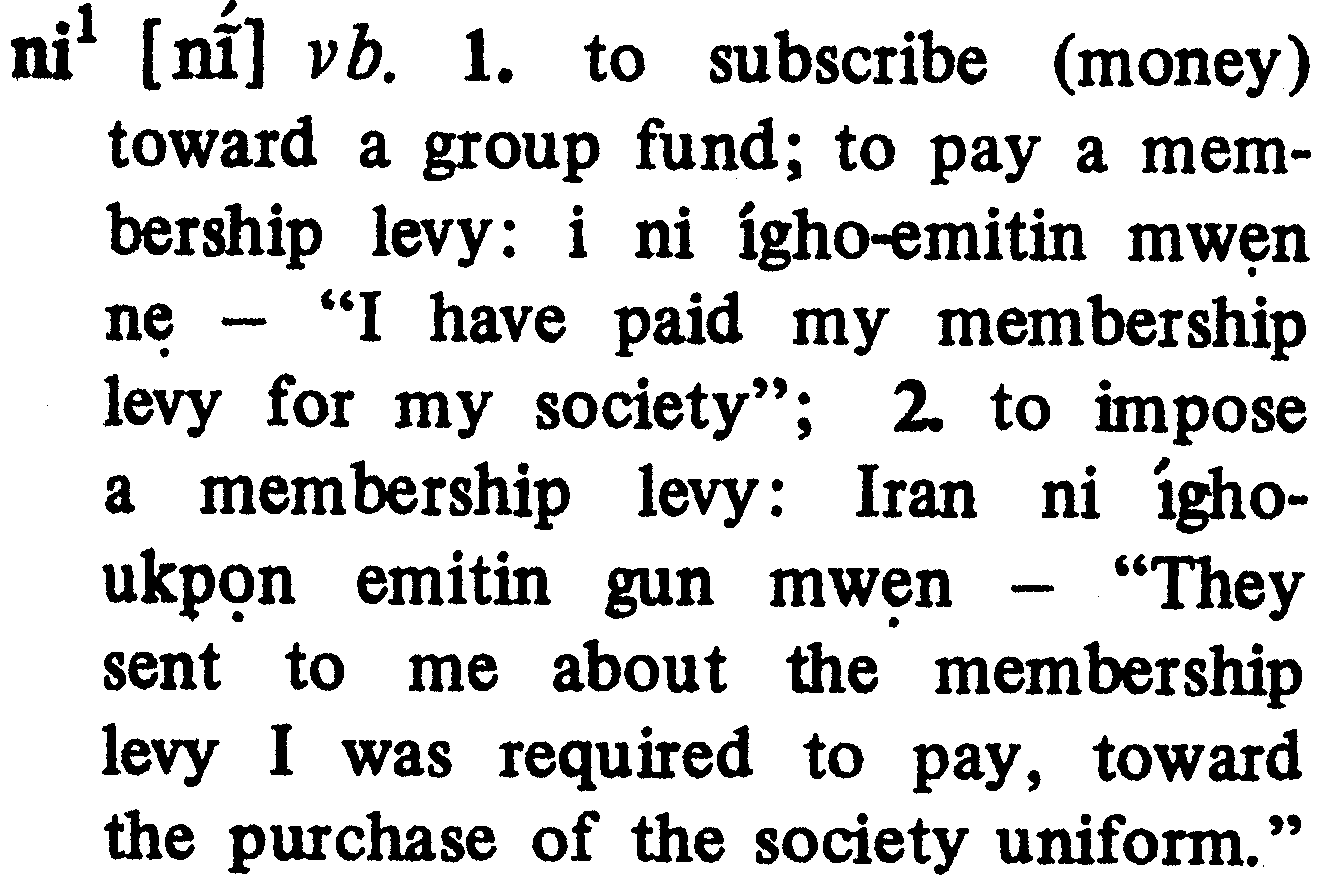
ni1 [nĩ́] vb. 1. to subscribe (money)
toward a group fund; to pay a mem-
bership levy: i ni ígho-emitin mwẹn
nẹ ― “I have paid my membership
levy for my society”; 2. to impose
a membership levy: Iran ni ígho-
ukpọn emitin gun mwẹn ― “They
sent to me about the membership
levy I was required to pay, toward
the purchase of the society uniform.”
ni2 [nĩ́] vb. 1. (of a boat or canoe)
to overturn; to sink: Ọkọ iran ni
%%

ye ẹzẹ ― “Their boat overturned
in the river.”

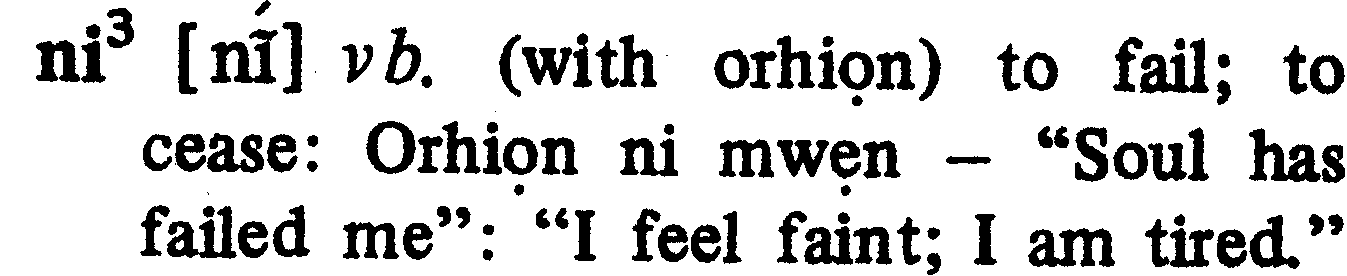
ni3 [nĩ́] vb. (with orhiọn) to fail; to
cease: Orhiọn ni mwẹn ― “Soul has
failed me”: “I feel faint; I am tired.”
nia [nĩ̀ã́] adv. 1. now; at this time:
ọ sẹtin gha khian nẹ nia ― He is now
able to walk already; 2. at last, finally:
Eban i ghi doo mioẹn nia ― “It is
now that I have finally found it.”^
(nia never occurs in utterance initial
position).
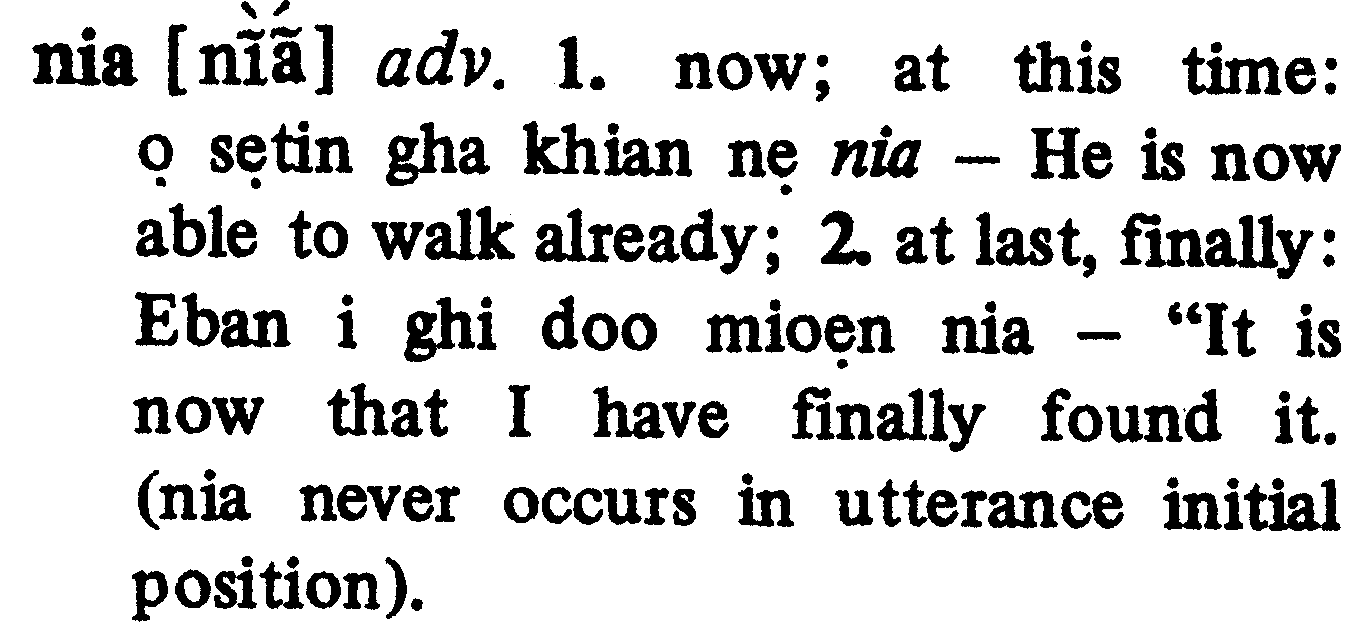
niania [nyã̀nyã́] vb. (usually with an
abstract obj.) to drag indefinitely;
to extend beyond proportions: Ọ
guẹ vbe a niania ẹmwẹn hẹẹ gbe ―
“He is too fond of dragging matters
indefinitely.” (also tiantian).
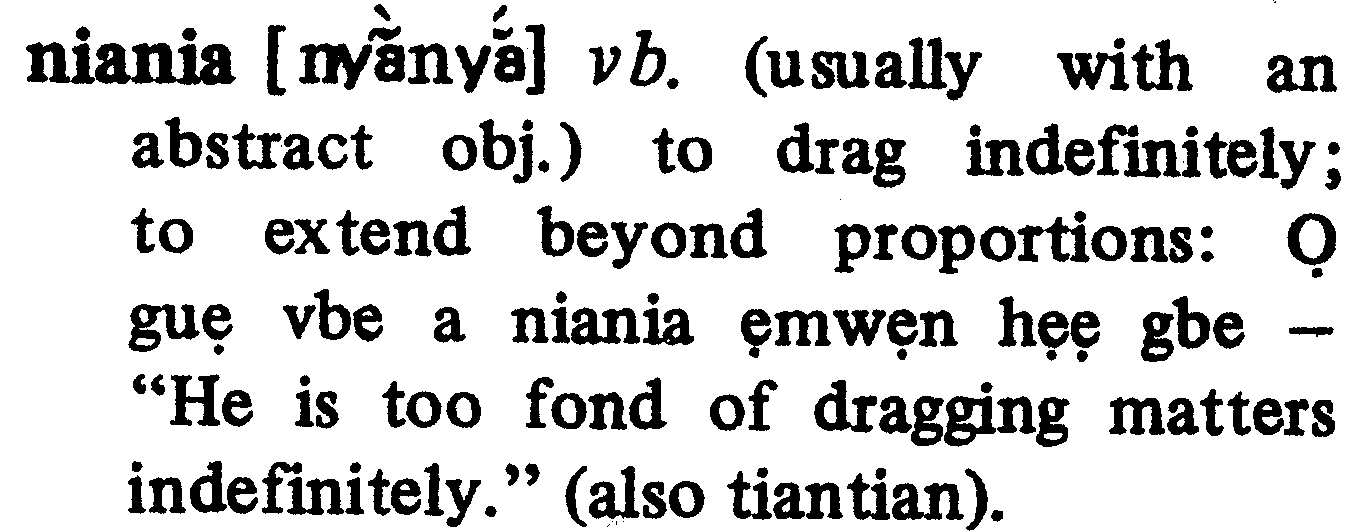
niẹ [nĩ̀ɛ̃́] vb. 1. to stretch; to extend,
to point: Ọ niẹ owẹ gbe odẹ ― “He
extended his legs across the way.”
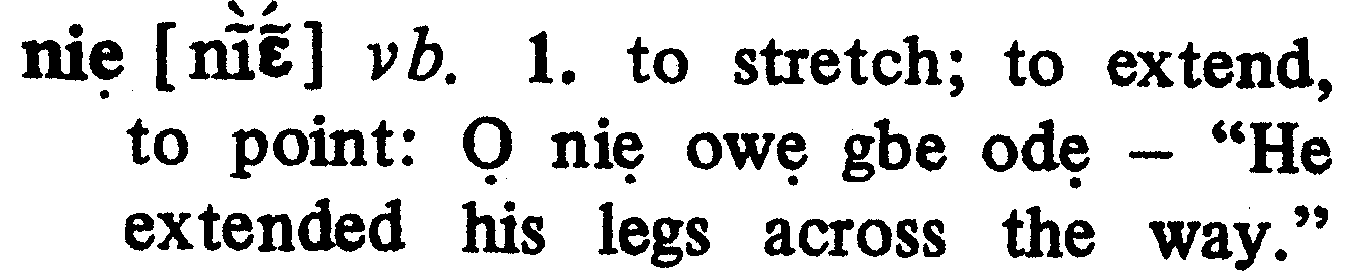
nii [nĩ́ĩ́] dem. adj. 1. “that”: ebe nii
― “that book”; 2. generally specifies
things remote or far away, in place
or time: Ne u na rre nii ― “that (time)
when you came”; ehe ne i ma te ye
nii ― “that place where we used
to be”, etc.
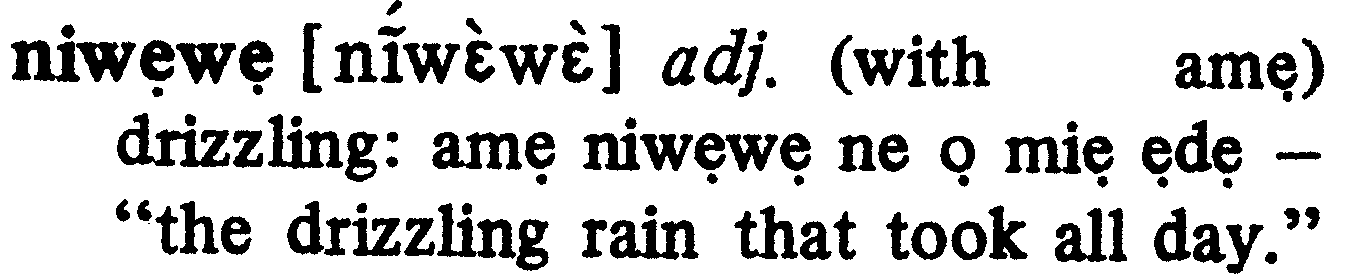
niwẹwẹ [nĩ́wɛ̀wɛ̀] adj. (with amẹ)
drizzling: amẹ niwẹwẹ ne ọ miẹ ẹdẹ ―
“the drizzling rain that took all day.”
nodẹ [nṍdɛ̀] adv.; adj. yesterday.

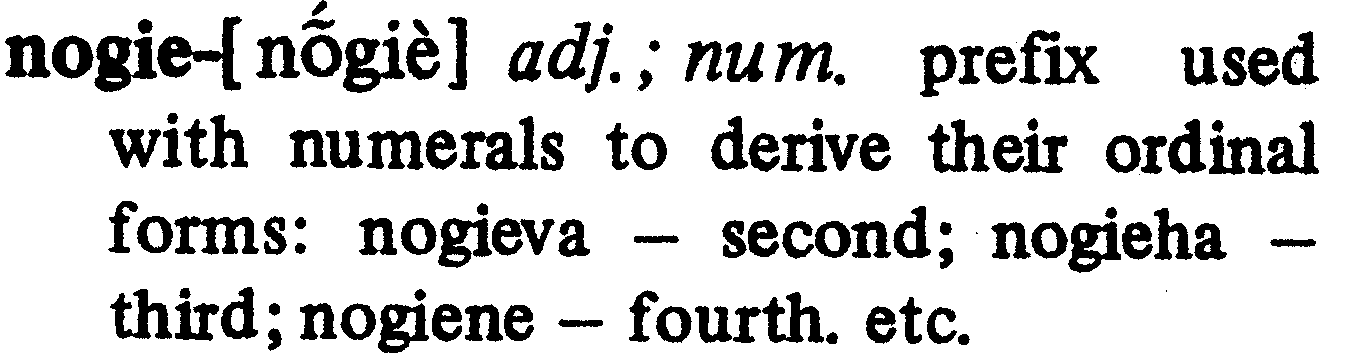
nogie- [nṍgiè] adj.; num. prefix used
with numerals to derive their ordinal
forms: nogieva ― second; nogieha ―
third; nogiene ― fourth. etc.
nokaro [nṍkàɽò] adv.; adj. the first.

nọ [nɔ̃́] cop. to be; a form of the
$Page 102$

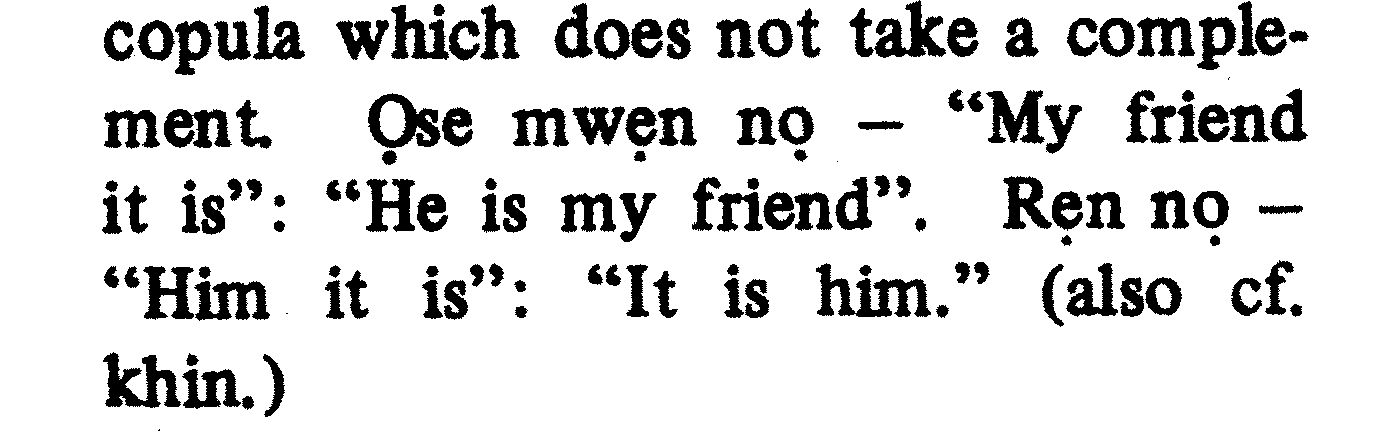
copula which does not take a comple-
ment. Ọse mwẹn nọ ― “My friend
it is”: “He is my friend”. Rẹn nọ ―
“Him it is”: “It is him.” (also cf.
khin.)
nọfua [nɔ̃́fwà] adj. white; whitish (pl.
nefua).

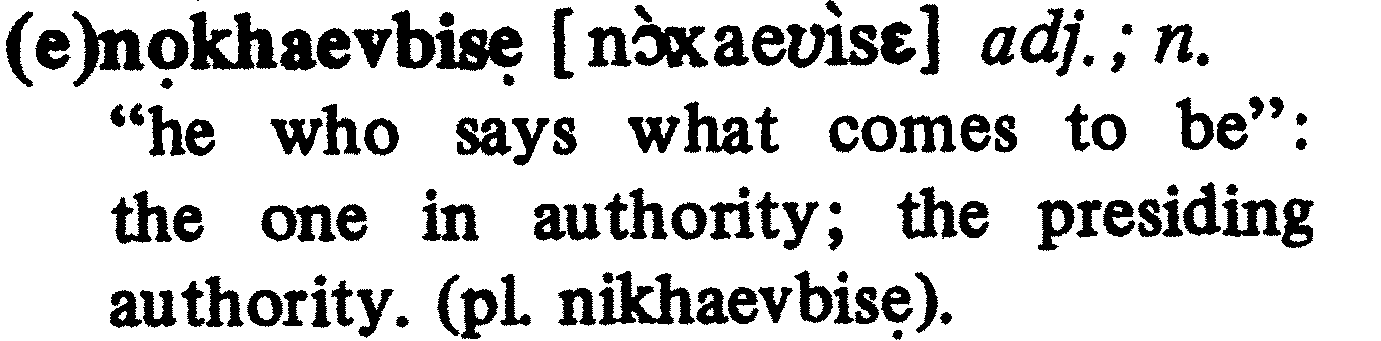
(e)nọkhaevbisẹ [nɔ̃̀xaeʋìsɛ] adj.; n.
“he who says what comes to be”:
the one in authority; the presiding
authority. (pl. nikhaevbisẹ).
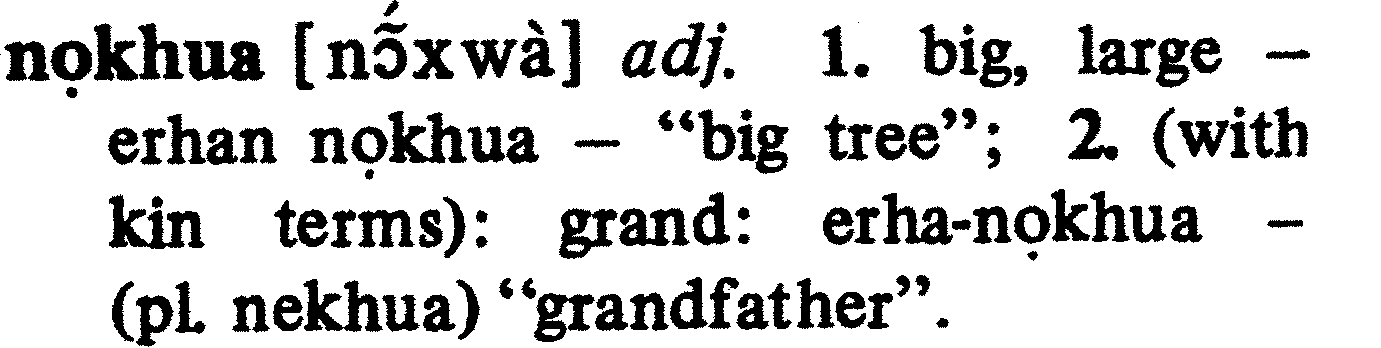
nọkhua [nɔ̃́xwà] adj. 1. big, large ―
erhan nọkhua ― “big tree”; 2. (with
kin terms): grand: erha-nọkhua ―
(pl. nekhua) “grandfather”.
%%
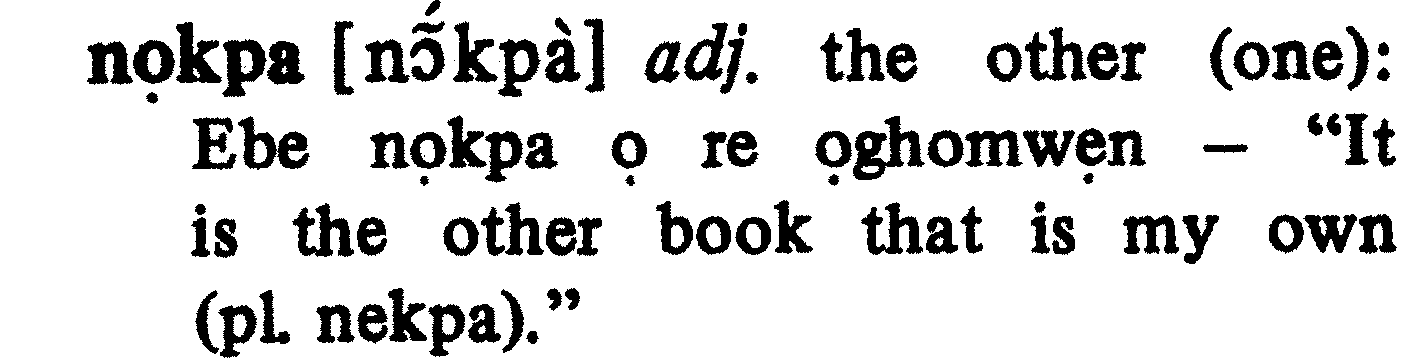
nọkpa [nɔ̃́kpà] adj. the other (one):
Ebe nọkpa ọre ọghomwẹn ― “It
is the other book that is my own
(pl. nekpa).”
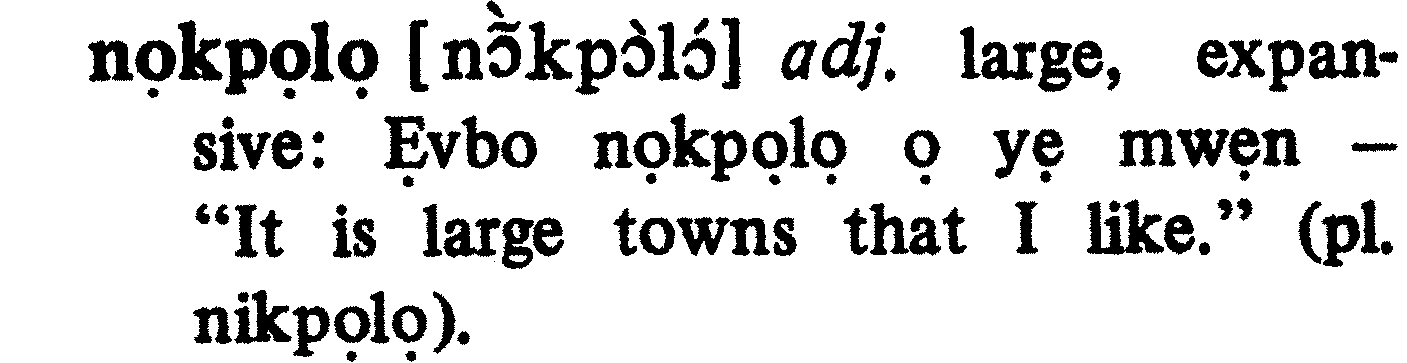
nọkpọlọ [nɔ̃̀kpɔ̀lɔ́] adj. large, expan-
sive: Ẹvbo nọkpọlọ ọ yẹ mwẹn ―
“It is large towns that I like.” (pl.
nikpọlọ).
nọmaa [nɔ̃̀mã̀ã́] adj. good: evbare
nọmaa ― “good food”.

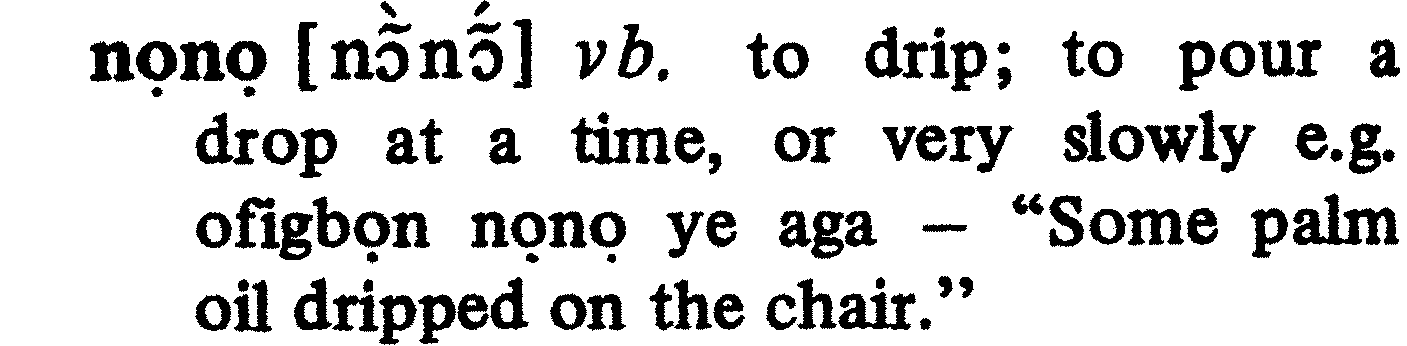
nọnọ [nɔ̃̀nɔ̃́] vb. to drip; to pour a
drop at a time, or very slowly e.g.
ofigbọn nọnọ ye aga ― “Some palm
oil dripped on the chair.”
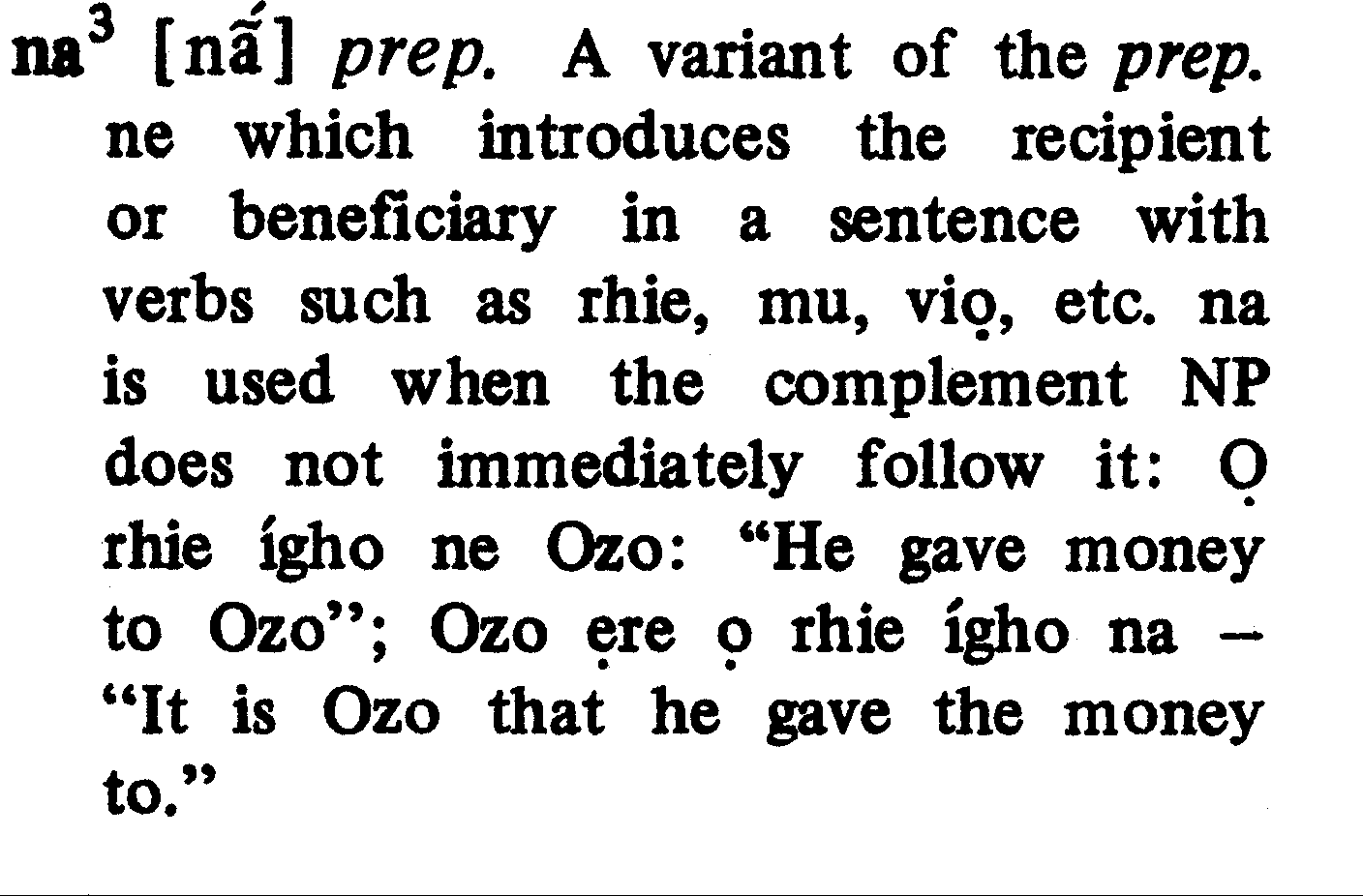
nukpo [nṹkpò] adv.; adj. last year: Ọ
rre nukpo ― “He came last year.”