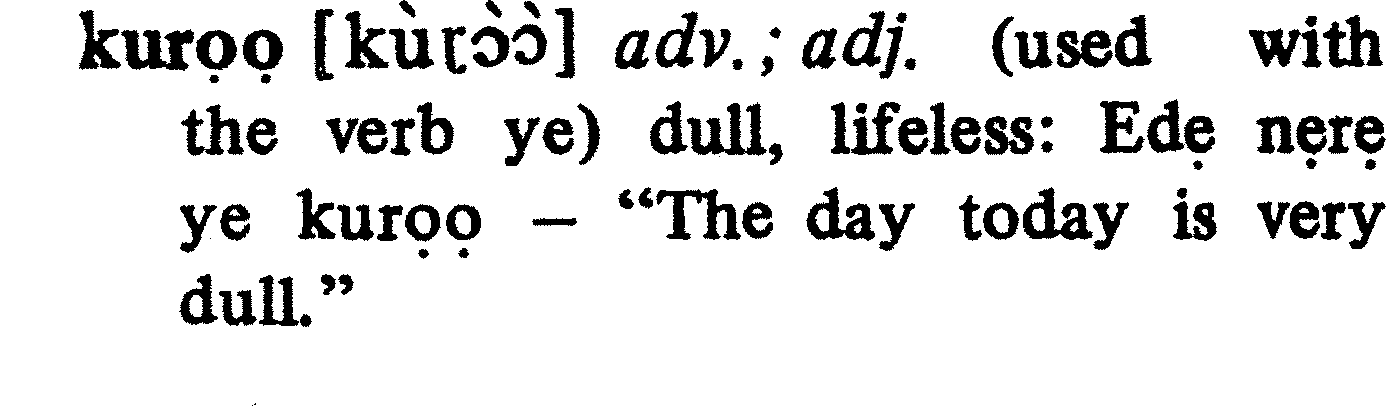
ka1 [ká] aux. 1. indicates that “the
subject” of the clause was first to
perform the action in the verb: mẹ ọ
ka rre ― “I came first”; 2. that the
action had been performed before
in the past: Ma ka rri ẹvbo naa yi ―
“We had come to this town before.”
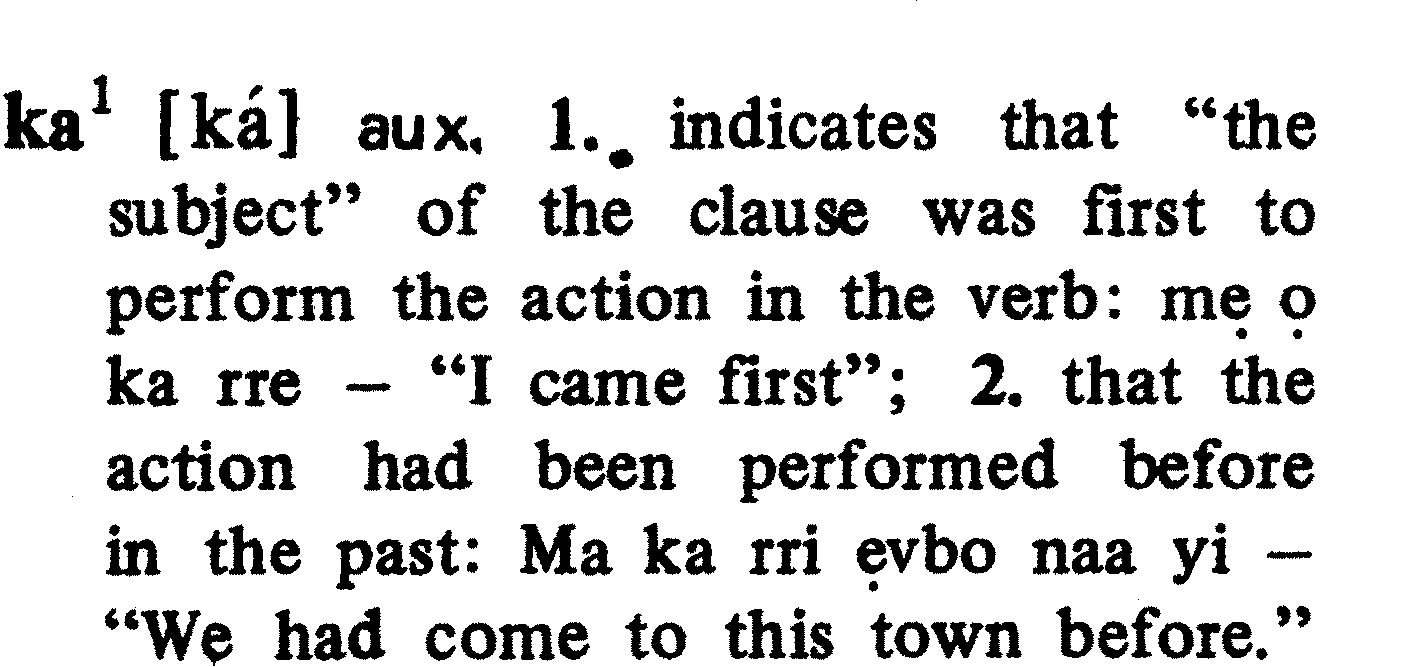
ka2 [ká] vb. to recount all the evil
deeds committed as a witch, or practi-
tioner of other strong and evil forces;
to confess to evil doings.
%%
ka3 [ká] vb. to count; to reckon: Ka
iran ghee deghẹ iran gbae ― “Count
them to see whether they are correct.”

ka4 [ká] vb. to dry; to be crisp: eka
ne ọ fiaẹn ma ka ― “The bean-cake
that she fried was not crisp!”

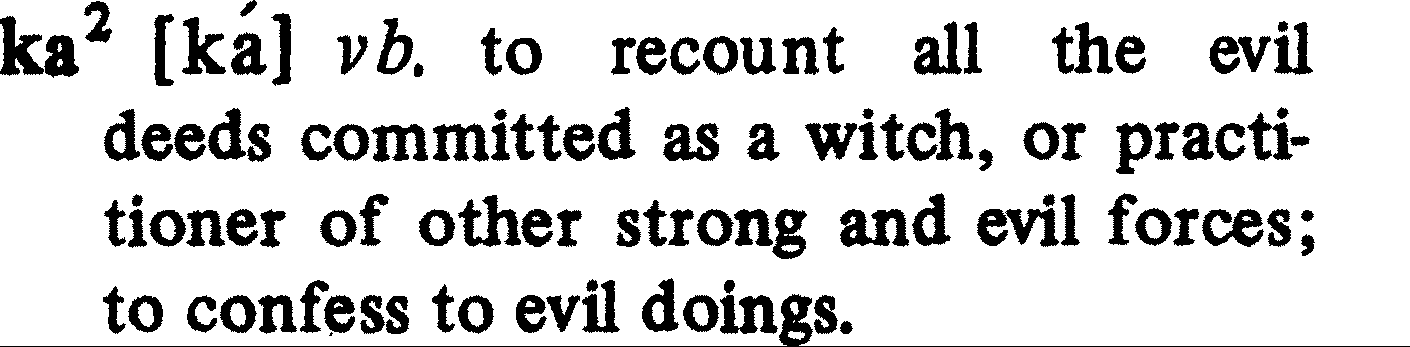
ka5 [ká] vb. to buy palm wine (or
other kinds of drinks): Ọ ka ọgọ
ayọn eha gie arowa ọre ― “He bought
and brought three bottles of wine to
his master.”
$Page 080$
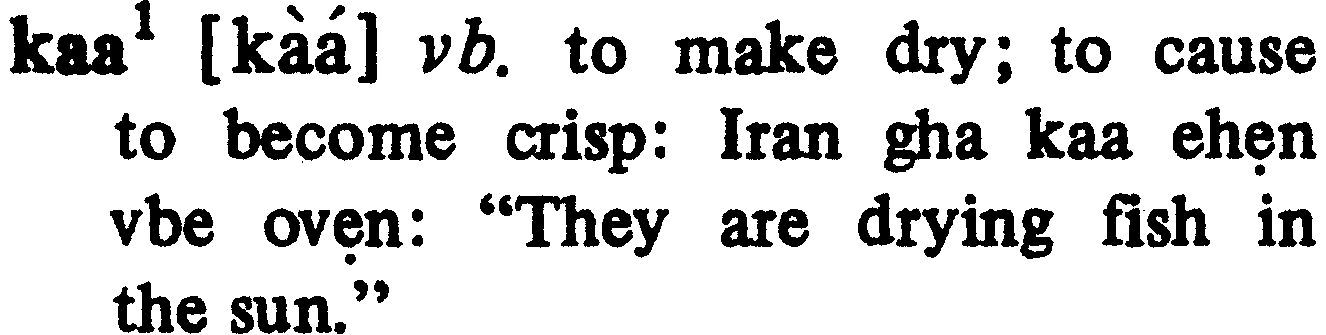
kaa1 [kàá] vb. to make dry; to cause
to become crisp: Iran gha kaa ehẹn
vbe ovẹn: “They are drying fish in
the sun.”
kaa2 [kàá] vb. to carve (e.g. a piece
of wood).

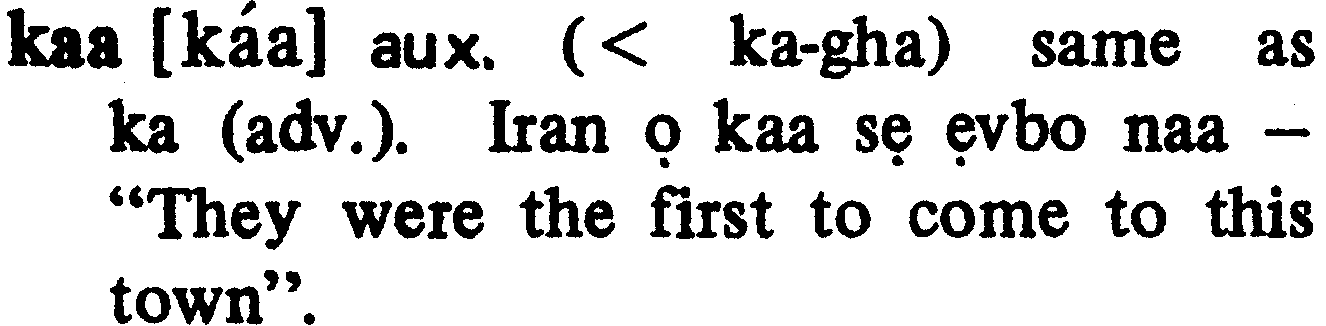
kaa [káa] aux. (< ka-gha) same as
ka (adv.). Iran ọ kaa sẹ ẹvbo naa ―
“They were the first to come to this
town”.
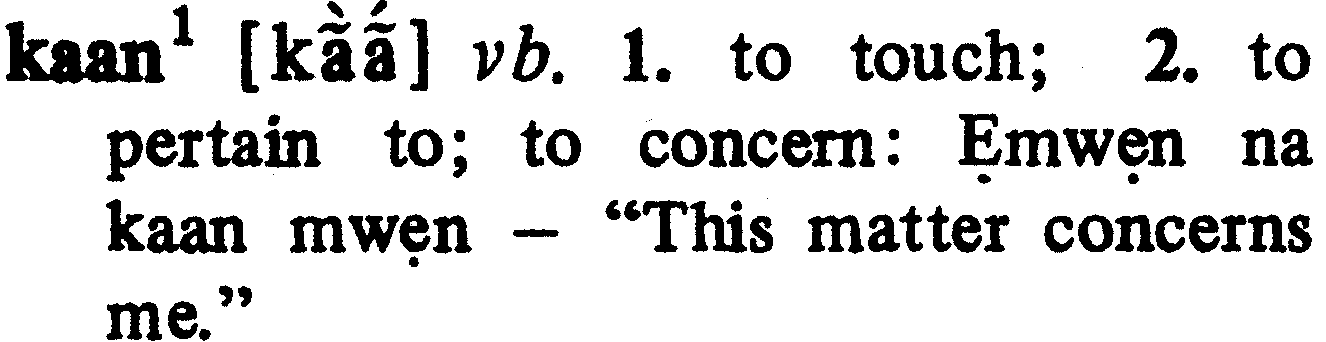
kaan1 [kã̀ã́] vb. 1. to touch; 2. to
pertain to; to concern: Ẹmwẹn na
kaan mwẹn ― “This matter concerns
me.”
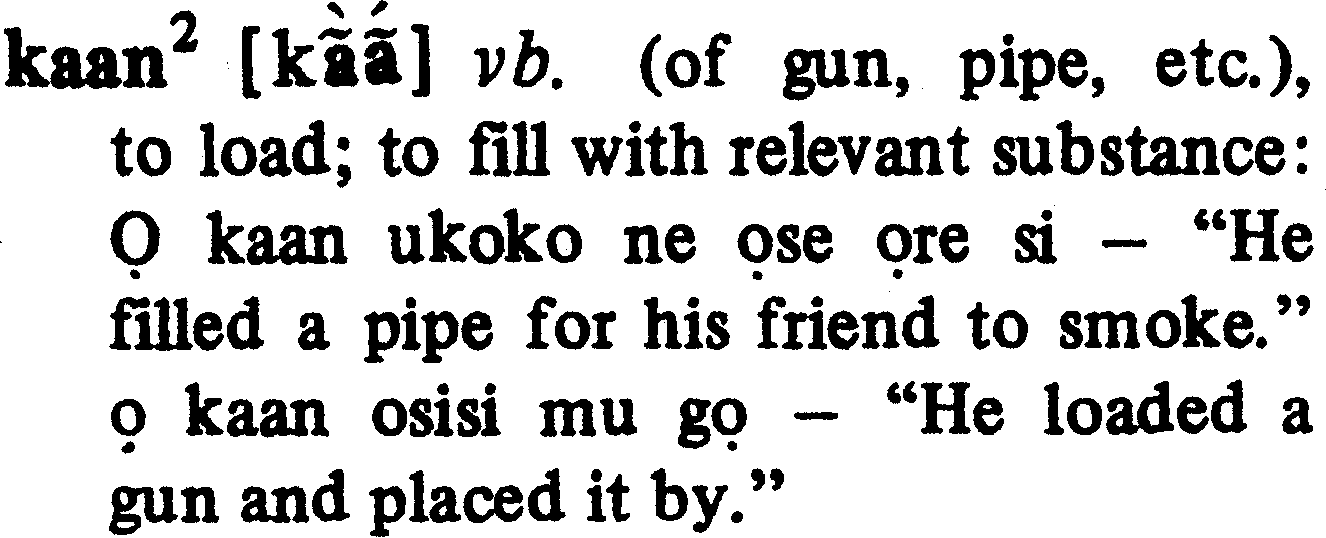
kaan2 [kã̀ã́] vb. (of gun, pipe, etc.),
to load; to fill with relevant substance:
Ọ kaan ukoko ne ọse ọre si ― “He
filled a pipe for his friend to smoke.”
ọ kaan osisi mu gọ ― “He loaded a
gun and placed it by.”
kada [kádà] idiom. a greeting formula
expressed by males to their elders
after a meal as a mark of respect and
gratitude. It is also expressed as a
good-will greeting to an elder when
he sneezes.
kadesẹ [kádèsɛ̀] adv. (< ke2 ― adesẹ).
to be located between; to be in the
middle of; to be at the centre of.
(also kadesẹneva).
kadesẹneva [kàdèsɛ̀névà] adv. cf.
kadesẹ.

kae [kàé] vb. the cry of a squirrel.

kaẹn [kã̀ɛ̃́] vb. 1. to construct or build
with wood; O kaẹn ùkhuerhe mẹ ―
“He constructed a stool for me.”;
2. to nail something; to attach things
together with a nail: Ọ kaẹn erhan
nii mu ẹkhu-orere mẹ: “He nailed
that wood to the front door for me.”
%%
kaka [kàká] vb. 1. to become dry; to
be dehydrated (e.g. of leaves becoming
dry and crisp).

kakabọ [kàkàbɔ́] adv. very much; ex-
ceedingly: Ọ kakabọ tan: “He is very
tall.”

kalọ [kàlɔ́] vb. to stab repeatedly; to
chop down: Izigha ya ọpia kalọ iran
vbe odẹ: “A highway robber stabbed
them with a machete on the way.”
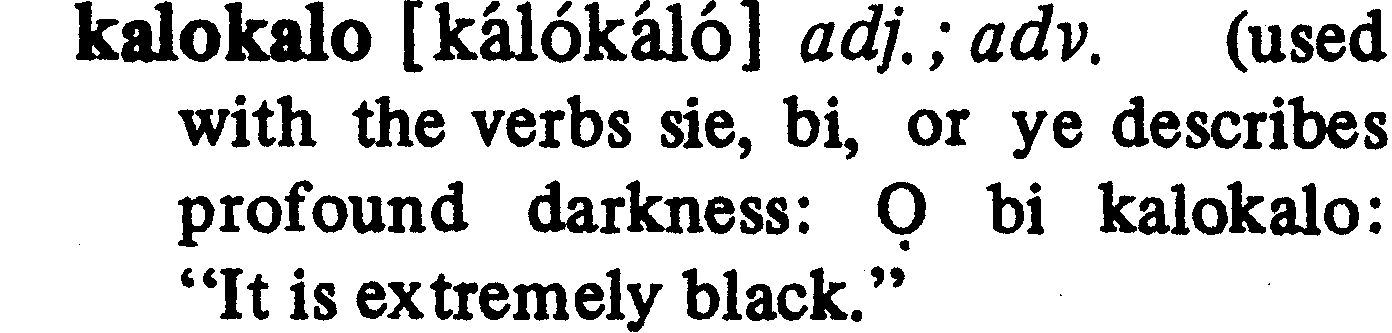
kalokalo [kálókáló] adj.; adv. (used
with the verbs sie, bi, or ye)^ describes
profound darkness: Ọ bi kalokalo:
“It is extremely black.”
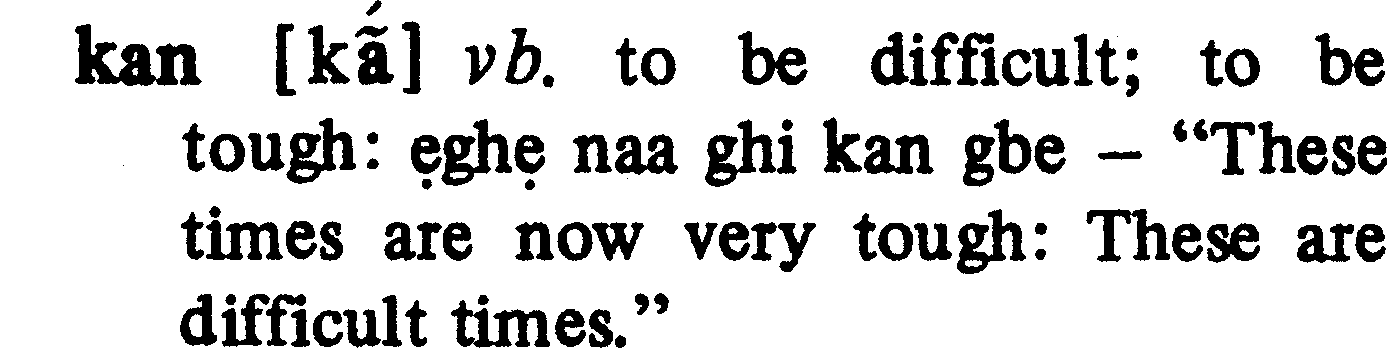
kan [kã́] vb. to be difficult; to be
tough: ẹghẹ naa ghi kan gbe ― “These
times are now very tough: These are
difficult times.”
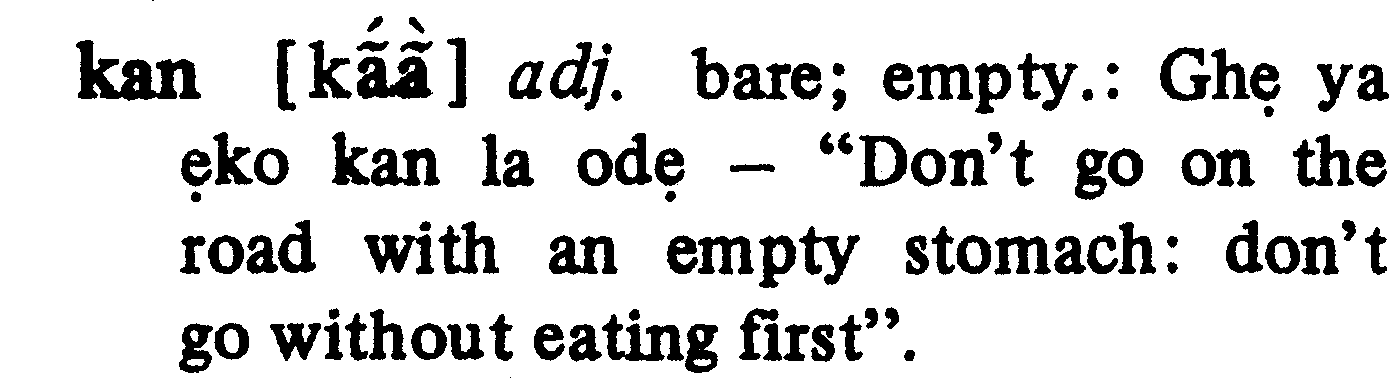
kan [kã́ã̀] adj. bare; empty.: Ghẹ ya
ẹko kan la odẹ ― “Don’t go on the
road with an empty stomach: don’t
go without eating first”.
kan [kã̀] vb. in the idiom kan ukọ:
to query; to find fault with.

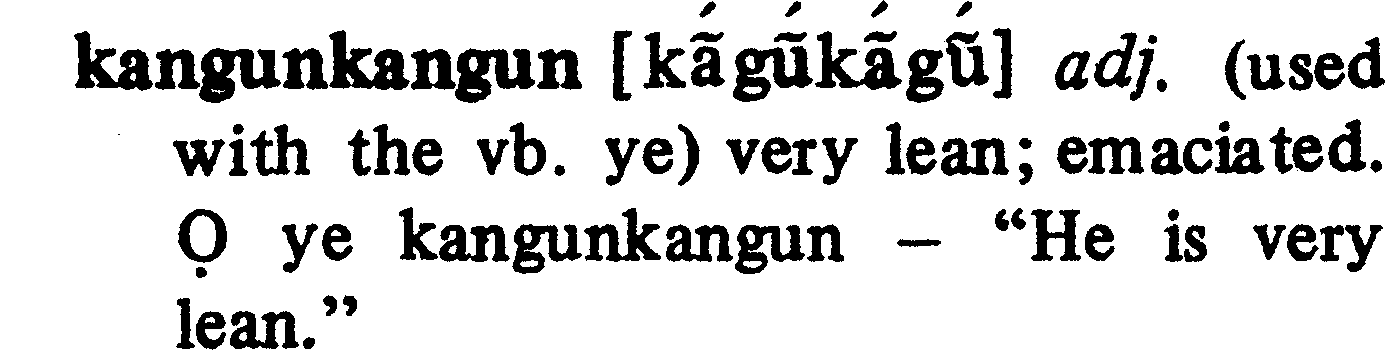
kangunkangun [kã́gṹkã́gṹ] adj. (used
with the vb. ye) very lean; emaciated.
Ọ ye kangunkangun ― “He is very
lean.”
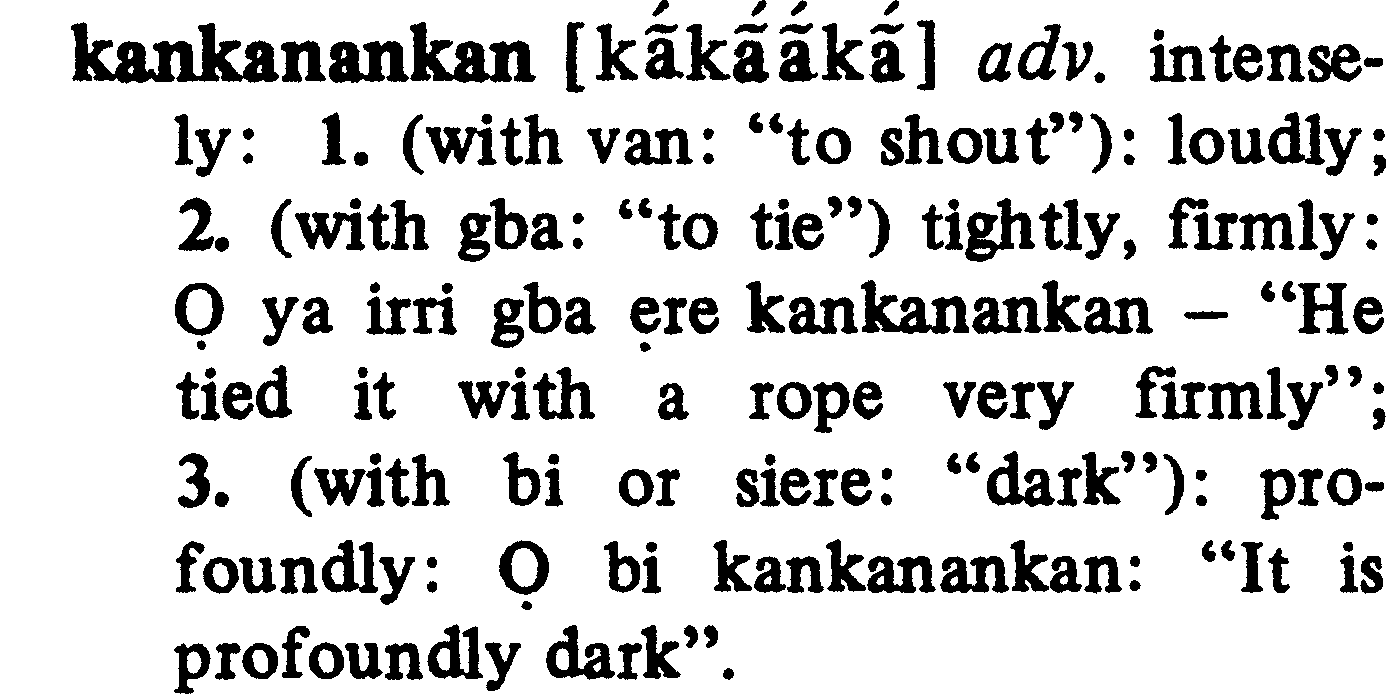
kankanankan [kã́kã́ã́kã́] adv. intense-
ly: 1. (with van: “to shout”): loudly;
2. (with gba: “to tie”) tightly, firmly:
Ọ ya irri gba ẹre kankanankan ― “He
tied it with a rope very firmly”;
3. (with bi or siere: “dark”): pro-
foundly: Ọ bi kankanankan: “It is
profoundly dark”.
kanro [kã́ɽò] vb. to feel unenthusiastic
about (doing something) to feel
reluctant about: Eki na waa kọn
mwẹn aro ne a yo: “I am not at
$Page 081$
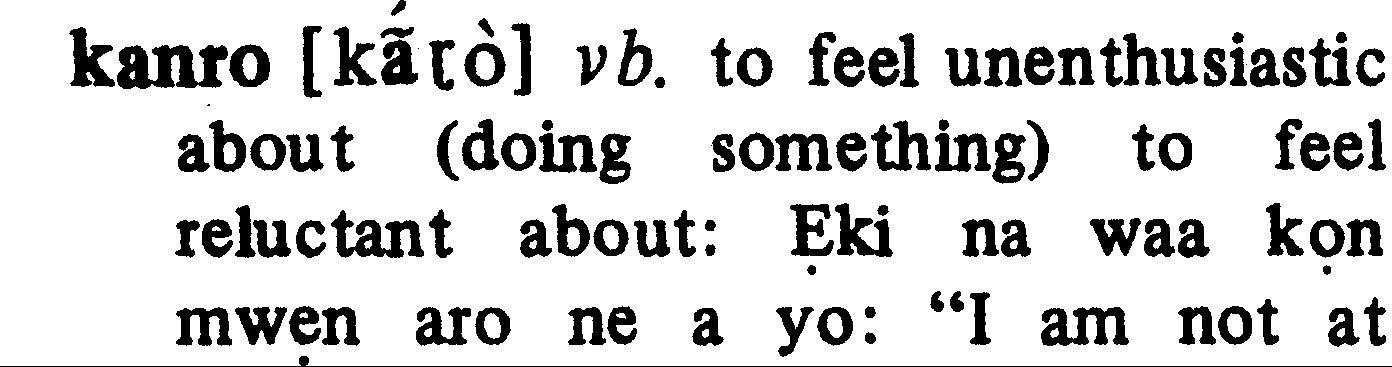
all eager about going to this market.”

kanmwan [kã̀ɱã́] vb. to be small.

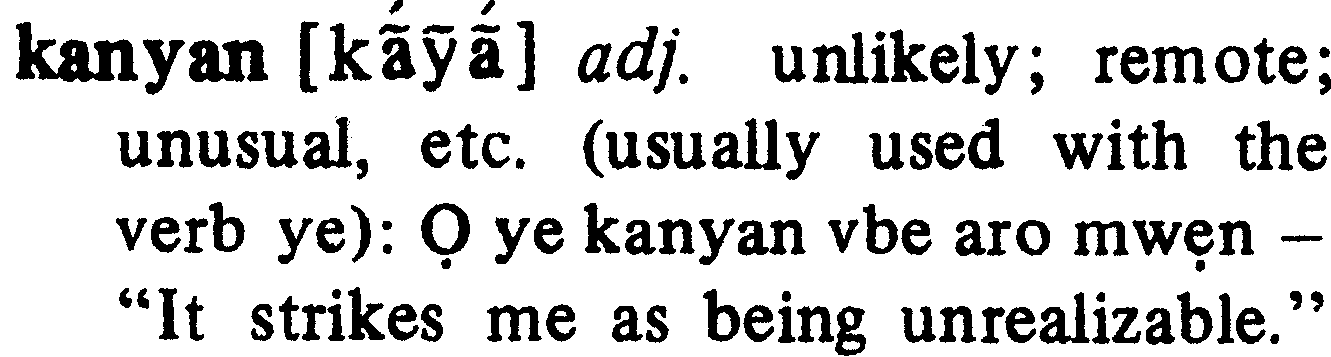
kanyan [kã́ỹã́] adj. unlikely; remote;
unusual, etc. (usually used with the
verb ye): Ọ ye kanyan vbe aro mwẹn ―
“It strikes me as being unrealizable.”
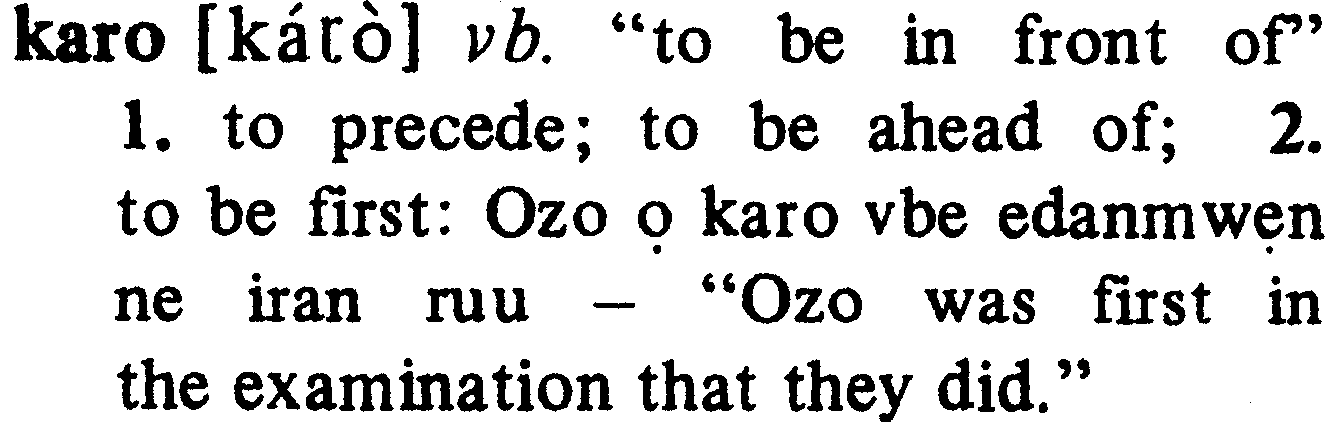
karo [káɽò] vb. “to be in front of”
1. to precede; to be ahead of; 2.
to be first: Ozo ọ karo vbe edanmwẹn
ne iran ruu ― “Ozo was first in
the examination that they did.”
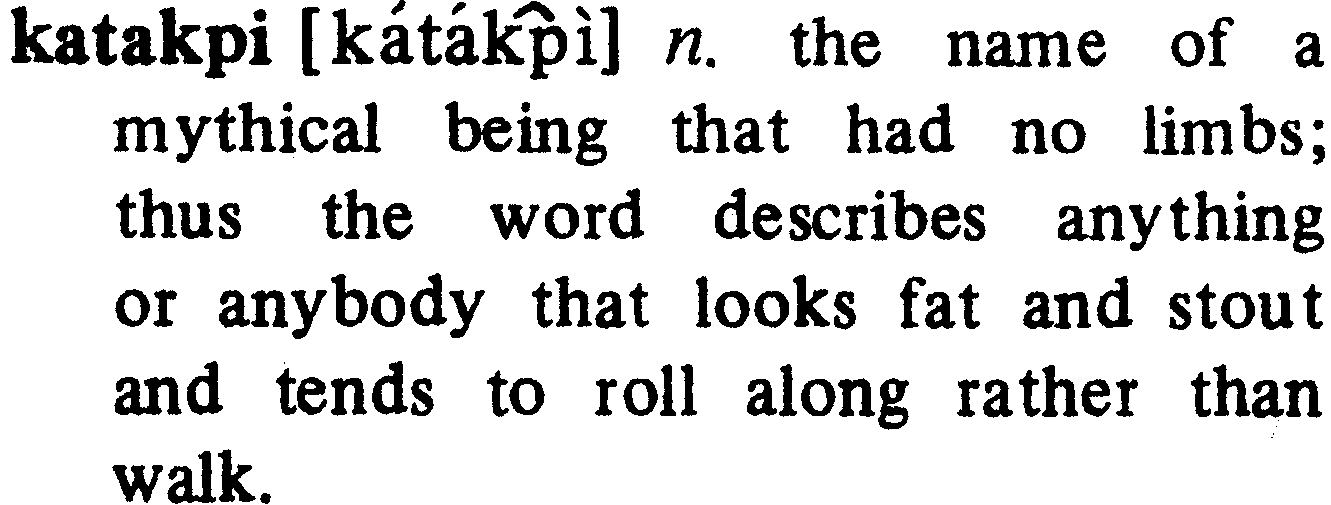
katakpi [káták͡pì] n. the name of a
mythical being that had no limbs;
thus the word describes anything
or anybody that looks fat and stout
and tends to roll along rather than
walk.
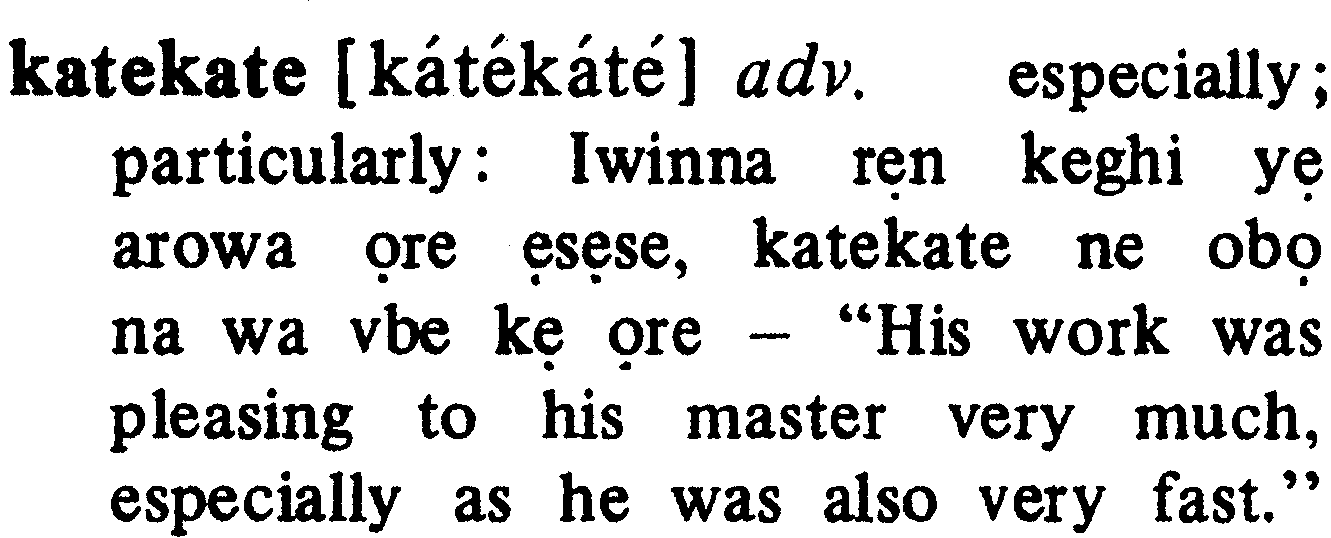
katekate [kátékáté] adv. especially;
particularly: Iwinna rẹn keghi yẹ
arowa ọre ẹsẹse, katekate ne obọ
na wa vbe kẹ ọre ― “His work was
pleasing to his master very much,
especially as he was also very fast.”
kayọn [kàyɔ̃́] vb. (< ka4 ― ayọn) to
buy wine.

ke1 [ké] vb. 1. to be located next to;
to be near: Owa mwẹn ọ ke ọghẹe ―
“My house is next to his.”

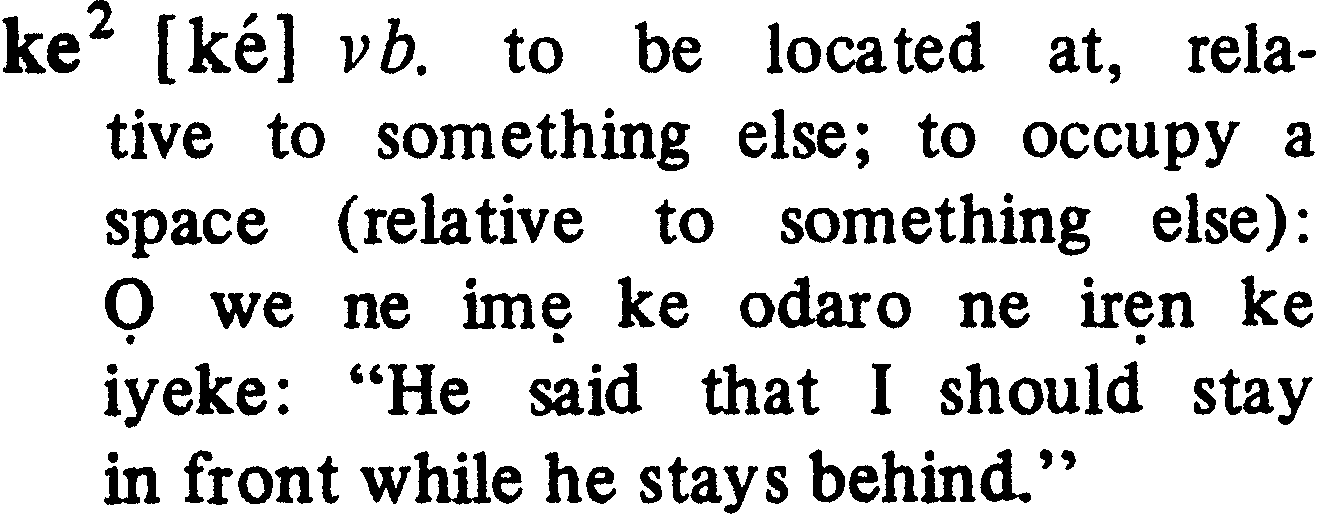
ke2 [ké] vb. to be located at, rela-
tive to something else; to occupy a
space (relative to something else):
Ọ we ne imẹ ke odaro ne irẹn ke
iyeke: “He said that I should stay
in front while he stays behind.”
ke3 [ké] aux. (often occurs with ghi)
sequential marker: indicates that the
action in the main verb occurred
sequentially after the action in the
verb of the preceding clause: Ọ
ghi sẹ evba, ọ ke totaa: “When he got
%%
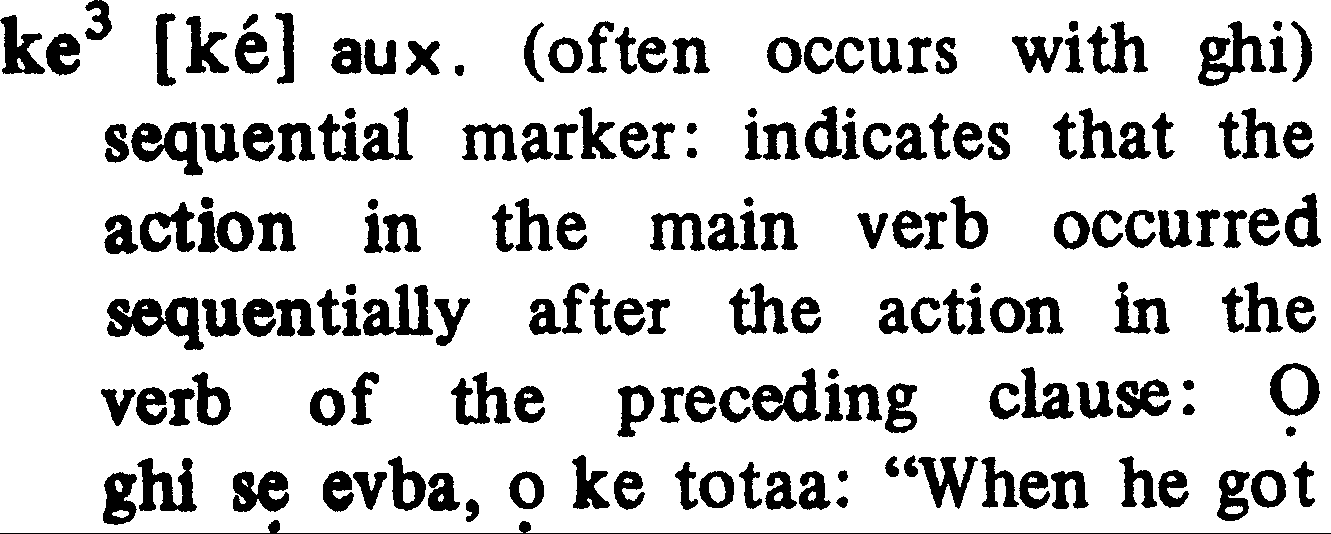
there; he then sat down.”

ke4 [ké] prep. 1. (occurs with verbs
of motion, such as yo, rre, dee, etc.)
indicates source or origin of motion:
from: Igue ọ ke rri iwinna: “It is
from the village that he comes to
work.”; 2. general “source” notion
(i.e. in respect to time and place).
Ẹgogo eva ẹre ọ ke winna: “He has
been working from 2 p.m., i.e. he
has been working since 2 p.m.”
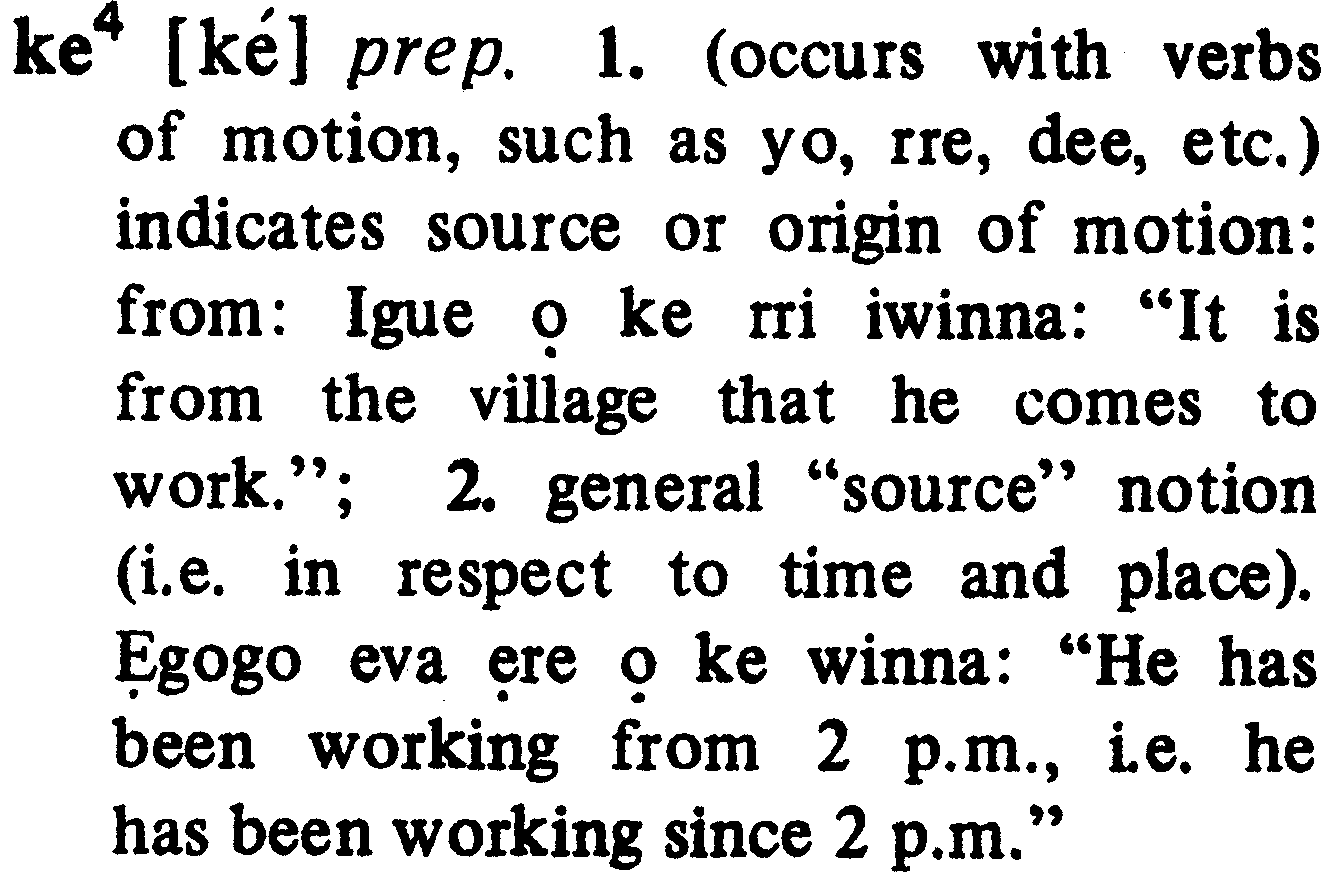
ke5 [kè] conj. serves to link up nouns,
pronouns and noun phrases: Ọ tie
enọdiọn ke enekherhe ― “He called
both the older and younger” (cf.
kevbe).
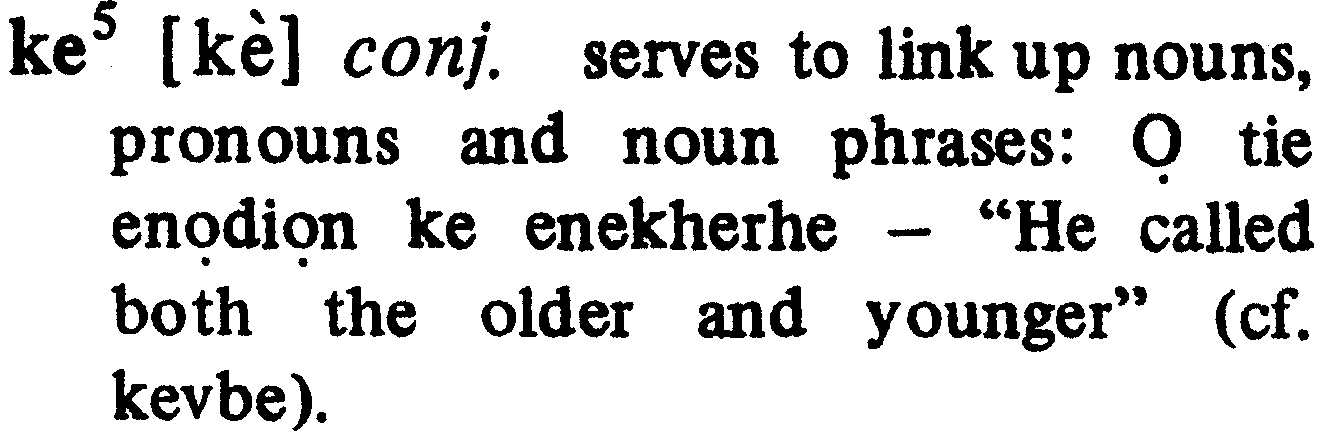
kee [kèé] vb. 1. to support on a pot-
rest (to cook): Mu iyan kee ne a re ―
“Put the yam on the pot-rest so that
we may eat: Cook the pot of yam
(over the fire) on the pot-rest for
us to eat.”. 2. to prop up, to hold
up in place: Ọ ya erhan kee ẹre ― “He
supported it with a stick.”^
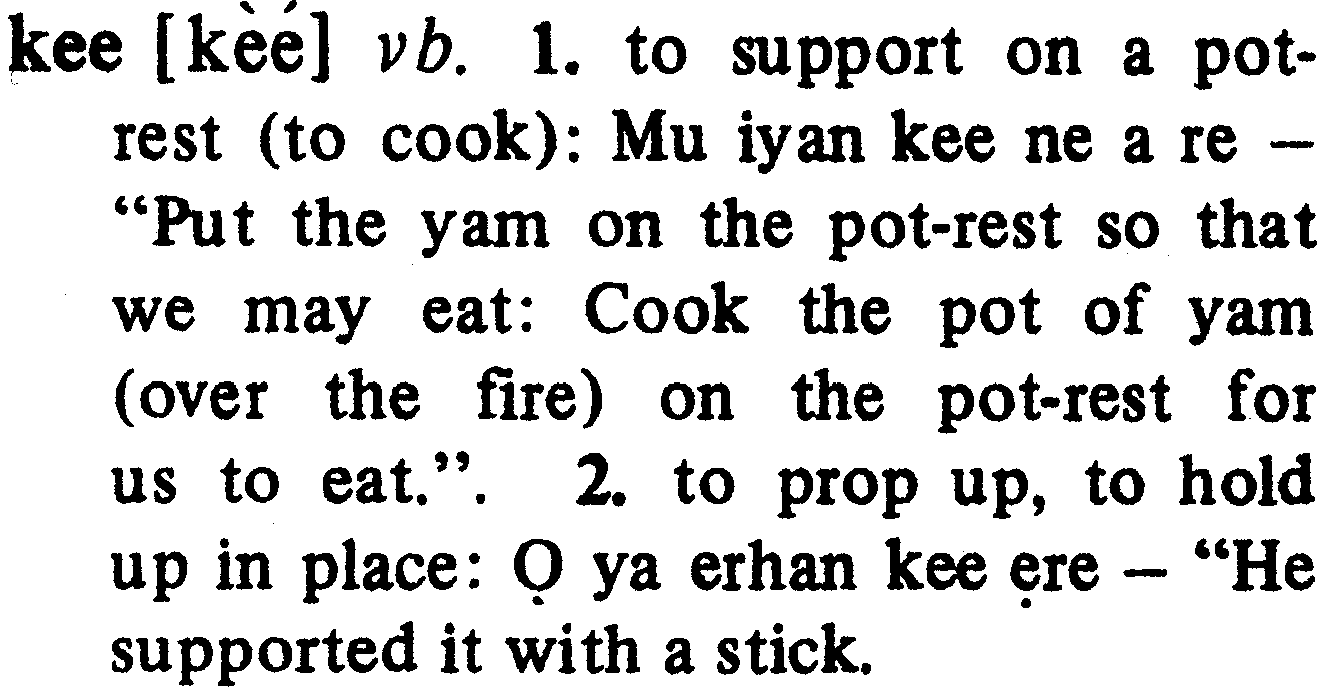
keegbe [kèègbé] vb. (< kee ― egbe)
“to prop up self”: to assume falsely
a higher status than one is entitled to.
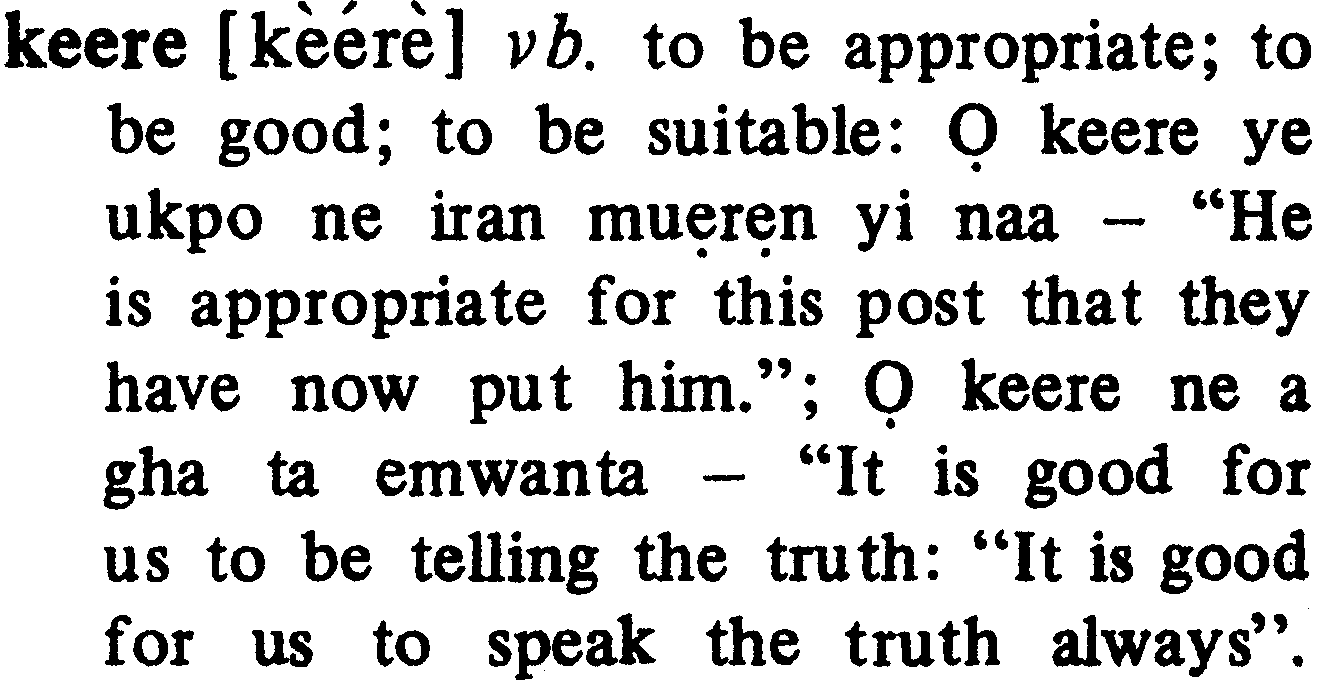
keere [kèérè] vb. to be appropriate; to
be good; to be suitable: Ọ keere ye
ukpo ne iran muẹrẹn yi naa ― “He
is appropriate for this post that they
have now put him.”; Ọ keere ne a
gha ta emwanta ― “It is good for
us to be telling the truth:”^ “It is good
for us to speak the truth always”.
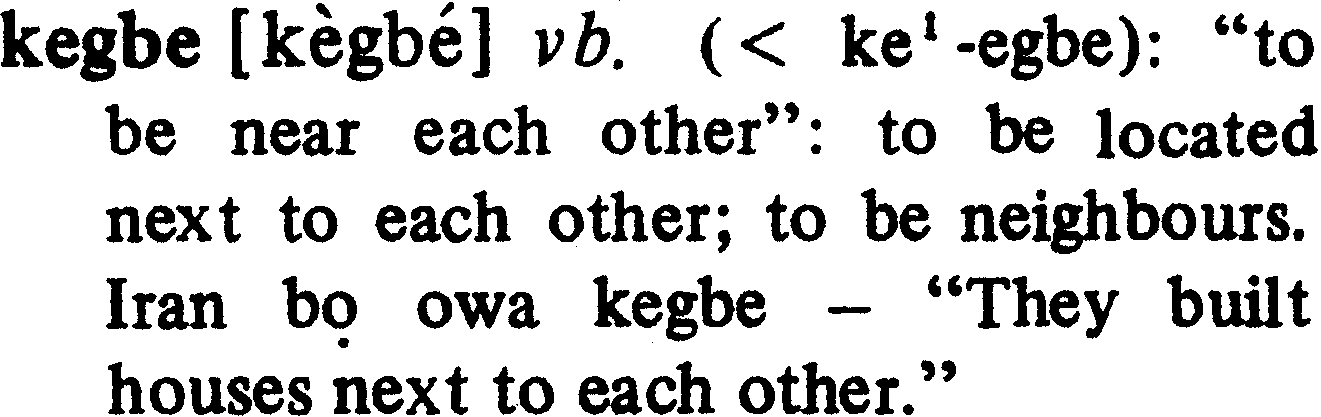
kegbe [kègbé] vb. (< ke1-egbe): “to
be near each other”: to be located
next to each other; to be neighbours.
Iran bọ owa kegbe ― “They built
houses next to each other.”
keke [kèké] vb. to jostle; to push
against: Ọ keke ẹre fi ẹkhokho ― “He
$Page 082$

jostled her into a corner.”

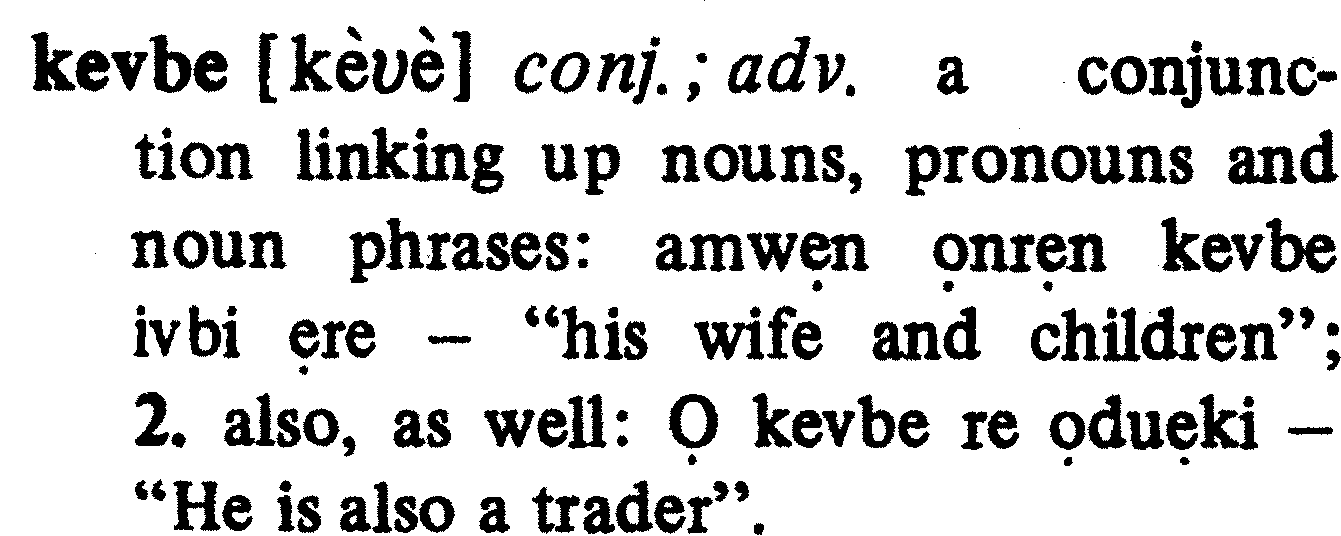
kevbe [kèʋè] conj.; adv. a conjunc-
tion linking up nouns, pronouns and
noun phrases: amwẹn ọnrẹn kevbe
ivbi ẹre ― “his wife and children”;
2. also, as well: Ọ kevbe re ọduẹki ―
“He is also a trader”.
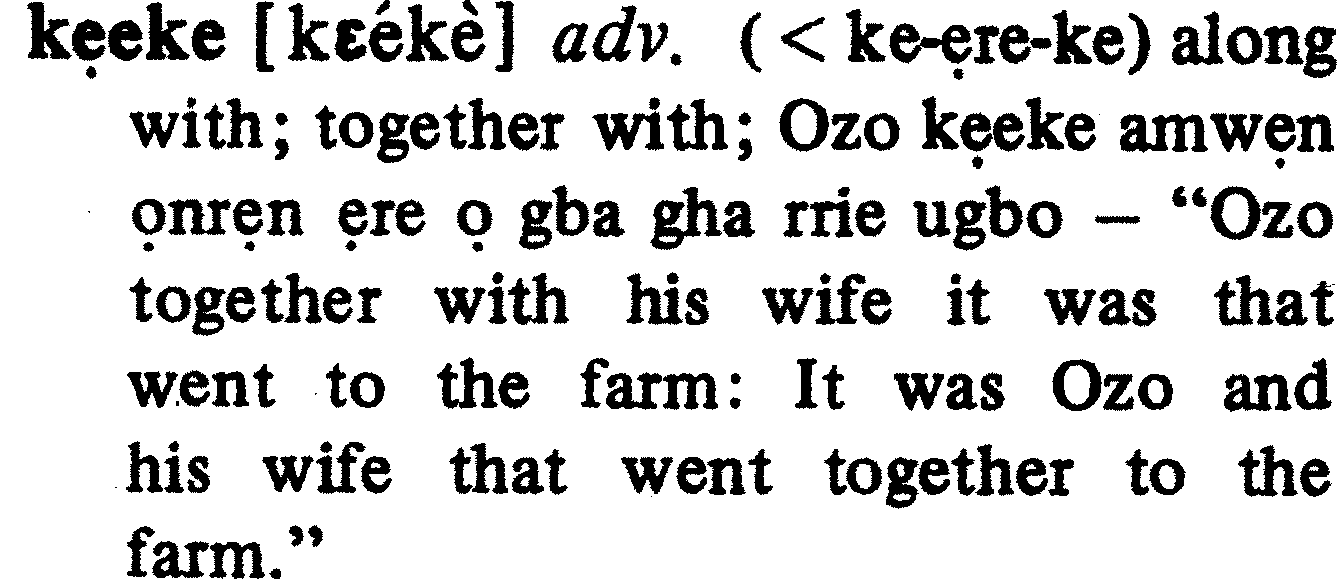
kẹeke [kɛékè] adv. (< ke-ẹre-ke) along
with; together with; Ozo kẹeke amwẹn
ọnrẹn ẹre ọ gba gha rrie ugbo ― “Ozo
together with his wife it was that
went to the farm: It was Ozo and
his wife that went together to the
farm.”
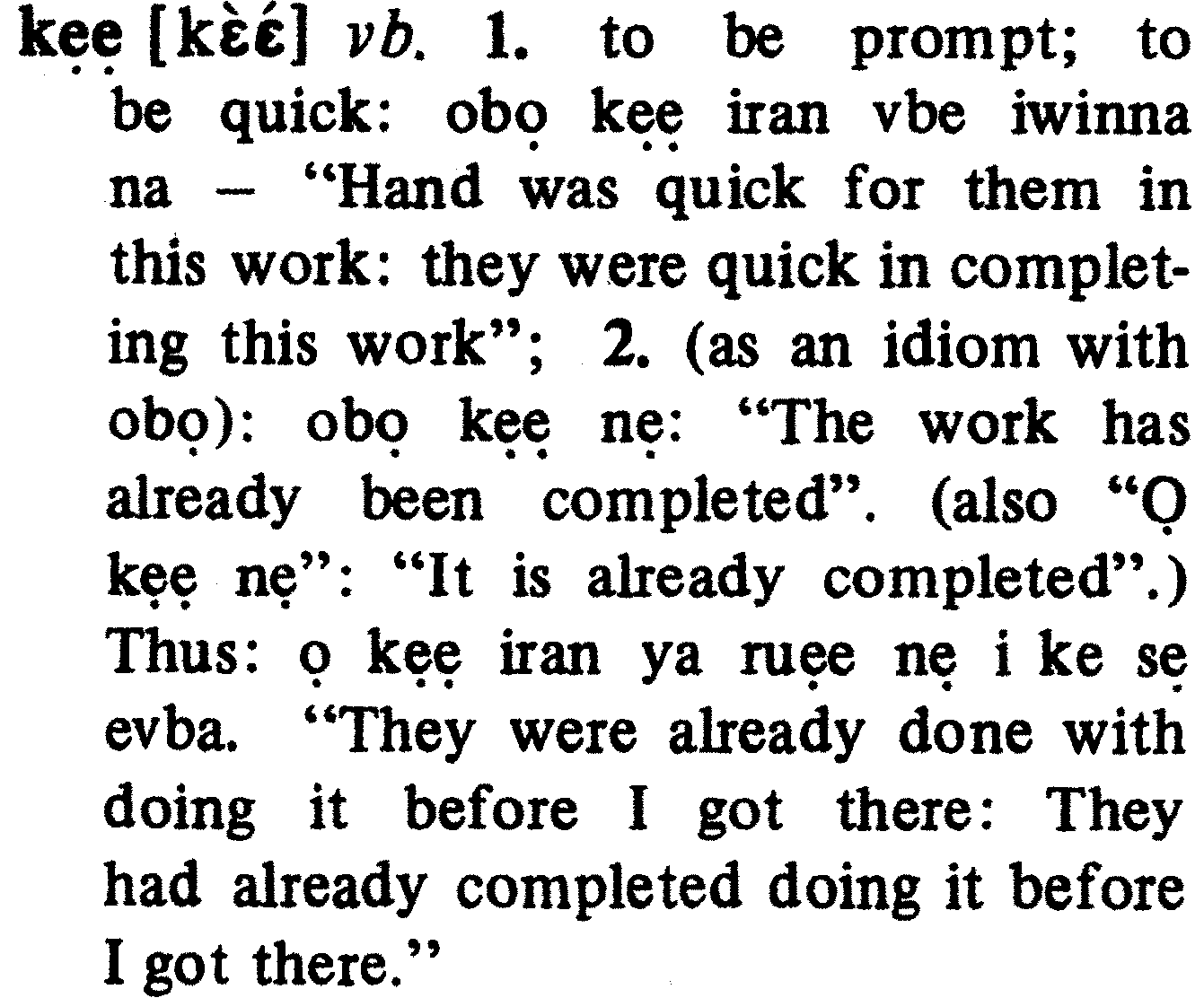
kẹẹ [kɛ̀ɛ́] vb. 1. to be prompt; to
be quick: obọ kẹẹ iran vbe iwinna
na ― “Hand was quick for them in
this work: they were quick in complet-
ing this work”; 2. (as an idiom with
obọ): obọ kẹẹ nẹ: “The work has
already been completed”. (also “Ọ
kẹẹ nẹ”: “It is already completed”.)
Thus: ọ kẹẹ iran ya ruẹe nẹ i ke sẹ
evba. “They were already done with
doing it before I got there: They
had already completed doing it before
I got there.”
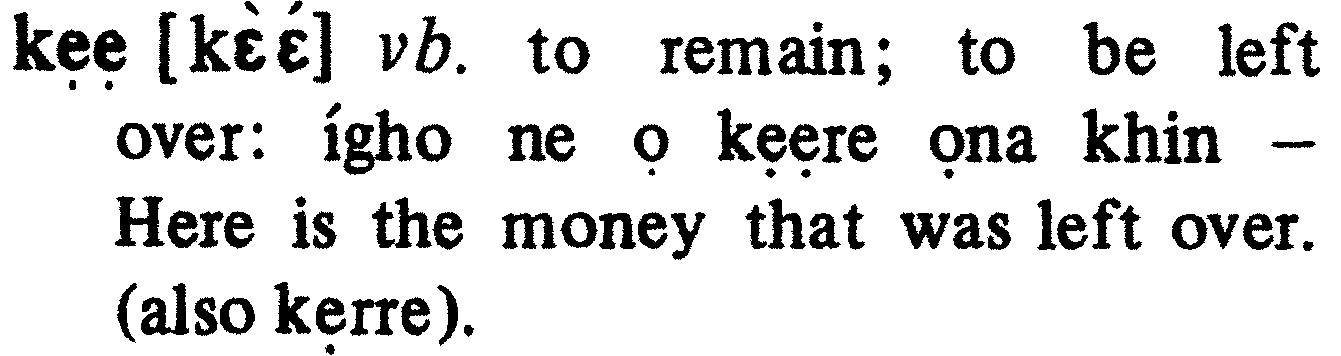
kẹẹ [kɛ̀ɛ́] vb. to remain; to be left
over: ígho ne ọ kẹẹre ọna khin ―
Here is the money that was left over.
(also kẹrre).
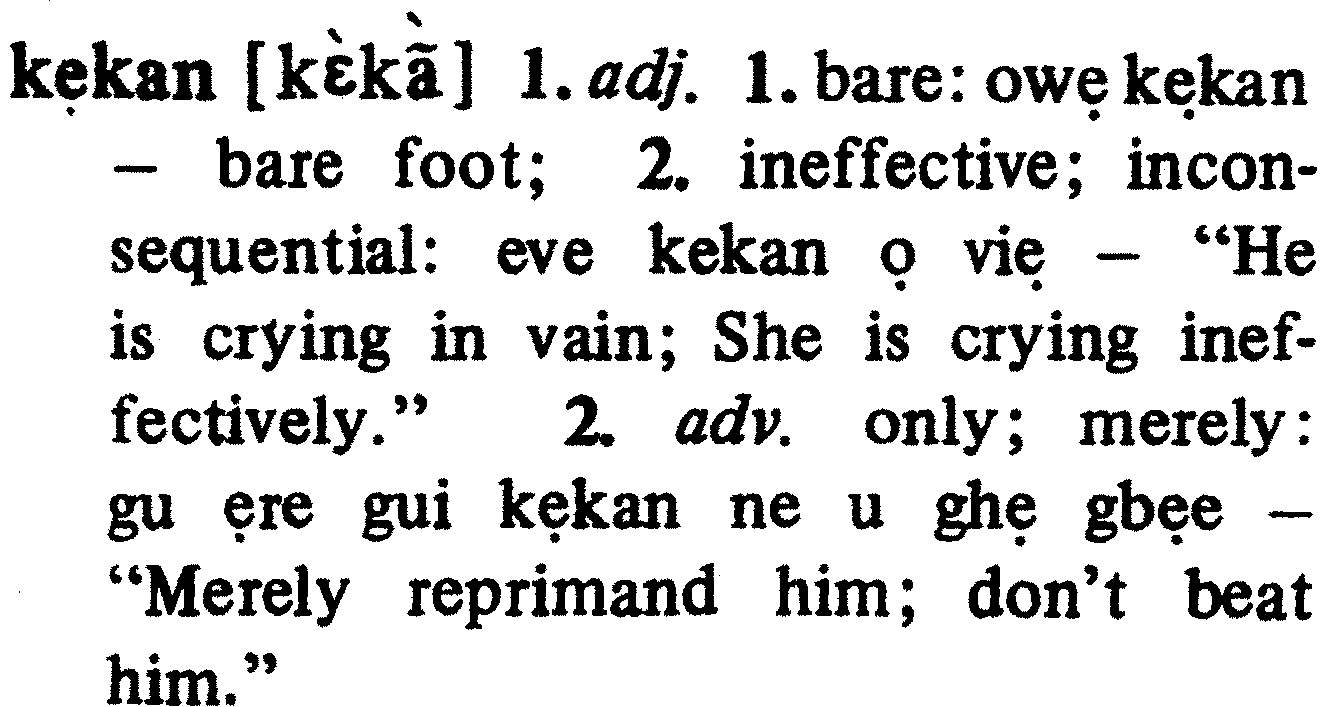
kẹkan [kɛ̀kã̀] 1. adj. 1. bare: owẹ kẹkan
― bare foot; 2. ineffective; incon-
sequential: eve kekan ọ viẹ ― “He
is crying in vain; She is crying inef-
fectively.” 2. adv. only; merely:
gu ẹre gui kẹkan ne u ghẹ gbẹe ―
“Merely reprimand him; don’t beat
him.”
kẹkẹ [kɛ̀kɛ́] vb. to rot; to become
rotten.

kẹkẹrẹkẹ [kɛ̀kɛ̀ɽɛ́kɛ̀] adv. describes the
%%

crowing of a rooster.

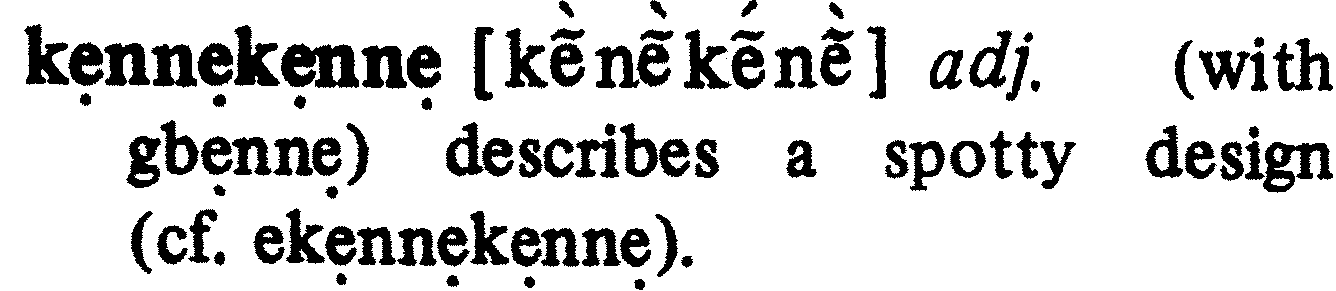
kẹnnẹkẹnnẹ [kẽ̀nẽ̀kẽ́nẽ̀] adj. (with
gbẹnnẹ) describes a spotty design
(cf. ekẹnnẹkẹnnẹ).
kẹrre [kɛ̀ré] vb. to remain; to be left
over. (cf. kẹẹ).

(e)kẹtẹkẹtẹ [kɛ́tɛ́kɛ́tɛ́] n. ass; donkey.
(cf. ekẹtẹkẹtẹ).

kẹtin [kɛ̀tín] vb. (< koo ― ẹtin) “to
gather strength”: 1. to rest, to relax;
2. to give up; to stop; 3. to die.

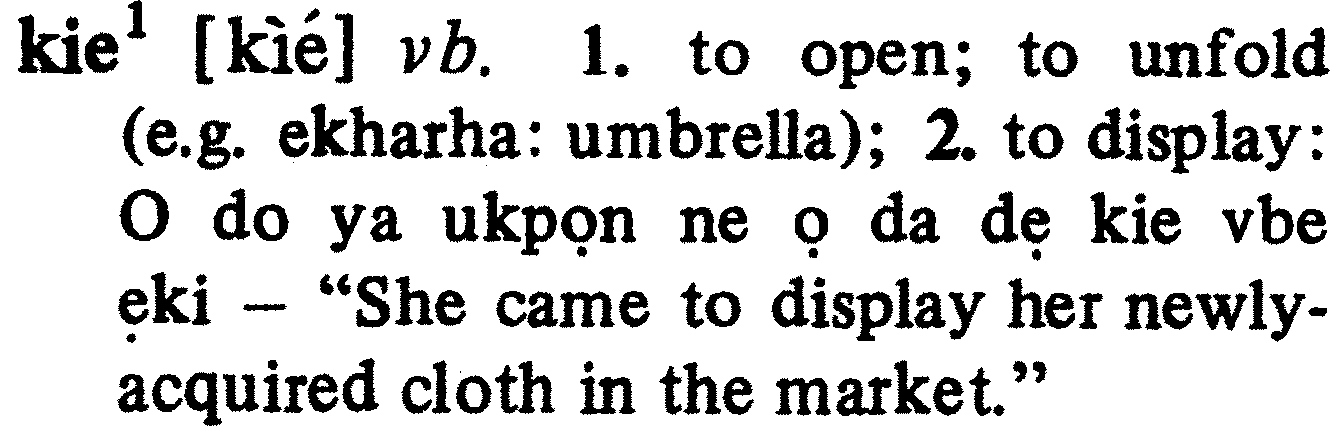
kie1 [kìé] vb. 1. to open; to unfold
(e.g. ekharha: umbrella); 2. to display:
O do ya ukpọn ne ọ da dẹ kie vbe
ẹki ― “She came to display her newly-
acquired cloth in the market.”
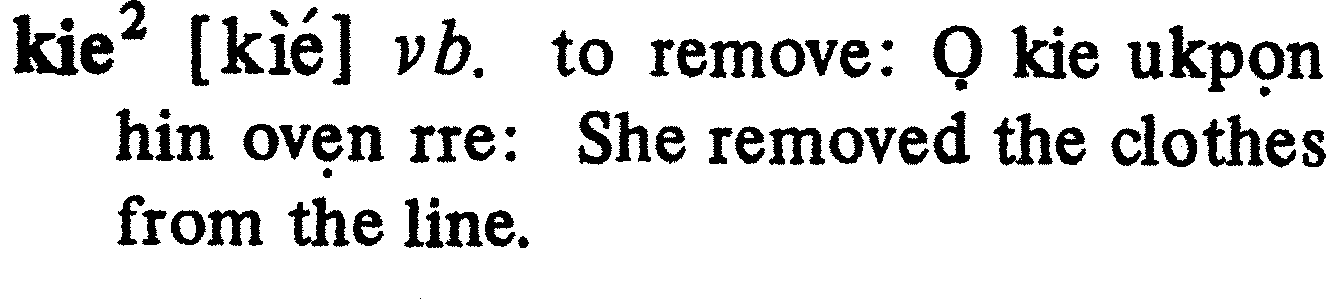
kie2 [kìé] vb. to remove: Ọ kie ukpọn
hin ovẹn rre: She removed the clothes
from the line.
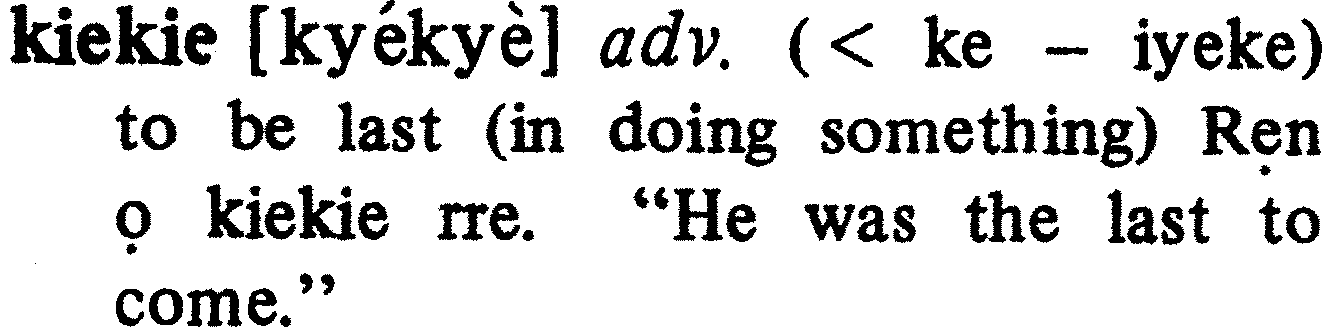
kiekie [kyékyè] adv. (< ke ― iyeke)
to be last (in doing something) Rẹn
ọ kiekie rre. “He was the last to
come.”
kigho [kíɣó] vb. (< ka ― ígho) “to
count money”; to reckon money.

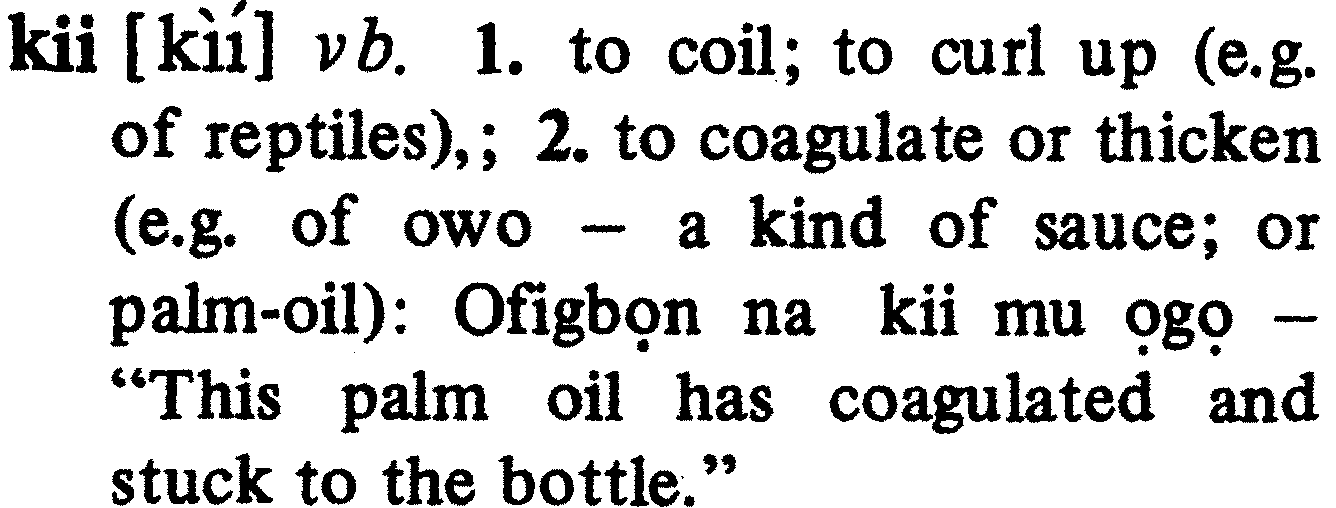
kii [kìí] vb. 1. to coil; to curl up (e.g.
of reptiles),; 2. to coagulate or thicken
(e.g. of owo ― a kind of sauce; or
palm-oil): Ofigbọn na kii mu ọgọ ―
“This palm oil has coagulated and
stuck to the bottle.”
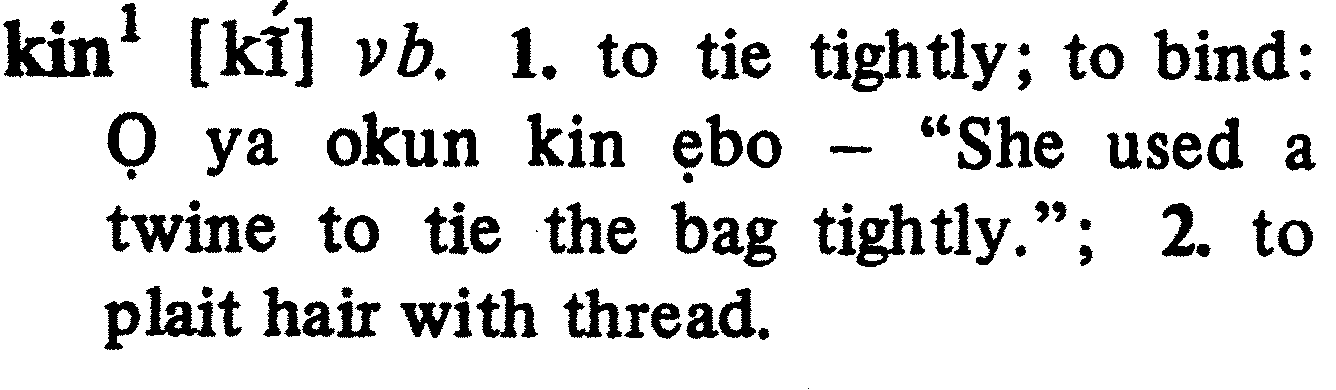
kin1 [kĩ́] vb. 1. to tie tightly; to bind:
Ọ ya okun kin ẹbo ― “She used a
twine to tie the bag tightly.”; 2. to
plait hair with thread.
kin2 [kĩ́] vb. 1. to look for (fallen)
fruits at the base of a tree; 2. to
examine traps for catch.
$Page 083$

kinmwin [kĩ̀ɱĩ́] vb. to hit hard; to
strike hard.

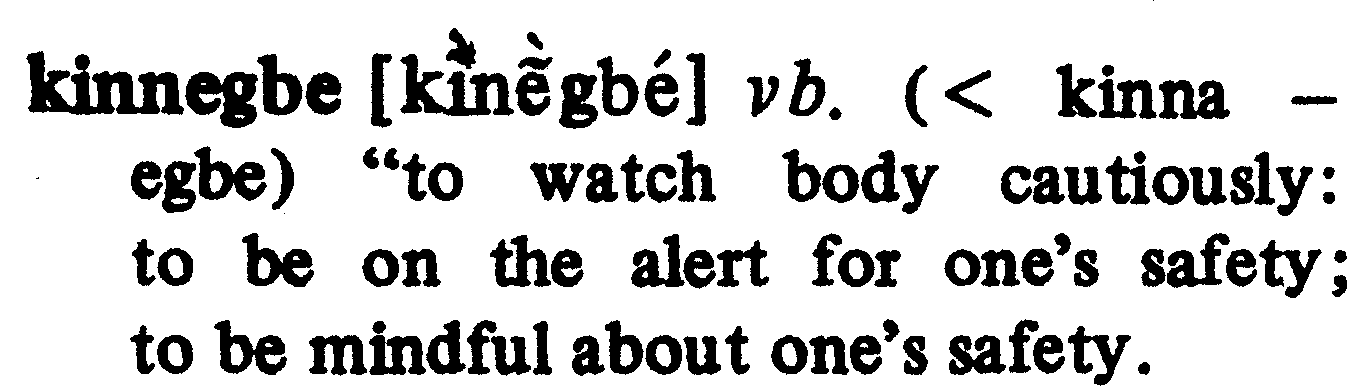
kinna [kĩ̀nã́] vb. to watch cautiously;
to spy on.

kinnegbe [kĩ̀nẽ̀gbé] vb. (< kinna ―
egbe) “to watch body cautiously”^:
to be on the alert for one’s safety;
to be mindful about one’s safety.
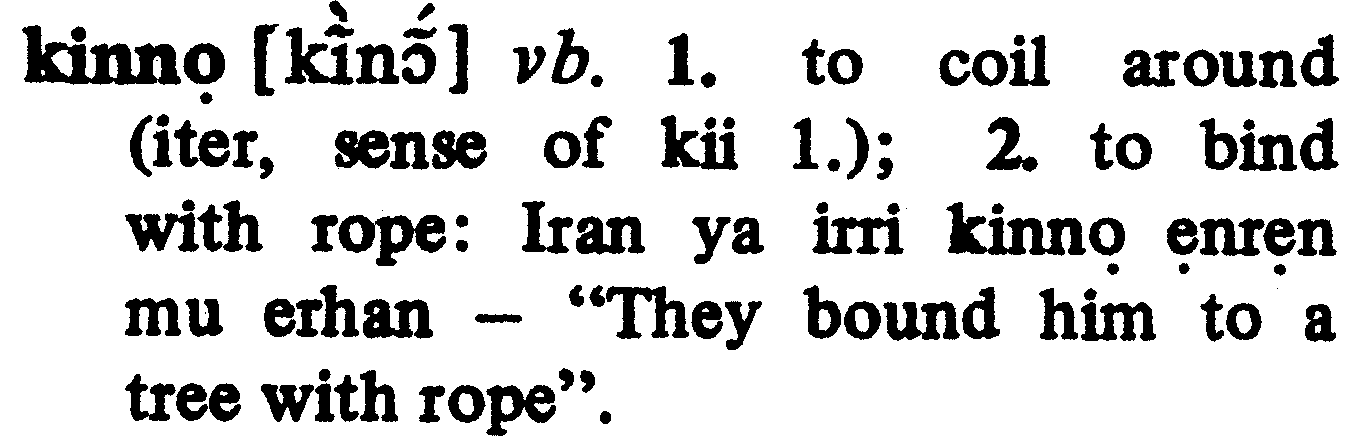
kinnọ [kĩ̀nɔ̃́] vb. 1. to coil around
(iter, sense of kii 1.); 2. to bind
with rope: Iran ya irri kinnọ ẹnrẹn
mu erhan ― “They bound him to a
tree with rope”.
kiokiokio [kyòkyòkyò] adv. describes
a peel of laughter.

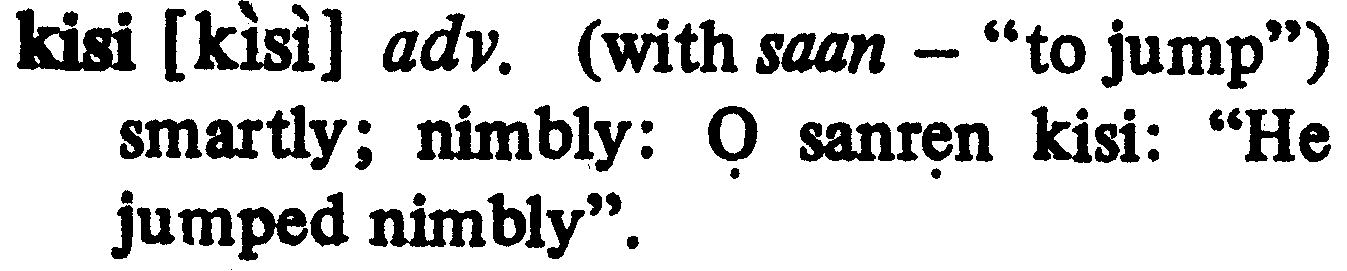
kisi [kìsì] adv. (with saan ― “to jump”)
smartly; nimbly: Ọ sanrẹn kisi: “He
jumped nimbly”.
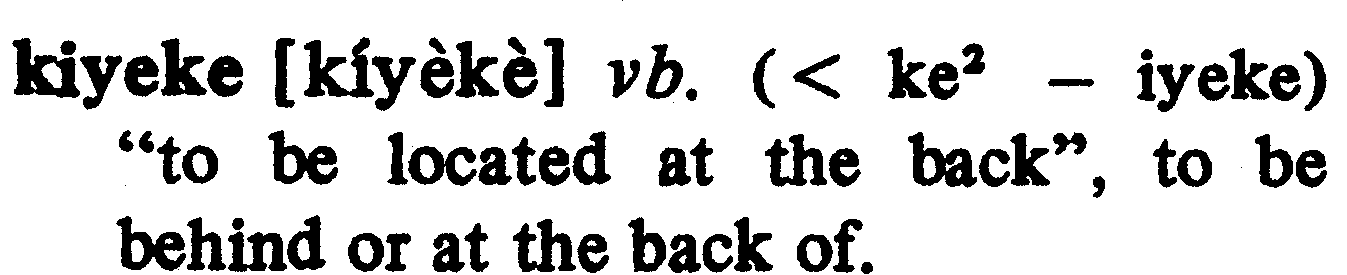
kiyeke [kíyèkè] vb. (< ke2 ― iyeke)
“to be located at the back”, to be
behind or at the back of.
kiza [kìzá] vb. 1. to be senseless; to be
stupid; 2. to be mad.

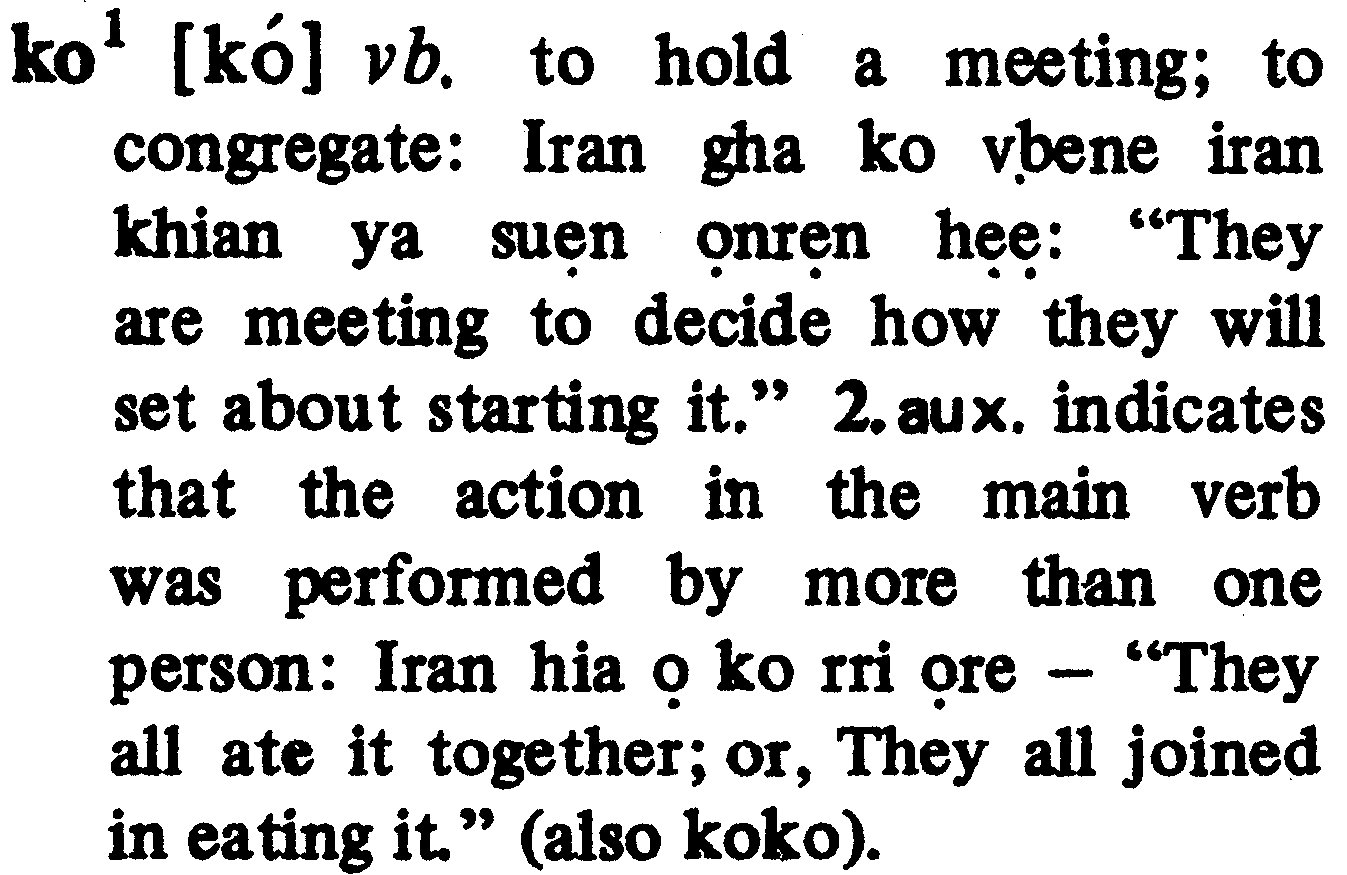
ko1 [kó] vb. to hold a meeting; to
congregate: Iran gha ko vbene iran
khian ya suẹn ọnrẹn hẹẹ: “They
are meeting to decide how they will
set about starting it.” 2. aux. indicates
that the action in the main verb
was performed by more than one
person: Iran hia ọ ko rri ọre ― “They
all ate it together; or, They all joined
in eating it.” (also koko).
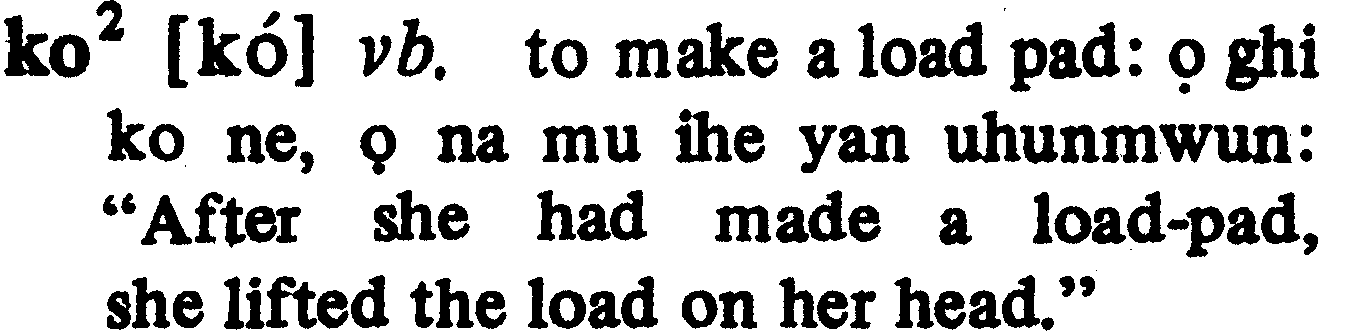
ko2 [kó] vb. to make aload pad: ọ ghi
ko ne, ọ na mu ihe yan uhunmwun:
“After she had made a load-pad,
she lifted the load on her head.”
kodaro [kòdárò] vb. (< ke2 ― odaro)
to be in front. (also karo).
%%

koikoi [koikoi] adv. describes the sound
of the pestle hitting the mortar during
the pounding of yam or other meal.

kokerhẹn [kòkéřɛ̃̀] vb. (< koko1 ―
erhẹn) “to assemble five” ― to make
a fire.

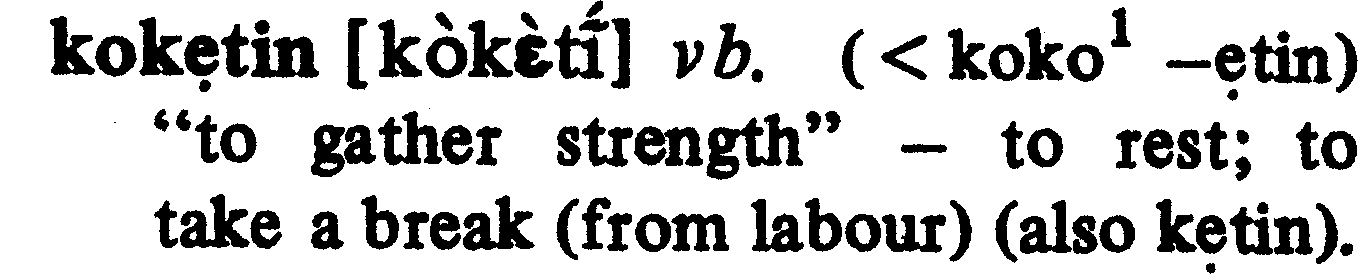
kokẹtin [kòkɛ̀tĩ́] vb. (< koko1 ― ẹtin)
“to gather strength” ― to rest; to
take a break (from labour) (also kẹtin).
koko1 [kòkó] 1. vb. to gather to-
gether; to assemble; to collect: Ọ na
koko iran ígho viọ: “He collected
their money and took it.” (Used only
in the transitive sense). 2. adv. same
as ko1: Iran koko kpaọ ― “They
left together”.
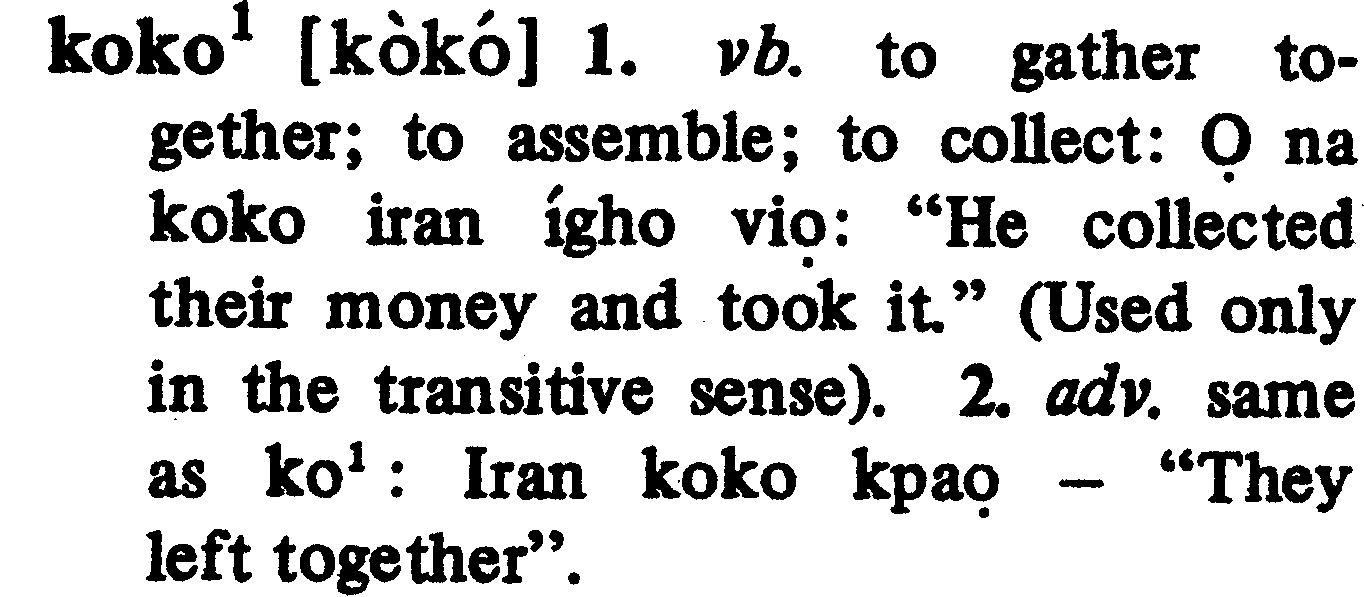
koko2 [kòkó] vb. 1. to care for; to
tend: Rẹn ọ koko ọmọ mẹ: She is
the one who tends the children for
me; 2. to feed; to provide for.
kokomẹmẹ [kókómɛ̃̀mɛ̃̀] n. cucumber
(cf. Engl.).

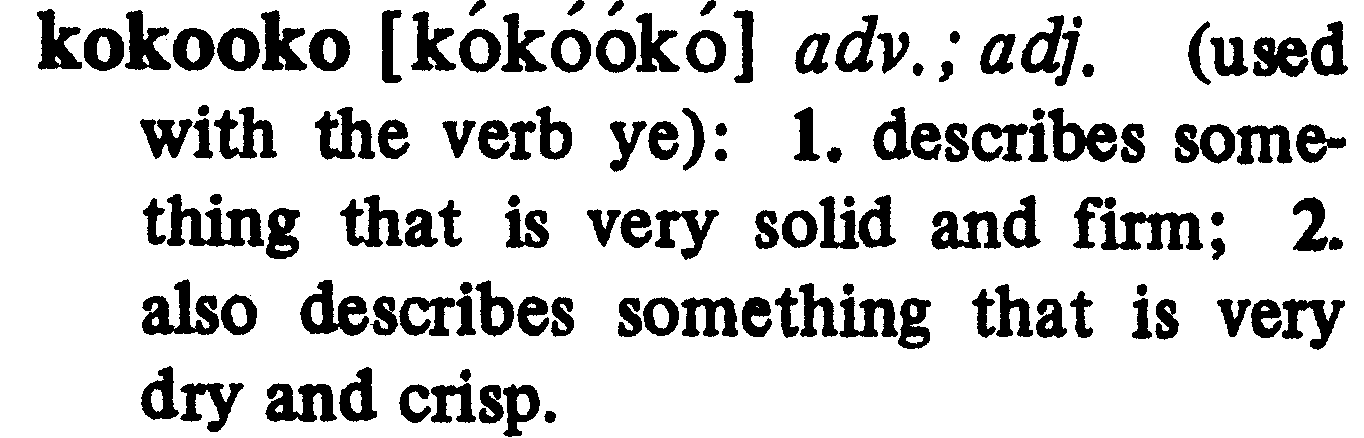
kokooko [kókóókó] adv.; adj. (used
with the verb ye): 1. describes some-
thing that is very solid and firm; 2.
also describes something that is very
dry and crisp.
koo [kòó] vb. to set fractured bones.

kotọ [kótɔ̀] vb. to be underneath or
below.

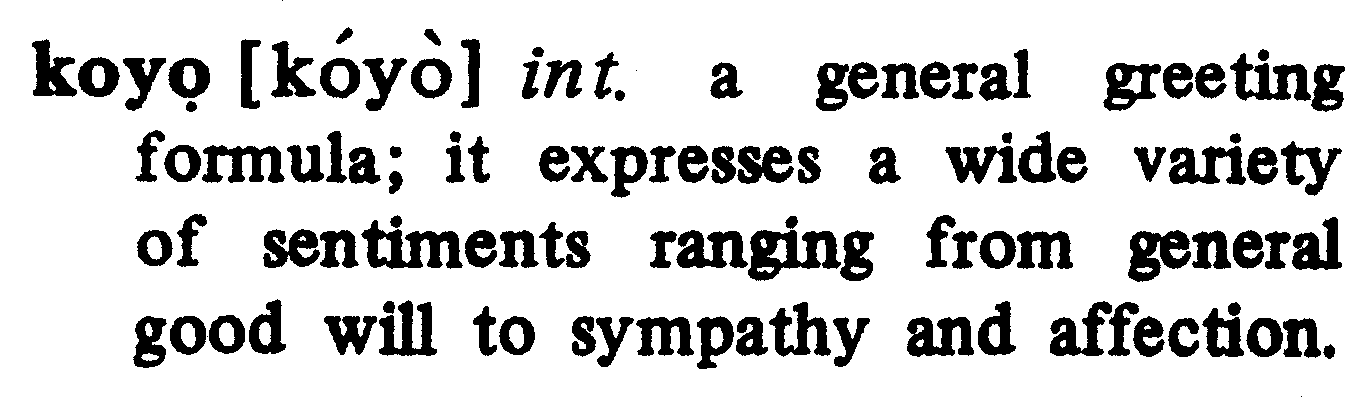
koyọ [kóyò] int. a general greeting
formula; it expresses a wide variety
of sentiments ranging from general
good will to sympathy and affection.
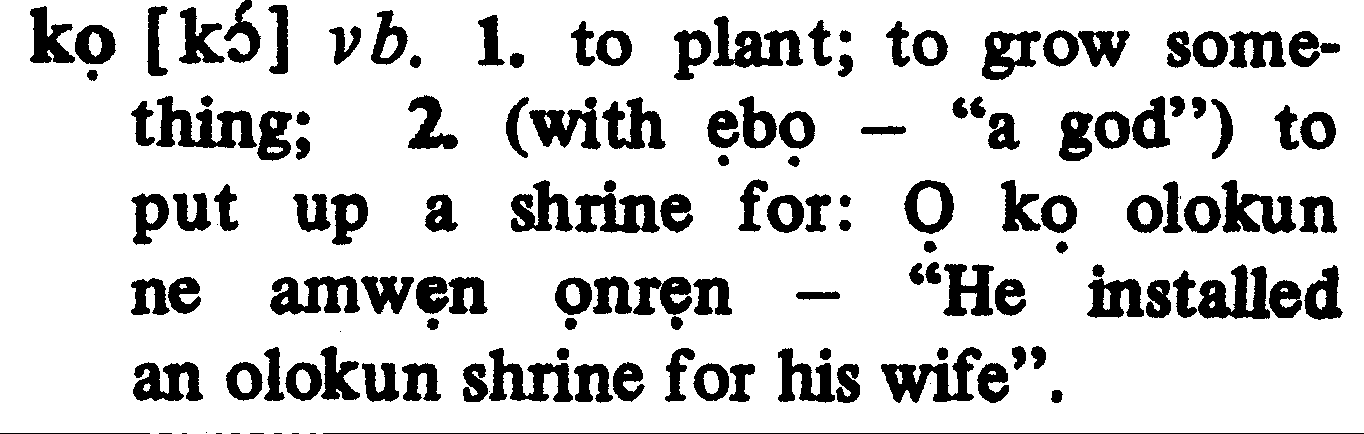
kọ [kɔ́] vb. 1. to plant; to grow some-
thing; 2. (with ẹbọ ― “a god”) to
put up a shrine for: Ọ kọ olokun
ne amwẹn ọnrẹn ― “He installed
an olokun shrine for his wife”.
$Page 084$
kọlọ [kɔ̀lɔ́] vb. to pick (fruit or leaves)
from a tree; to pluck.

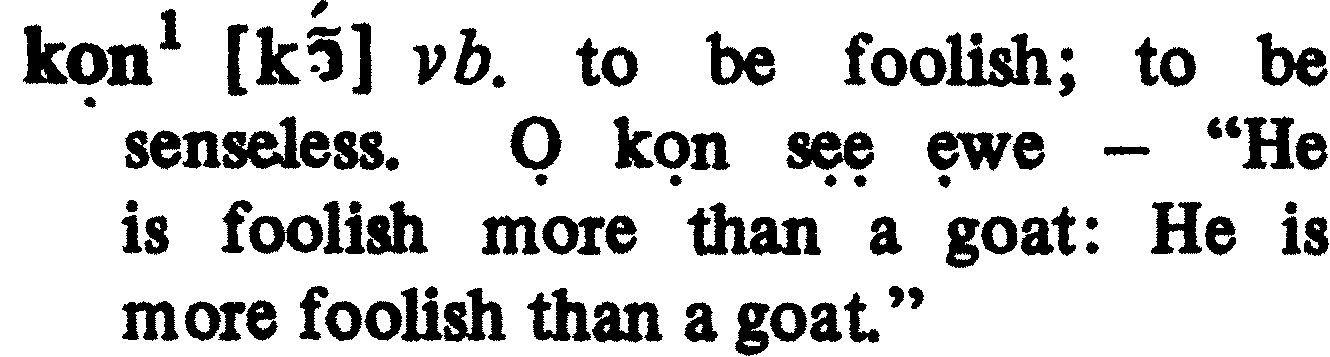
kọn1 [kɔ̃́] vb. to be foolish; to be
senseless. Ọ kọn sẹẹ ẹwe ― “He
is foolish more than a goat: He is
more foolish than a goat.”
kọn2 [kɔ̃́] vb. (of humans) to crawl
around on all fours; (of animals) to
graze.

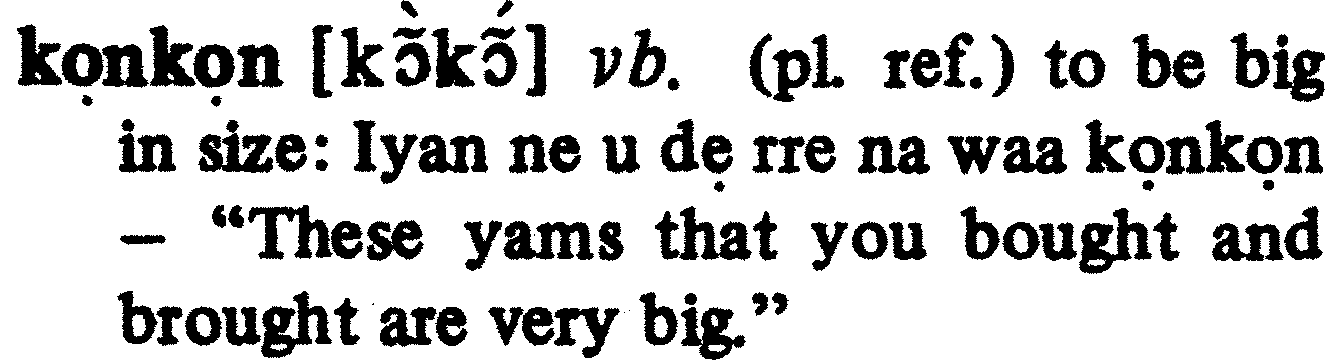
kọnkọn [kɔ̃̀kɔ̃́] vb. (pl. ref.) to be big
in size: Iyan ne u dẹ rre na waa kọnkọn
― “These yams that you bought and
brought are very big.”
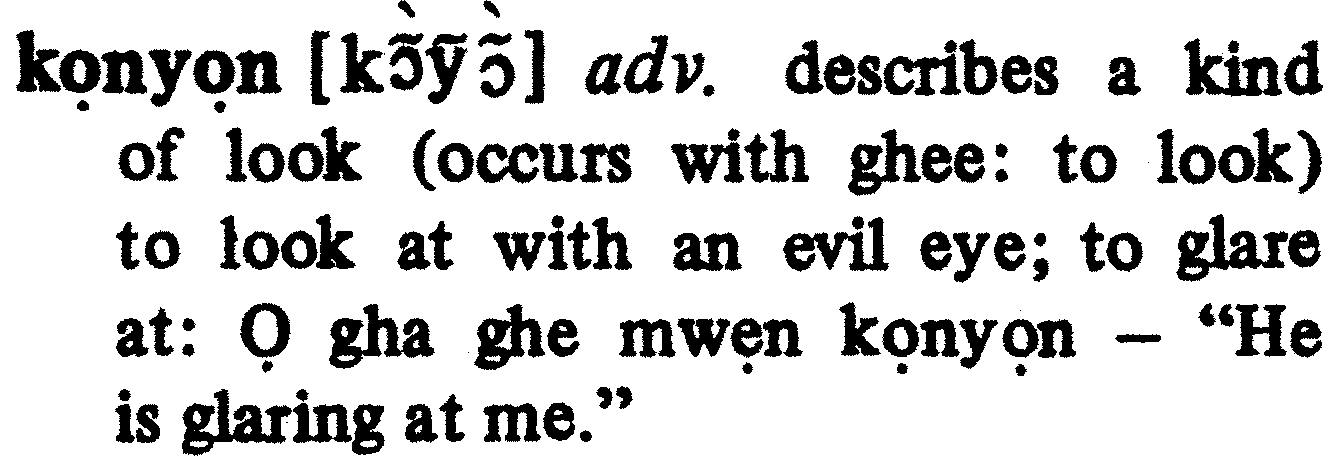
kọnyọn [kɔ̃̀ỹɔ̃̀] adv. describes a kind
of look (occurs with ghee: to look)
to look at with an evil eye; to glare
at: Ọ gha ghe mwẹn kọnyọn ― “He
is glaring at me.”
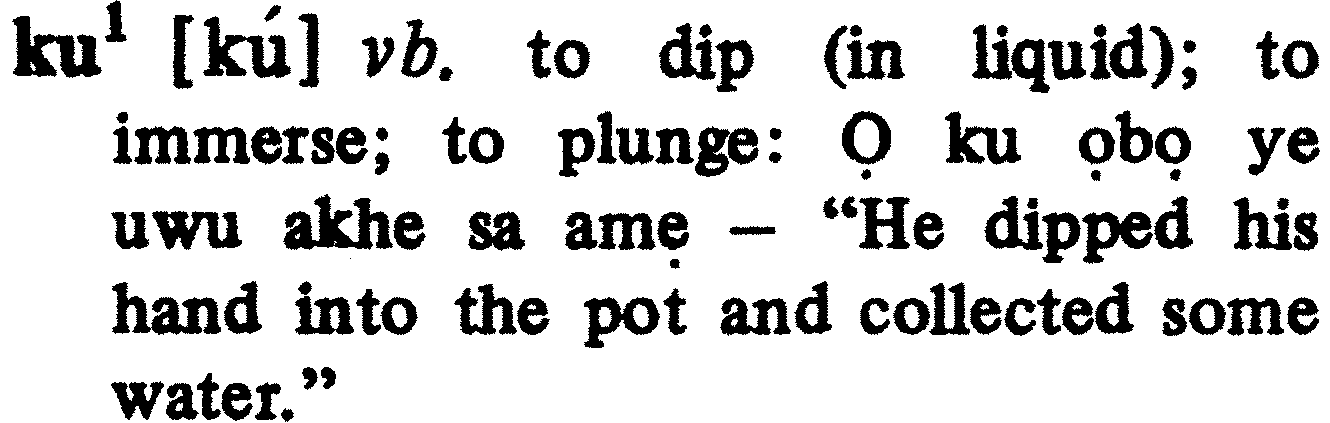
ku1 [kú] vb. to dip (in liquid); to
immerse; to plunge: Ọ ku ọbọ ye
uwu akhe sa amẹ ― “He dipped his
hand into the pot and collected some
water.”
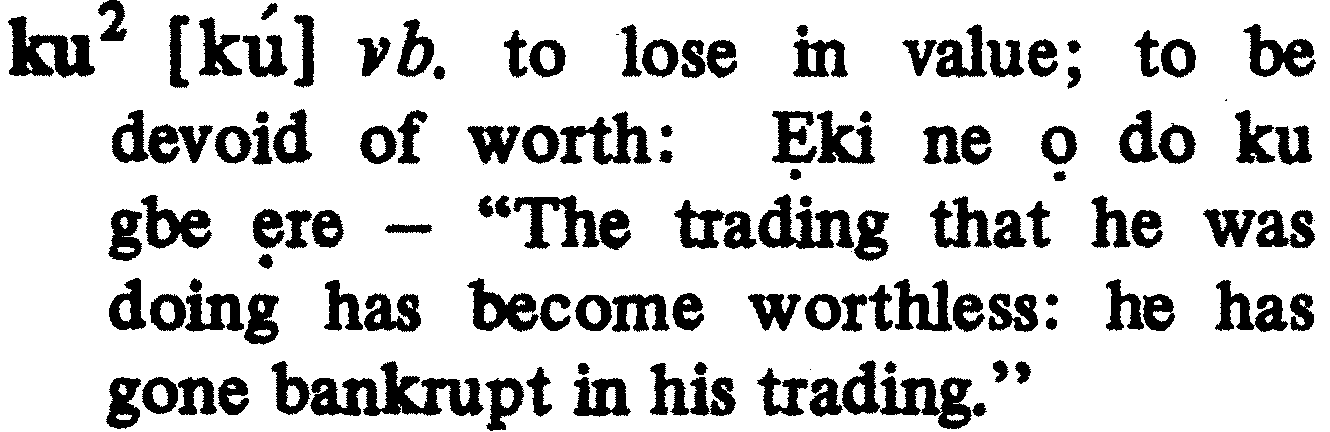
ku2 [kú] vb. to lose in value; to be
devoid of worth: Ẹki ne ọ do ku
gbe ẹre ― “The trading that he was
doing has become worthless: he has
gone bankrupt in his trading.”
ku3 [kú] vb. to join with; Iran ku
kugbe rri ọre: “They joined together
to eat it”.

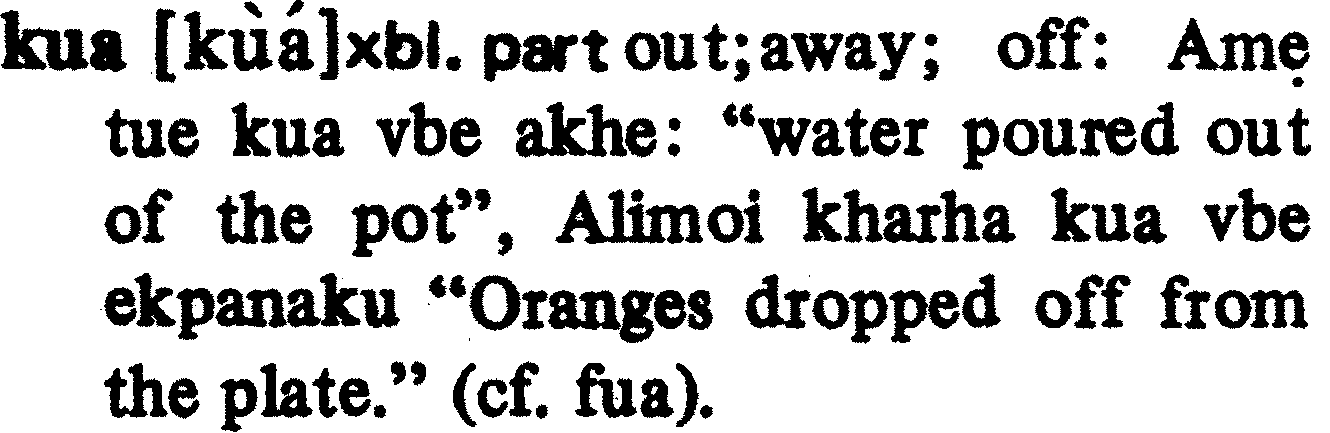
kua [kùá] xbl. part out; away; off: Amẹ
tue kua vbe akhe: “water poured out
of the pot”, Alimoi kharha kua vbe
ekpanaku “Oranges dropped off from
the plate.” (cf. fua).
kuakuakua [kwàkwàkwà] adv. de-
scribes a peal of laughter.

kuamẹ [kuámɛ̀] vb. (< kue ― amẹ)
%%

“to allow water” ― to become soggy;
to become unwholesomely or un-
pleasantly damp.

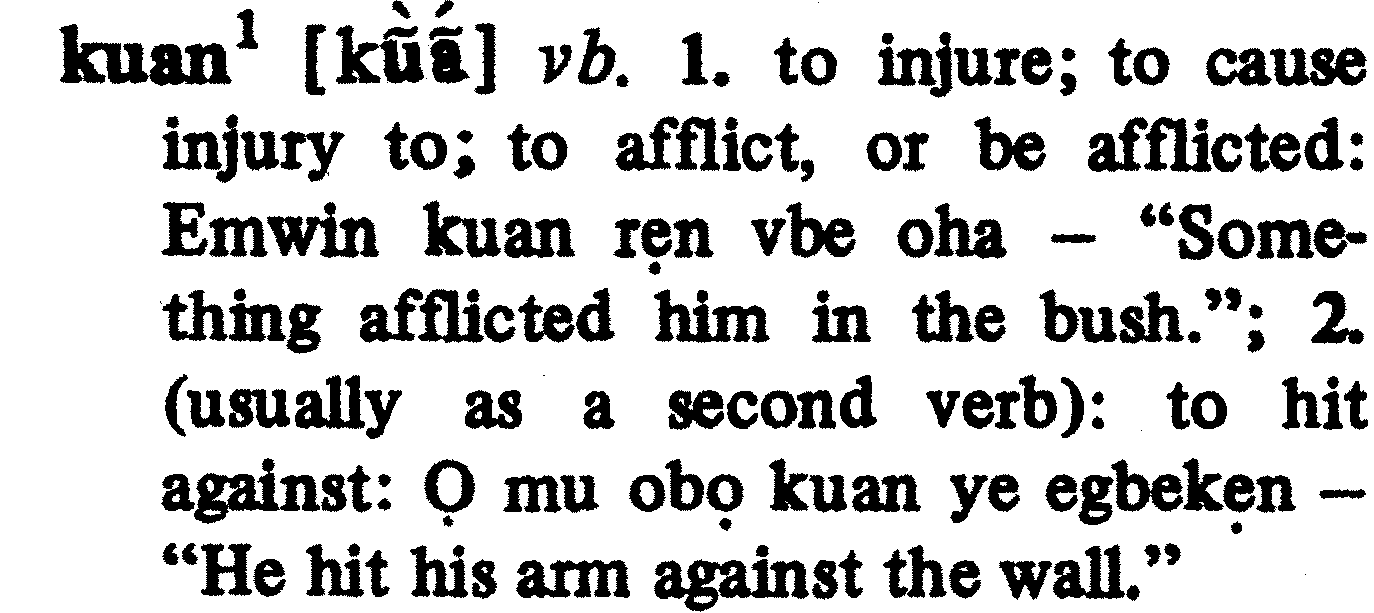
kuan1 [kũ̀ã́] vb. 1. to injure; to cause
injury to; to afflict, or be afflicted:
Emwin kuan rẹn vbe oha ― “Some-
thing afflicted him in the bush.”; 2.
(usually as a second verb): to hit
against: Ọ mu obọ kuan ye egbekẹn ―
“He hit his arm against the wall.”
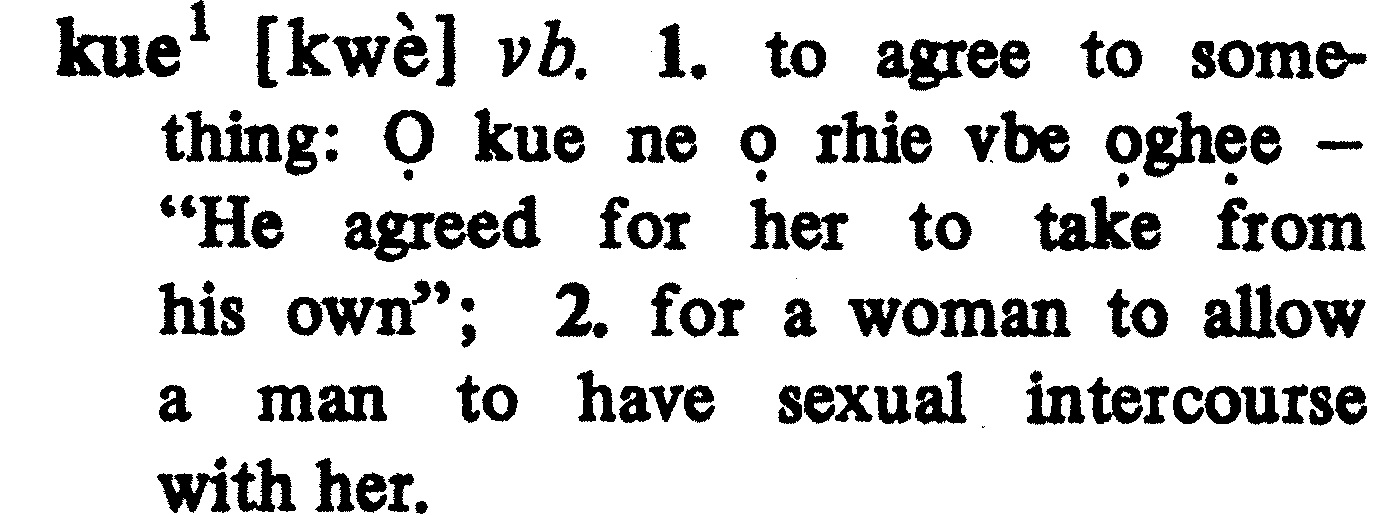
kue1 [kwè] vb. 1. to agree to some-
thing: Ọ kue ne ọ rhie vbe ọghẹe ―
“He agreed for her to take from
his own”; 2. for a woman to allow
a man to have sexual intercourse
with her.
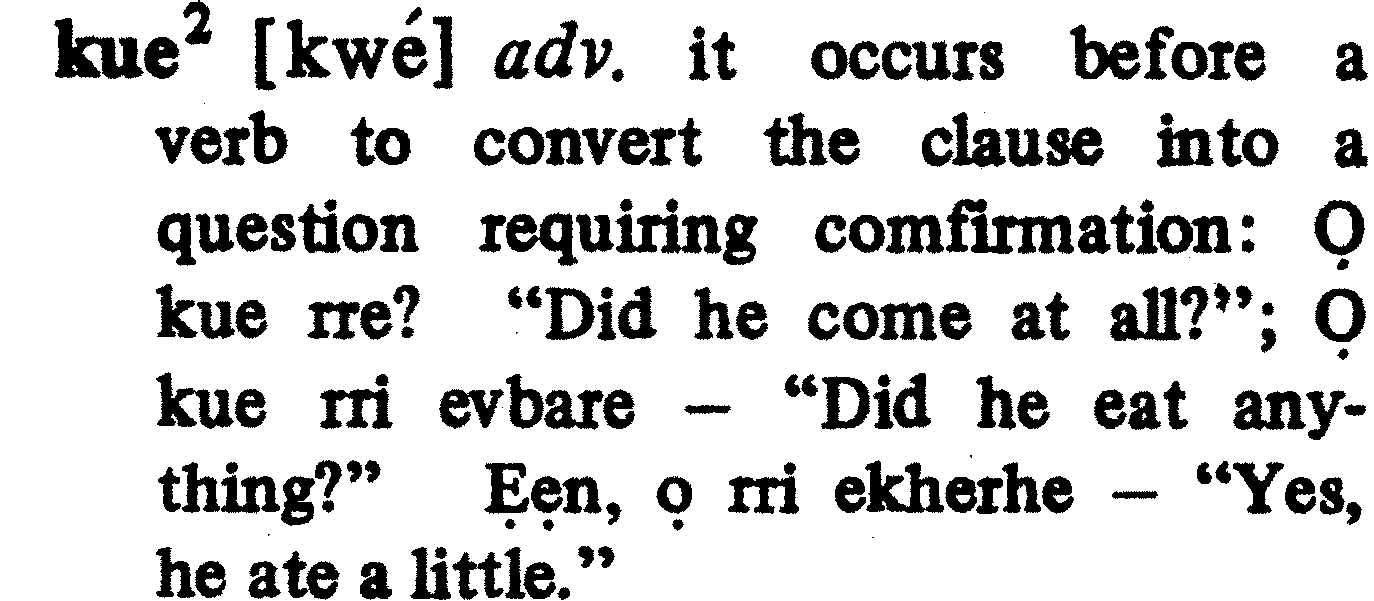
kue2 [kwé] adv. it occurs before a
verb to convert the clause into a
question requiring comfirmation: Ọ
kue rre? “Did he come at all?”; Ọ
kue rri evbare ― “Did he eat any-
thing?” Ẹẹn, ọ rri ekherhe ― “Yes,
he ate a little.”
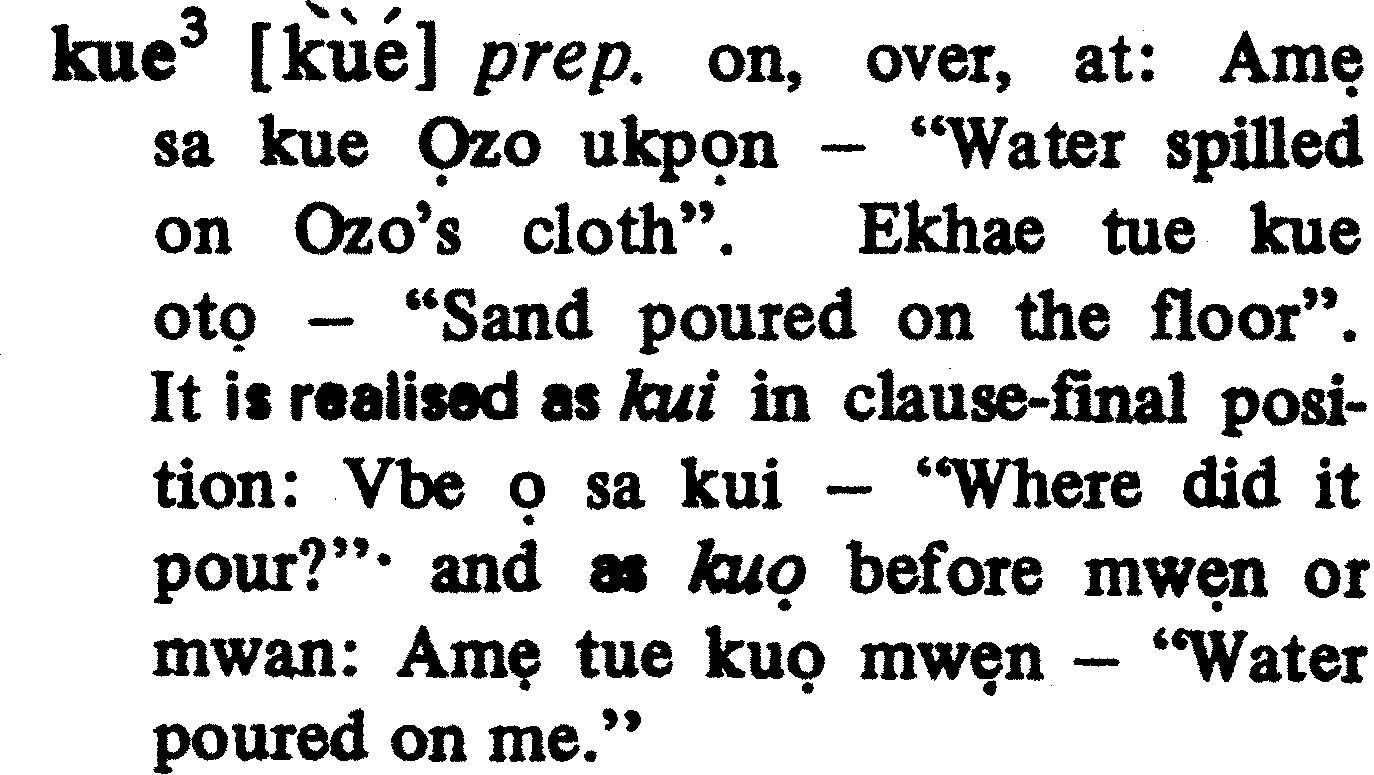
kue3 [kùé] prep. on, over, at: Amẹ
sa kue Ọzo ukpọn ― “Water spilled
on Ozo’s cloth”. Ekhae tue kue
otọ ― “Sand poured on the floor”.
It is realised as kui in clause-final posi-
tion: Vbe ọ sa kui ― “Where did it
pour?” and as kuọ before mwẹn or
mwan: Amẹ tue kuọ mwẹn ― “Water
poured on me.”
kuebe [kwèbé] vb. (< ku2 ― ebe) “to
be devoid of leaves”, (of a tree) loose
leaves; to become bare.

kuẹi [kwɛi] adv.; adj. describes some-
thing very small; iter.: kuẹikuẹi: very
tiny.

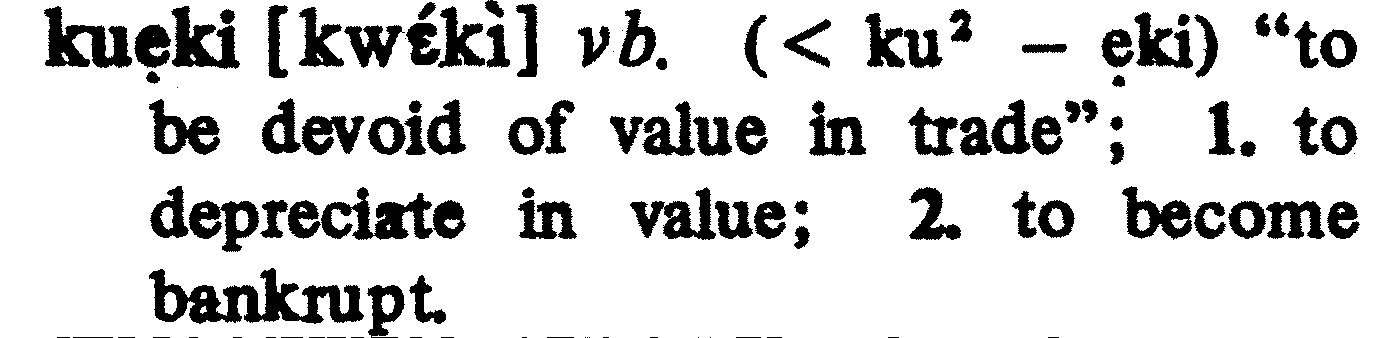
kuẹki [kwɛ́kì] vb. (< ku2 ― ẹki) “to
be devoid of value in trade”; 1. to
depreciate in value; 2. to become
bankrupt.
$Page 085$
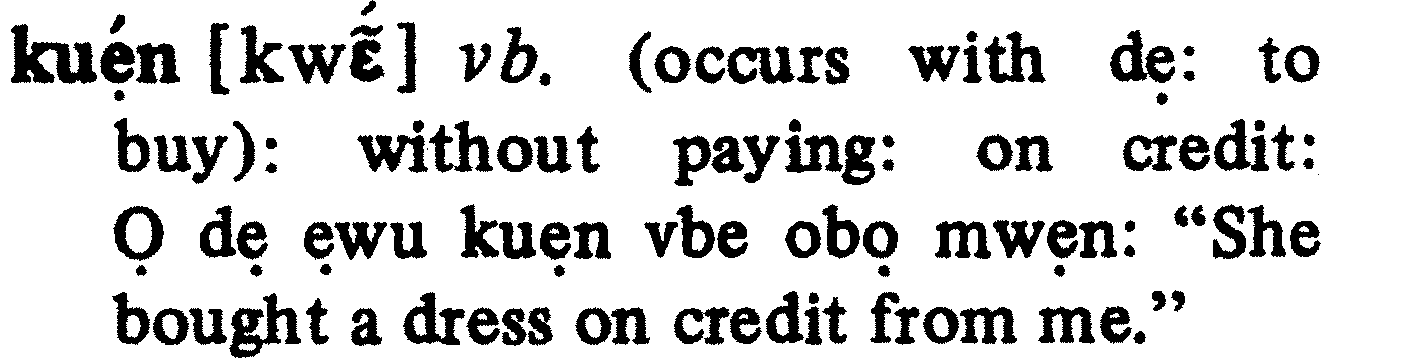
kuẹ́n [kwɛ̃́] vb. (occurs with dẹ: to
buy): without paying: on credit:
Ọ dẹ ẹwu kuẹn vbe obọ mwẹn: “She
bought a dress on credit from me.”
kùẹn [kwɛ̃̀ɛ̃́] vb. to curl (also sikuẹn).

kuẹnkhun [kwɛ̃́xũ̀] vb. (< kun-ekhun)
“to form a cripple”: to become im-
mobile; to be rendered motionless.

kuẹtin [kwɛ̀tĩ́] n. cf. kẹtin.

kugbakẹghẹrẹ [kúgbakɛ̀ɣɛ́ɽɛ] adv. cf.
ukugbakẹghẹrẹ.

kugbe1 [kùgbé] vb. to join together;
to unite (also kukugbe).

kugbe2 [kùgbé] adv. together.

kughudu [kúɣúdú] adj. describes some-
thing small and deep, like a little bowl.

kukugbe [kùkùgbé] vb. cf. kugbe1.

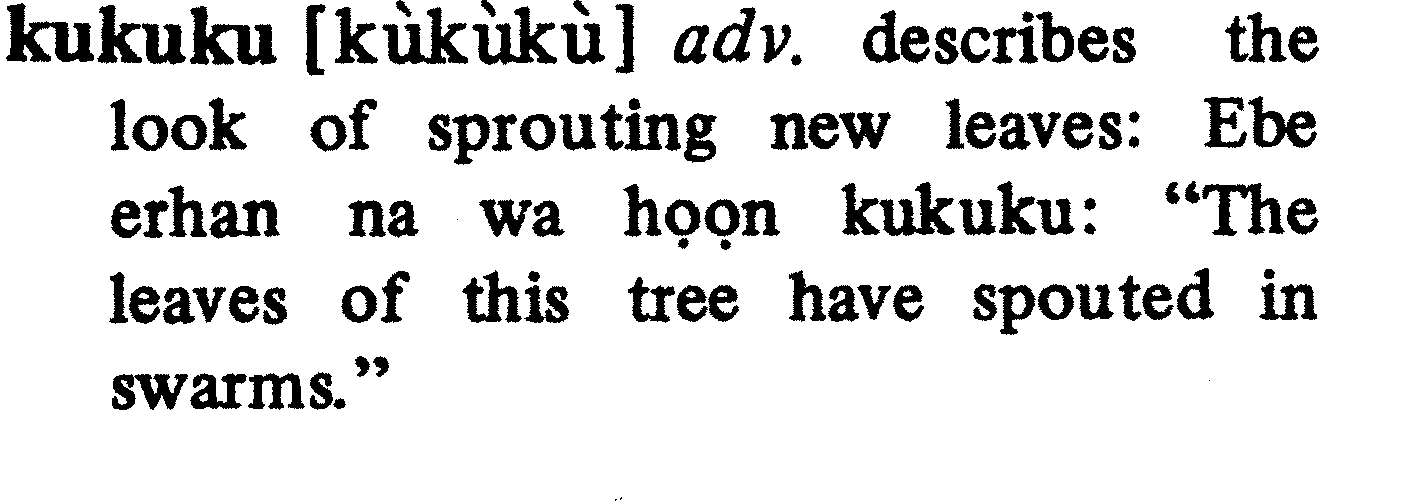
kukuku [kùkùkù] adv. describes the
look of sprouting new leaves: Ebe
erhan na wa họọn kukuku: “The
leaves of this tree have spouted in
swarms.”
%%
kukhunmwun [kúxũ̀ɱù] vb. (< ke2
― ukhunmwun) to be above: to
be on top of; to be higher than.

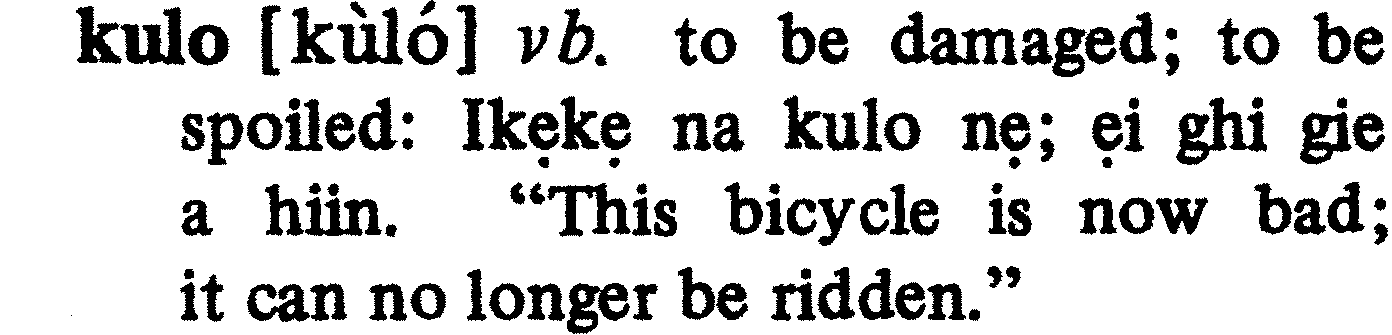
kulo [kùló] vb. to be damaged; to be
spoiled: Ikẹkẹ na kulo nẹ; ẹi ghi gie
a hiin. “This bicycle is now bad;
it can no longer be ridden.”
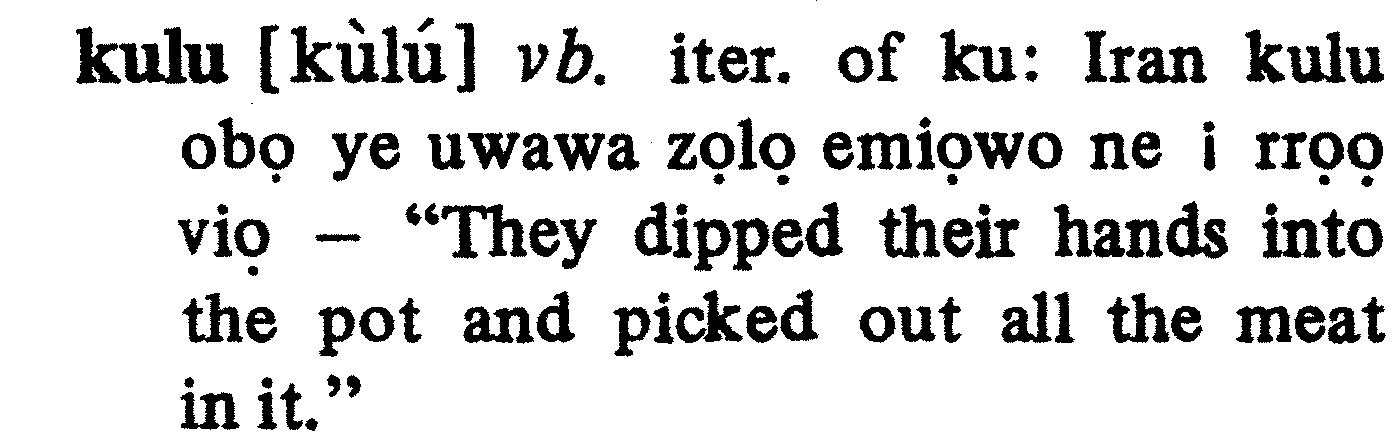
kulu [kùlú] vb. iter. of ku: Iran kulu
obọ ye uwawa zọlọ emiọwo ne i rrọọ
viọ ― “They dipped their hands into
the pot and picked out all the meat
in it.”
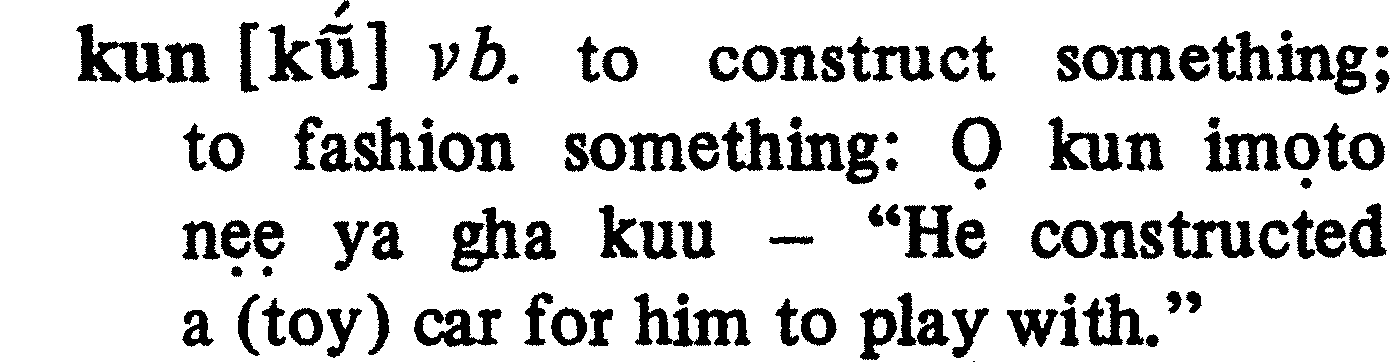
kun [kṹ] vb. to construct something;
to fashion something: Ọ kun imọto
nẹẹ ya gha kuu ― “He constructed
a (toy) car for him to play with.”
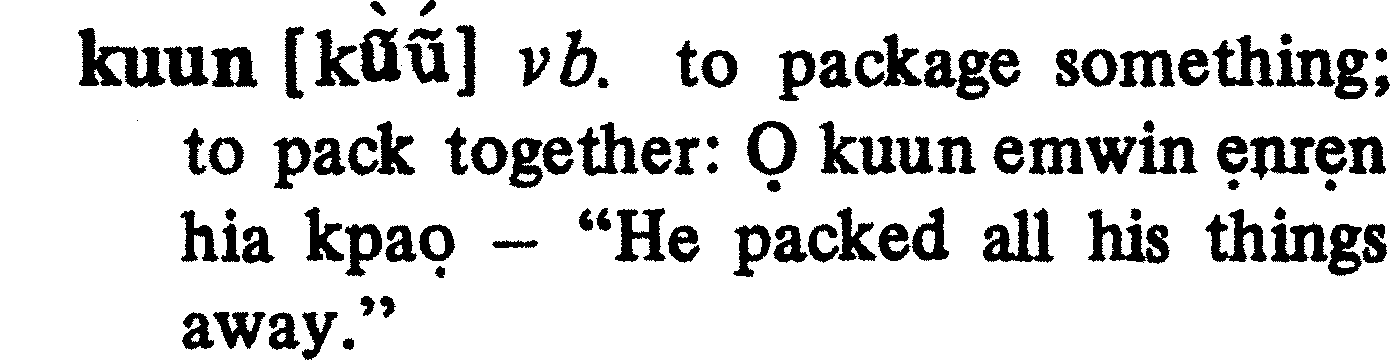
kuun [kũ̀ṹ] vb. to package something;
to pack together: Ọ kuun emwin ẹnrẹn
hia kpaọ ― “He packed all his things
away.”
kuọ [kùɔ́] vb. to faint; to become un-
conscious.

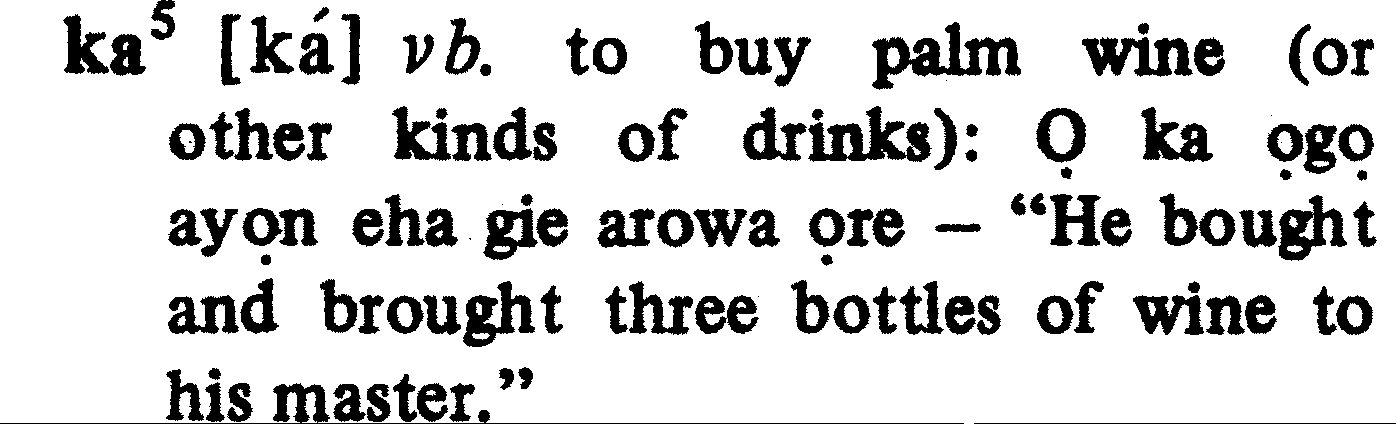
kurọọ [kùɽɔ̀ɔ̀] adv.; adj. (used with
the verb ye) dull, lifeless: Edẹ nẹrẹ
ye kurọọ ― “The day today is very
dull.”